After this sheet you know the 100 words that carry most everyday Lebanese conversations and the 20 expressions that make you sound like Beirut, and you can say them from the English without looking.
No sign-up. Print and copy for personal and classroom use. Please keep the credit in the footer.
By Fouad El Ajouaoui, founder of Yallah Speak · · Free worksheet, no sign-up
Quick answer The most common Lebanese words are small everyday words: shu (what), wein (where), kif (how), hallaʾ (now), baddiبدّي (I want), fi (there is), mish (not), ktir (very) and mnih (good). The expressions that make you sound Lebanese are yalla (come on), tfaddal (here you are), yaʿtik el-ʿafyeيعطيك العافية (said to anyone working) and merci, used for thanks all over Beirut. The first 50 words are in the table below; the PDF has all 100 plus 20 expressions with a 7-day plan.
What are the most common Lebanese words?
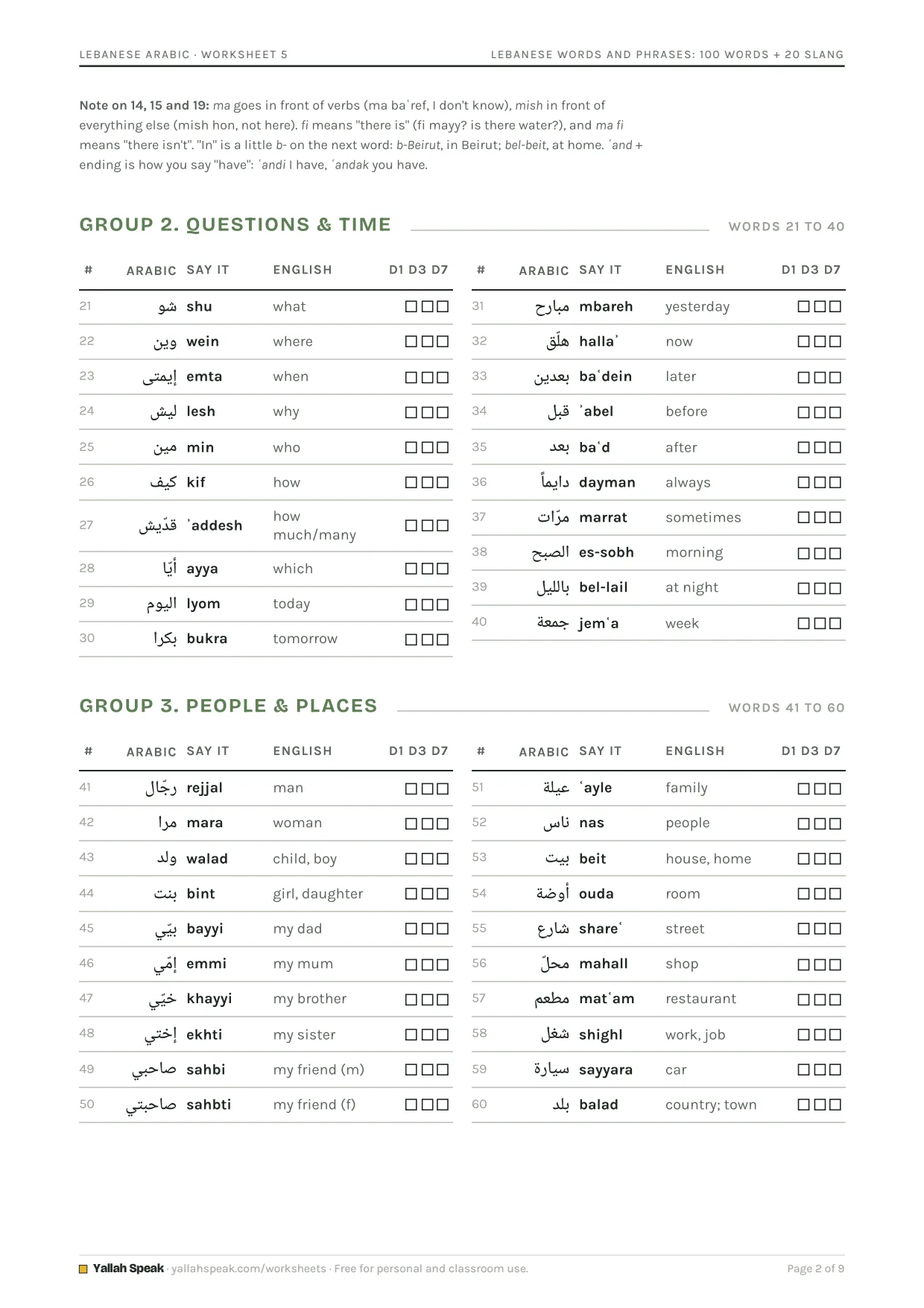
The 100 words on this sheet are grouped by what they do in a sentence, not alphabetically: little words and pronouns, questions and time, people and places, food and café, verbs, and adjectives. On top come 20 expressions and slang words that every Lebanese person uses daily. Here are the first fifty, the words you will hear within an hour of arriving in Beirut, in Arabic script and in the Beirut pronunciation.
English
Lebanese
Arabic
English
Lebanese
Arabic
I
ana
أنا
how
kif
كيف
you (m)
enta
إنت
how much, how many
ʾaddesh
قدّيش
you (f)
enti
إنتي
which
ayya
أيّا
he, it
huwwe
هوّي
today
lyom
اليوم
she, it
hiyye
هيّي
tomorrow
bukra
بكرا
we
nehna
نحنا
yesterday
mbareh
مبارح
you (pl.)
entu
إنتو
now
hallaʾ
هلّق
they
hinne
هنّي
later
baʿdein
بعدين
this, that (m)
hayda
هيدا
before
ʾabel
قبل
this, that (f)
hayde
هيدي
after
baʿd
بعد
here
hon
هون
always
dayman
دايماً
yes
eh
إيه
sometimes
marrat
مرّات
no
laʾ
لأ
morning
es-sobh
الصبح
not (with nouns, adjectives)
mish
مش
at night
bel-lail
بالليل
not (with verbs)
ma
ما
week
jemʿa
جمعة
and
w
و
come on, let's go, hurry up
yalla
يلّا
only, but
bass
بس
here you are; come in
tfaddal
تفضّل
also, more
kamen
كمان
how are you? (to a man)
kifak?
كيفك؟
there is
fi
في
thanks (French loan, used everywhere)
merci
ميرسي
at; have
ʿand
عند
enjoy your meal (reply: ʿa ʾalbak)
sahtein
صحتين
what
shu
شو
never mind; sorry
maʿleish
معليش
where
wein
وين
enough; done; okay, deal
khalas
خلص
when
emta
إيمتى
I mean; so-so
yaʿni
يعني
why
lesh
ليش
my dear (to friends, kids, even strangers)
habibi, habibti
حبيبي، حبيبتي
who
min
مين
bye (when you leave)
bkhatrak
بخاطرك
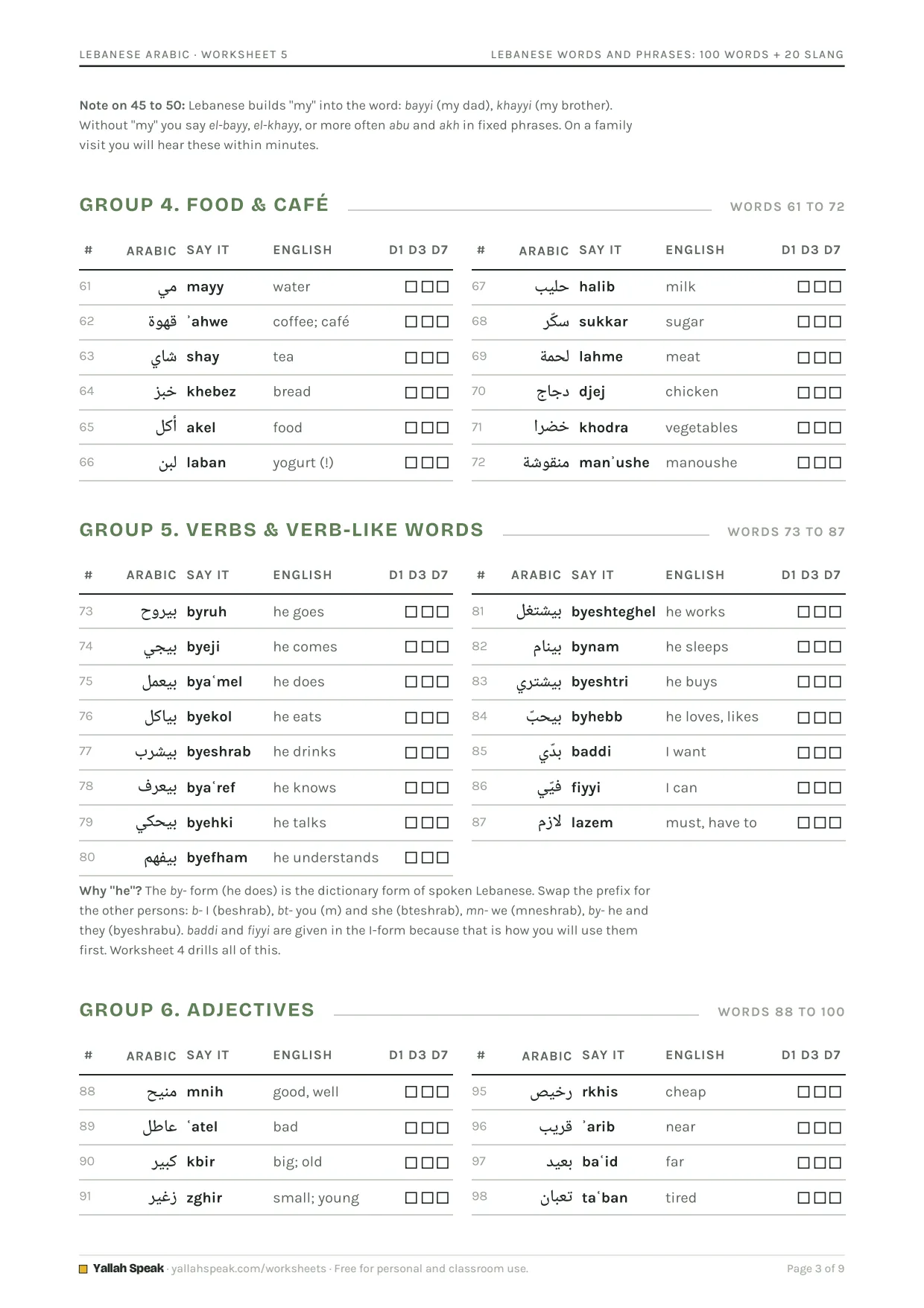
The other 50 words (people, places, food, verbs and adjectives) and the remaining expressions are in the PDF with the same columns, plus three tick boxes (day 1, day 3, day 7) next to every word for the 7-day plan.
What are some common Lebanese phrases and slang expressions?
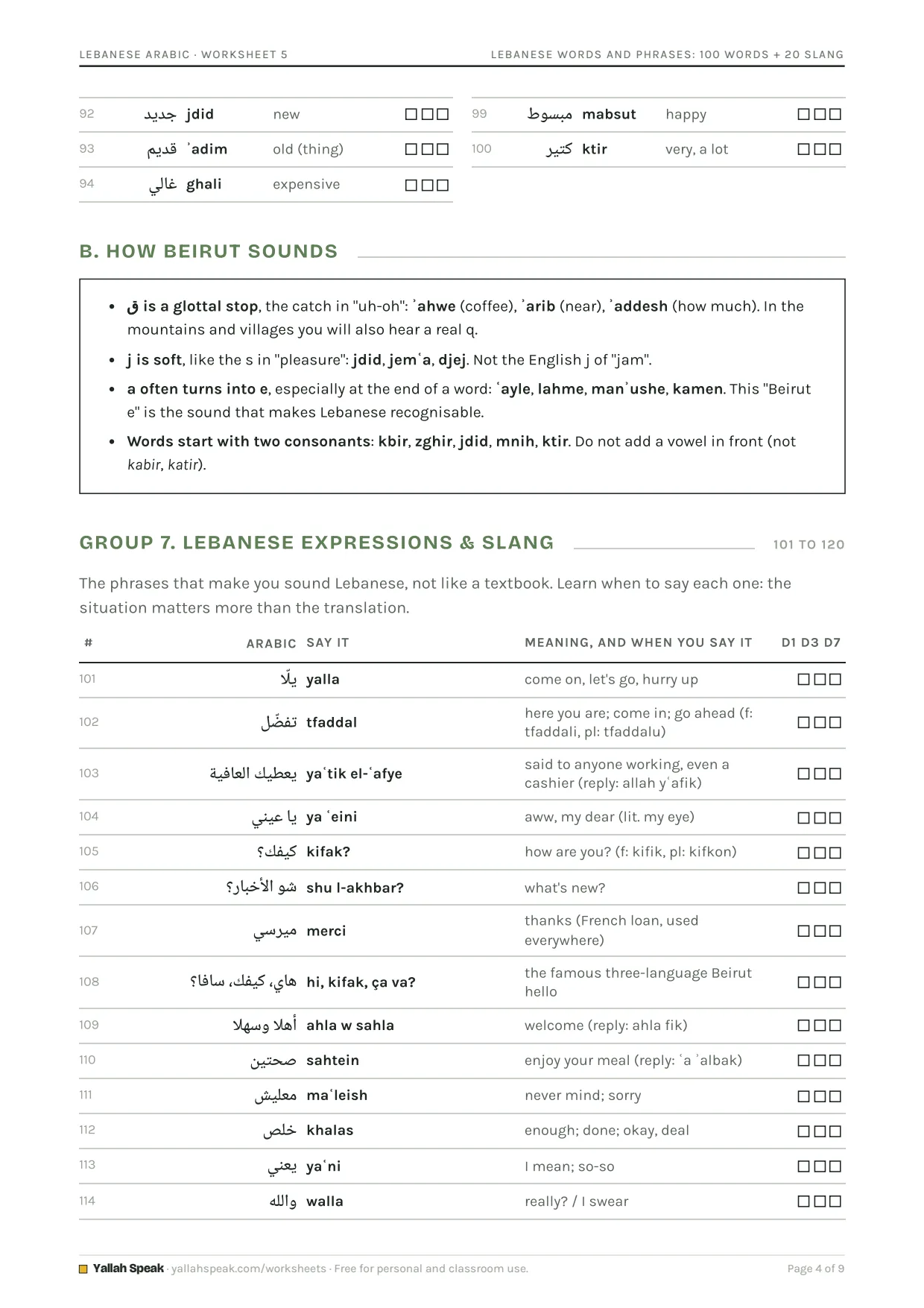
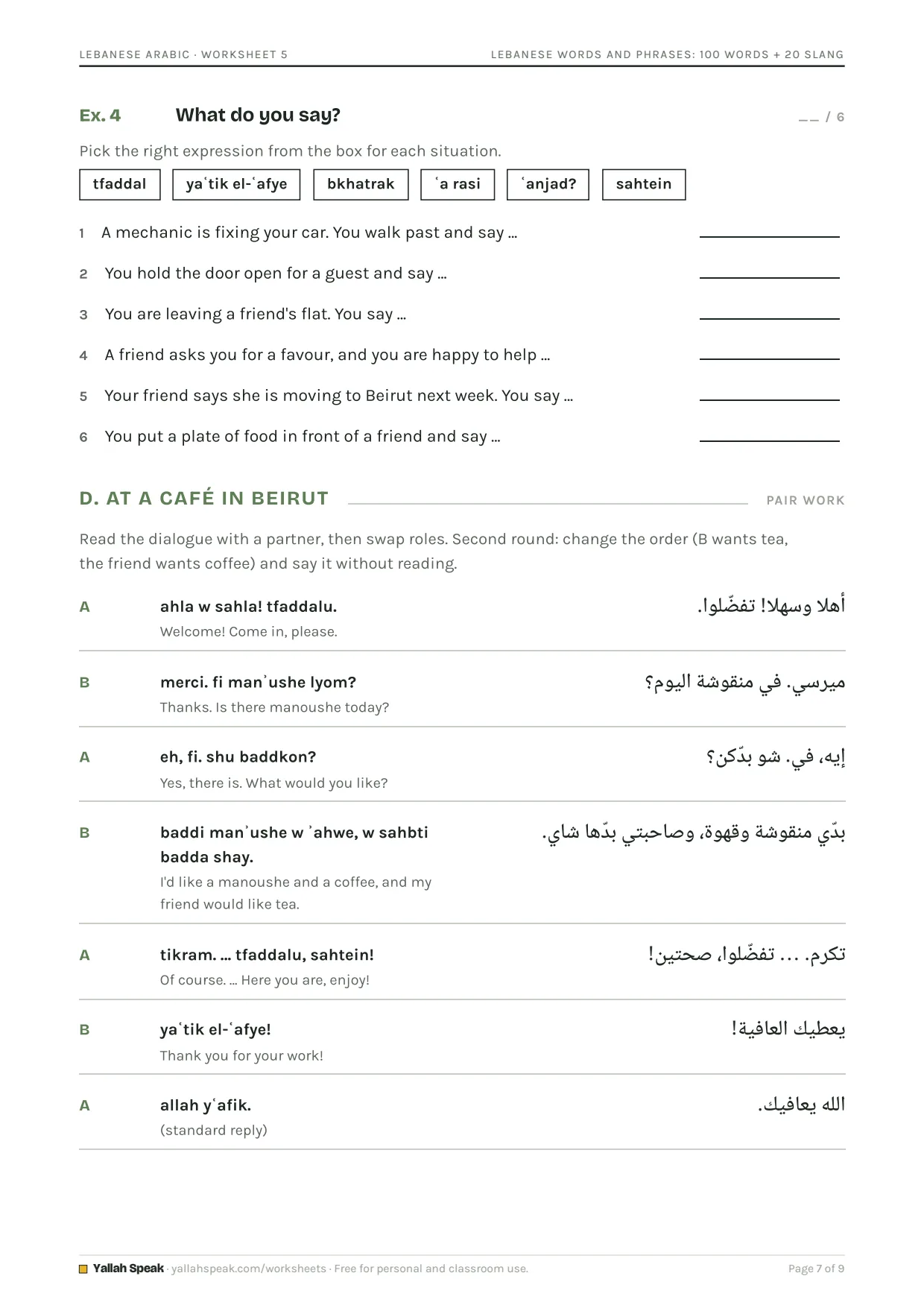
Lebanese conversation runs on a handful of set phrases. yalla means come on, let's go or hurry up, depending on the tone. tfaddal (to a woman tfaddali) is what you say when you offer something, hold a door or invite someone in. yaʿtik el-ʿafye, literally "may God give you strength", is said to anyone who is working, from a mechanic to a cashier; the answer is allah yʿafik. sahtein means enjoy your meal. When someone asks a favour, a Lebanese answer is tikram or ʿa rasi ("on my head"), both meaning "gladly". For surprise there is ʿanjad? (seriously?) and walla (really? or I swear), and for affection habibi, habibti and ya ʿeini. When you leave, say bkhatrak; the person staying answers maʿ s-salame.
Beirut also mixes languages. merci is the normal word for thanks, and the famous greeting hi, kifak, ça va? uses English, Arabic and French in three words. Learn the Arabic first, but do not be surprised when people answer you in a mix.
How do you say "thank you" in Lebanese?
Most people say merci or merci ktir (thanks a lot). shukran is understood everywhere and sounds a little more formal. To answer, say ahla w sahla or tikram. Worksheet 1, hello in Lebanese, covers greetings and replies in detail.
How is Lebanese different from Standard Arabic and other dialects?
A Standard Arabic word list and a Lebanese one disagree on about a third of the core words. "What" is ma or madha in Standard Arabic and shu in Lebanese; "now" is al-an versus hallaʾ; "I want" is uridu versus baddi; "how much" is kam versus ʾaddesh. The sound changes too: ق becomes a glottal stop (ʾahwe, coffee), j is soft as in "pleasure", and many a sounds turn into e (ʿayle, family). Syrian Arabic shares almost all of these words, with small differences such as hallaʾ and halla or hayda and hada. Palestinian is close as well. Egyptian differs more: eh for what, dilwaʾti for now, ʿayiz for I want. For a cross-dialect overview, read common Arabic words or see all Levantine Arabic worksheets.
How the 7-day plan on the sheet works
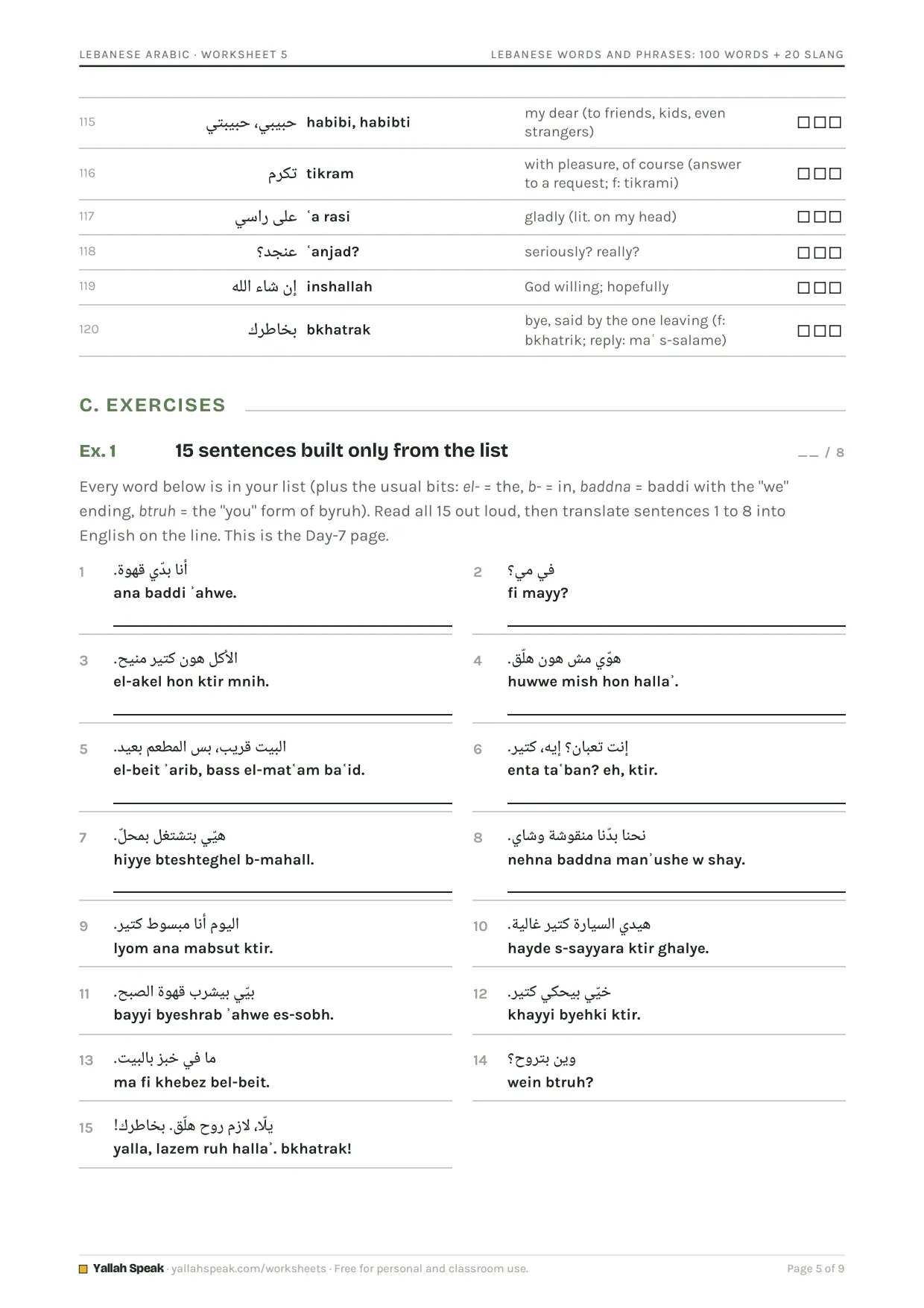
About 20 minutes a day. Days 1 to 5 take the list in blocks of 20 words, with built-in reviews on day 3 and day 5. Day 6 is the 20 expressions, and day 7 is the whole list plus the sentence page: 15 sentences built only from the list, to read aloud and translate. Every word has three tick boxes: cover the pronunciation and English, say the word, then tick. The exercises add opposites, odd one out, a "what do you say?" task for the expressions and a café dialogue for pair work. To turn the words into full sentences, use worksheet 4 on Lebanese verbs and worksheet 3 on pronouns and questions.
What's inside the PDF
100 numbered words in six groups: little words, questions and time, people and places, food and café, verbs, adjectives. Arabic script, Beirut pronunciation and English side by side
20 Lebanese expressions and slang (yalla, tfaddal, yaʿtik el-ʿafye, ya ʿeini, sahtein, ʿanjad, bkhatrak …) with when to say each one
A 7-day plan (about 20 minutes a day) with tick boxes and two built-in review days, plus three tick boxes per word for spaced repetition
15 sentences built only from words in the list, with Arabic script, to read aloud and translate
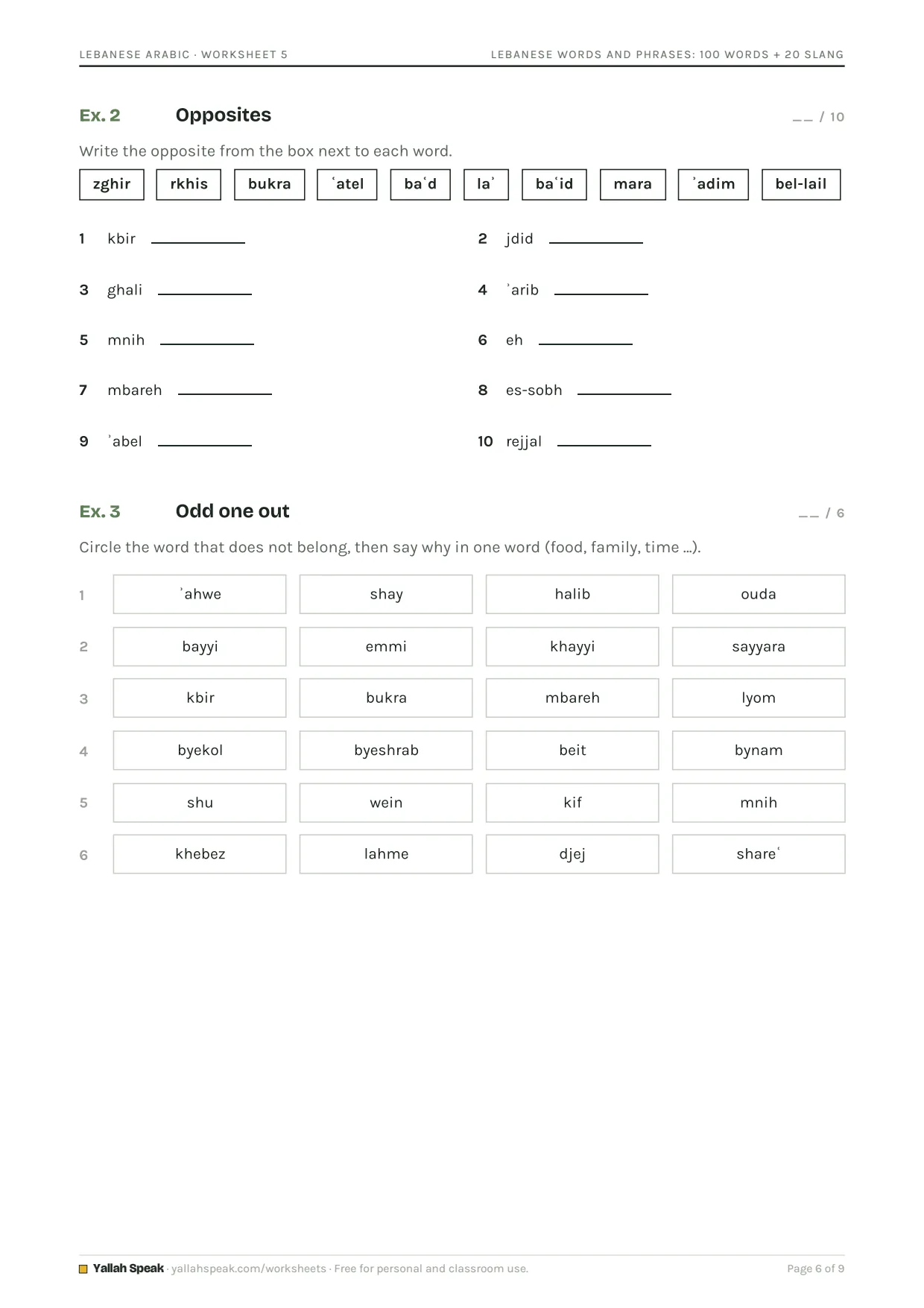
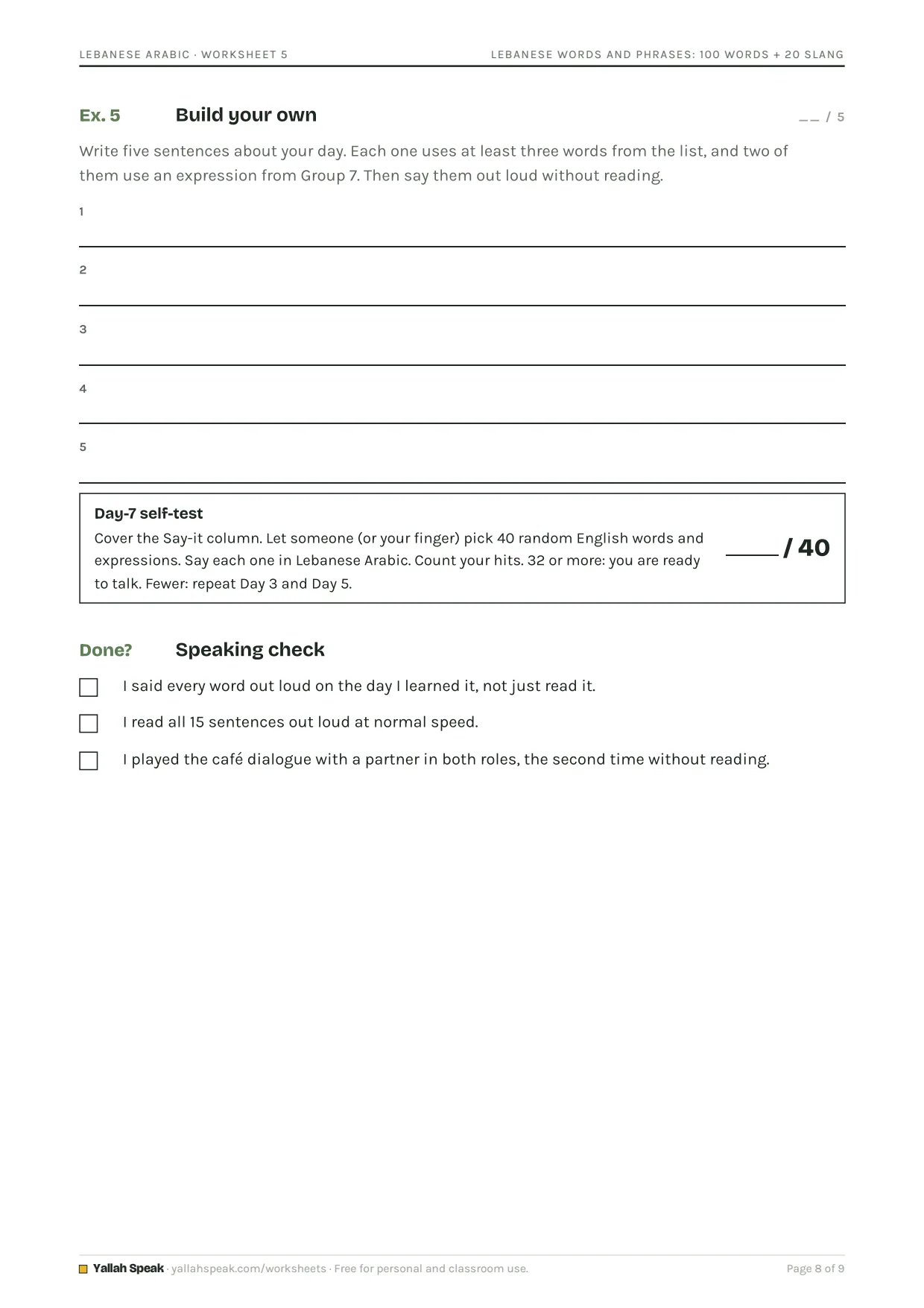
Exercises: opposites, odd one out, pick the right expression for 6 situations, a café dialogue for pair work, a Day-7 self-test out of 40
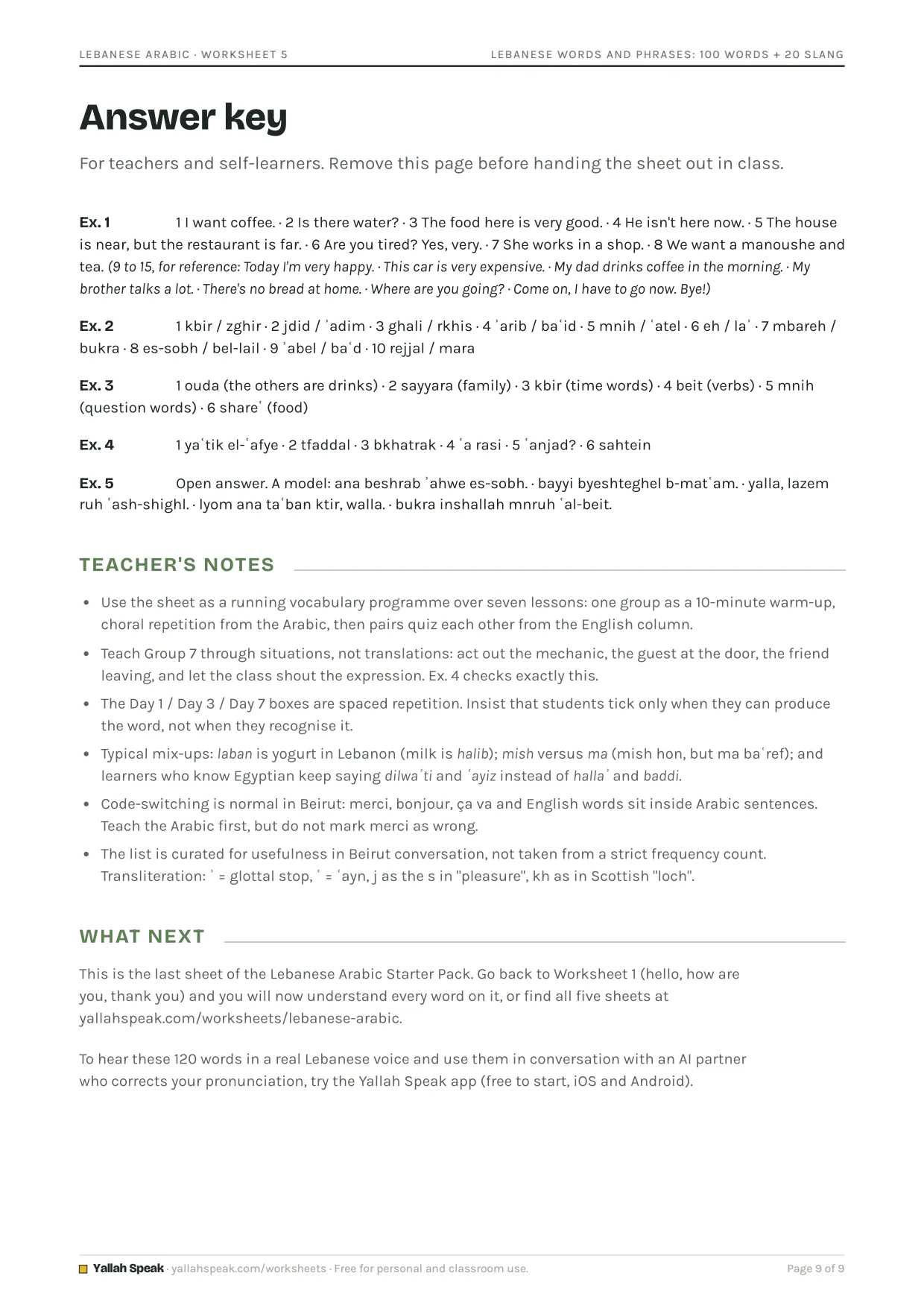
A Beirut pronunciation box, answer key and teacher notes on a separate page you can remove before handing out
How to use it on your own
Follow the plan on page 1: about 20 words a day, each said out loud three times and put into one sentence you could use this week. On Day 3 and Day 5 you review earlier groups, Day 6 is the expressions, and on Day 7 you do the sentence page and the 40-word self-test. 32 hits or more means the words are yours.
How to use it in class
Works as a running vocabulary programme over seven lessons: one group as a 10-minute warm-up with choral repetition, then pairs quiz each other from the English column. Teach the expressions through role play (the mechanic, the guest at the door, the friend leaving) and check them with Ex. 4. The café dialogue is ready for pair work with a role swap. The sentence page (Ex. 1) is the test: reading all 15 fluently and translating eight shows the core vocabulary is in place.
Worksheets teach you the words. Someone still has to answer back. Practise this exact dialogue with an AI partner who speaks Lebanese Arabic, stays in character and shows you word by word where your pronunciation slips. Try Yallah Speak free
Preview
Page 1 is above. Here are the other pages; click one to open it full size.
Frequently asked questions
What are the most common Lebanese words?
The top of the list is small words you hear in every sentence: shu (what), wein (where), kif (how), hayda (this), hon (here), hallaʾ (now), baddi (I want), fi (there is), mish (not), bass (only, but), kamen (also), ktir (very), mnih (good), eh (yes) and laʾ (no). The first 50 of the 100 are in the table on this page.
What are some common Lebanese slang words and expressions?
yalla (come on, let's go), habibi (my dear), ya ʿeini (aww, my dear), ʿanjad? (seriously?), khalas (enough, done), walla (really? I swear) and yaʿtik el-ʿafye, which you say to anyone who is working. Beirut also mixes in French and English: merci for thanks and the famous greeting hi, kifak, ça va? All 20 are on the sheet with when to use them.
How do you say thank you and you're welcome in Lebanese?
Most people say merci or merci ktir (thanks a lot); shukran is understood and a little more formal. For you're welcome, say ahla w sahla or tikram. When someone serves you food, say sahtein (enjoy), and the reply is ʿa ʾalbak.
Is Lebanese Arabic very different from Standard Arabic?
In everyday words, yes. About a third of the core words differ: what is ma in Standard Arabic and shu in Lebanese, now is al-an versus hallaʾ, I want is uridu versus baddi, and how much is kam versus ʾaddesh. The sound changes too, with ق said as a glottal stop and many a sounds turning into e. Standard Arabic is for reading; this list is for talking.
Is this word list free?
Yes. Download the PDF, print it and copy it as often as you like for personal use and in class. Please keep the Yallah Speak credit in the footer.
Stop studying Arabic. Start speaking it.
AI conversations in 10 real dialects, honest pronunciation feedback and a course from A1.