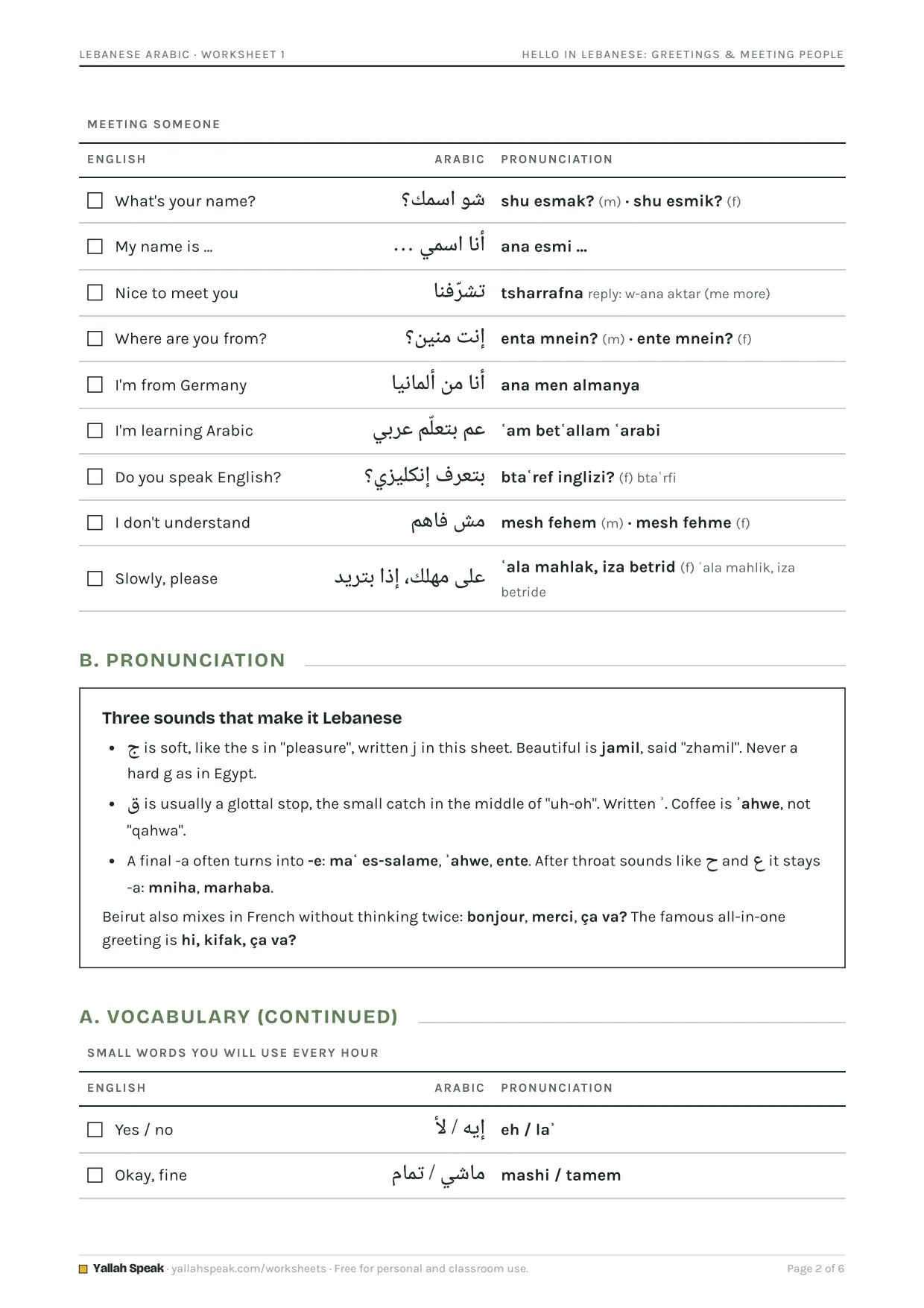
After this sheet you can greet someone, say how you are, thank people, introduce yourself and say goodbye the right way round, in Lebanese Arabic and out loud.
No sign-up. Print and copy for personal and classroom use. Please keep the credit in the footer.
By Fouad El Ajouaoui, founder of Yallah Speak · · Free worksheet, no sign-up
Quick answer Hello in Lebanese is marhaba (مرحبا), answered with marhabtein; "how are you" is kifak? to a man and kifik? to a woman, answered with mnih, el-hamdella. Good morning is sabah el-kheir, reply sabah en-nur, and thank you is merci, shukran or yeslamo, answered with ʿafwan. The full greetings table is below; the PDF adds a Beirut café dialogue and exercises.
How do you say hello in Lebanese?
The everyday hello in Lebanon is marhaba (مرحبا), and the classic reply doubles it: marhabtein, "two hellos". To welcome someone you say ahla w sahla, answered with ahla fik to a man or ahla fiki to a woman. The religious greeting es-salamu ʿaleikon works everywhere too. And because Beirut mixes French and English into Arabic, you will hear people greet each other with hi, bonjour or the famous three-language hi, kifak, ça va?
English
Lebanese Arabic
Arabic
The reply
Hi / hello
marhaba
مرحبا
marhabtein
Welcome
ahla w sahla
أهلا وسهلا
ahla fik (m) · ahla fiki (f)
Peace be upon you (formal hello)
es-salamu ʿaleikon
السلام عليكم
w ʿaleikon es-salam
Good morning
sabah el-kheir
صباح الخير
sabah en-nur · sabah el-ward
Good evening
masa el-kheir
مسا الخير
masa en-nur
How are you?
kifak? (m) · kifik? (f) · kifkon? (pl)
كيفك؟
mnih, el-hamdella (f: mniha)
Thank you
merci · shukran · yeslamo
ميرسي / شكراً / يسلمو
ʿafwan · tekram (f: tekrame)
Bye (said by the one leaving)
bkhatrak (m) · bkhatrik (f)
بخاطرك
maʿ es-salame
Good night
tesbah ʿala kheir (f: tesbahi)
تصبح على خير
w-enta men ahlo
Good morning in Lebanese, and the replies people expect
sabah el-kheir means "morning of goodness". The standard reply is sabah en-nur, "morning of light", and a warm, slightly playful one is sabah el-ward, "morning of roses". In the evening it is masa el-kheir, answered with masa en-nur. Many Lebanese simply say bonjour and bonsoir, especially in shops and offices in Beirut. In Lebanon the reply is half the greeting: answering marhaba with marhabtein, or ahla w sahla with ahla fik, is what makes you sound like you belong.
How do you say how are you in Lebanese, to a man or a woman?
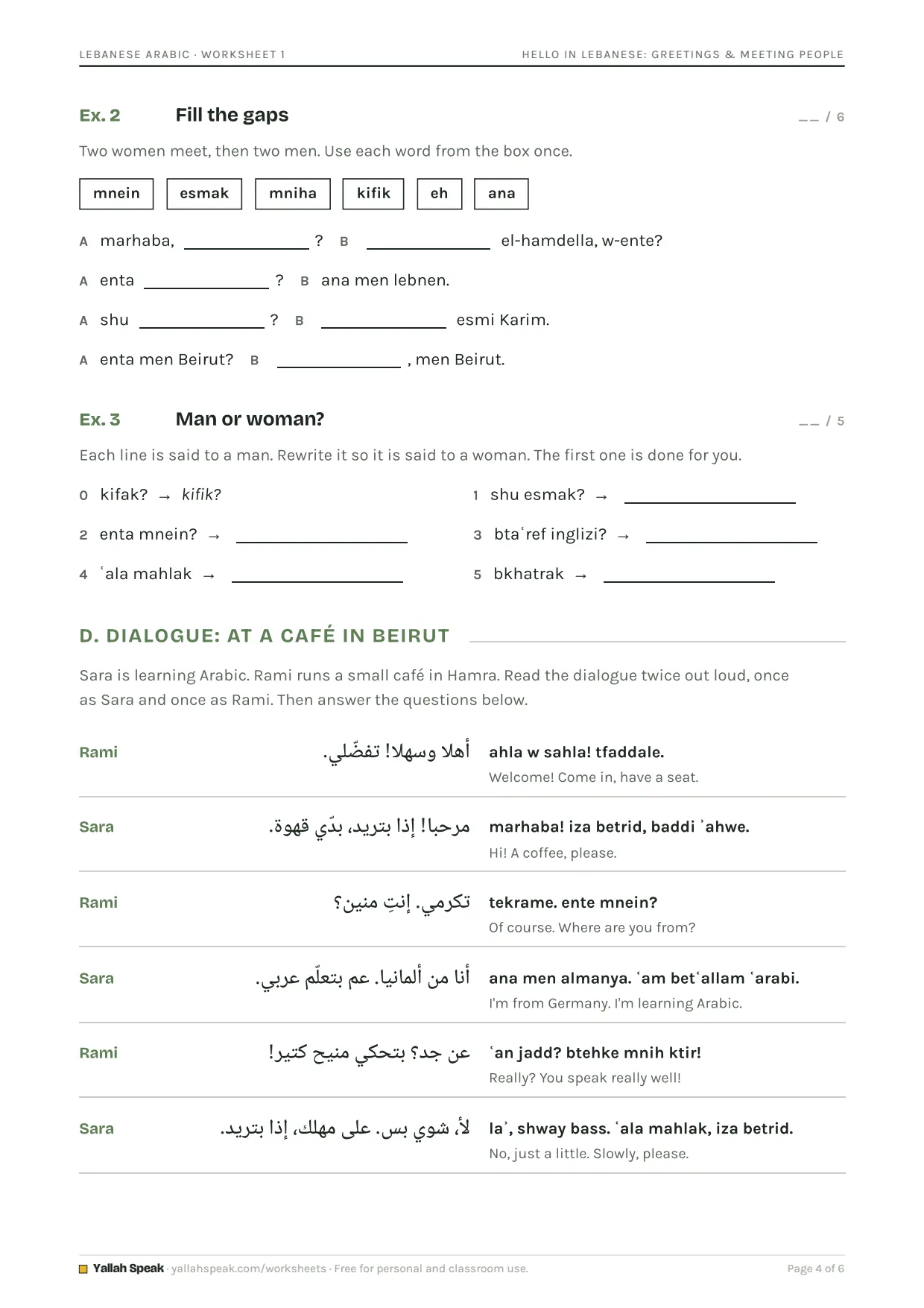
Lebanese changes the ending of many phrases depending on who you talk to. kifak? is to a man, kifik? to a woman, kifkon? to a group. The answer is mnih, el-hamdella (good, thank God), or mniha if you are a woman, then w-enta? or w-ente? (and you?). The same -ak / -ik switch runs through the whole worksheet: shu esmak? / shu esmik? (what's your name?), bkhatrak / bkhatrik (bye). Exercise 3 on the sheet drills exactly this.
English
Lebanese Arabic
Arabic
What's your name?
shu esmak? (m) · shu esmik? (f)
شو اسمك؟
My name is …
ana esmi …
أنا اسمي …
Nice to meet you
tsharrafna (reply: w-ana aktar)
تشرّفنا
Where are you from?
enta mnein? (m) · ente mnein? (f)
إنت منين؟
I'm learning Arabic
ʿam betʿallam ʿarabi
عم بتعلّم عربي
I don't understand
mesh fehem (m) · mesh fehme (f)
مش فاهم
Slowly, please
ʿala mahlak, iza betrid
على مهلك، إذا بتريد
How do you say thank you and I love you in Lebanese?
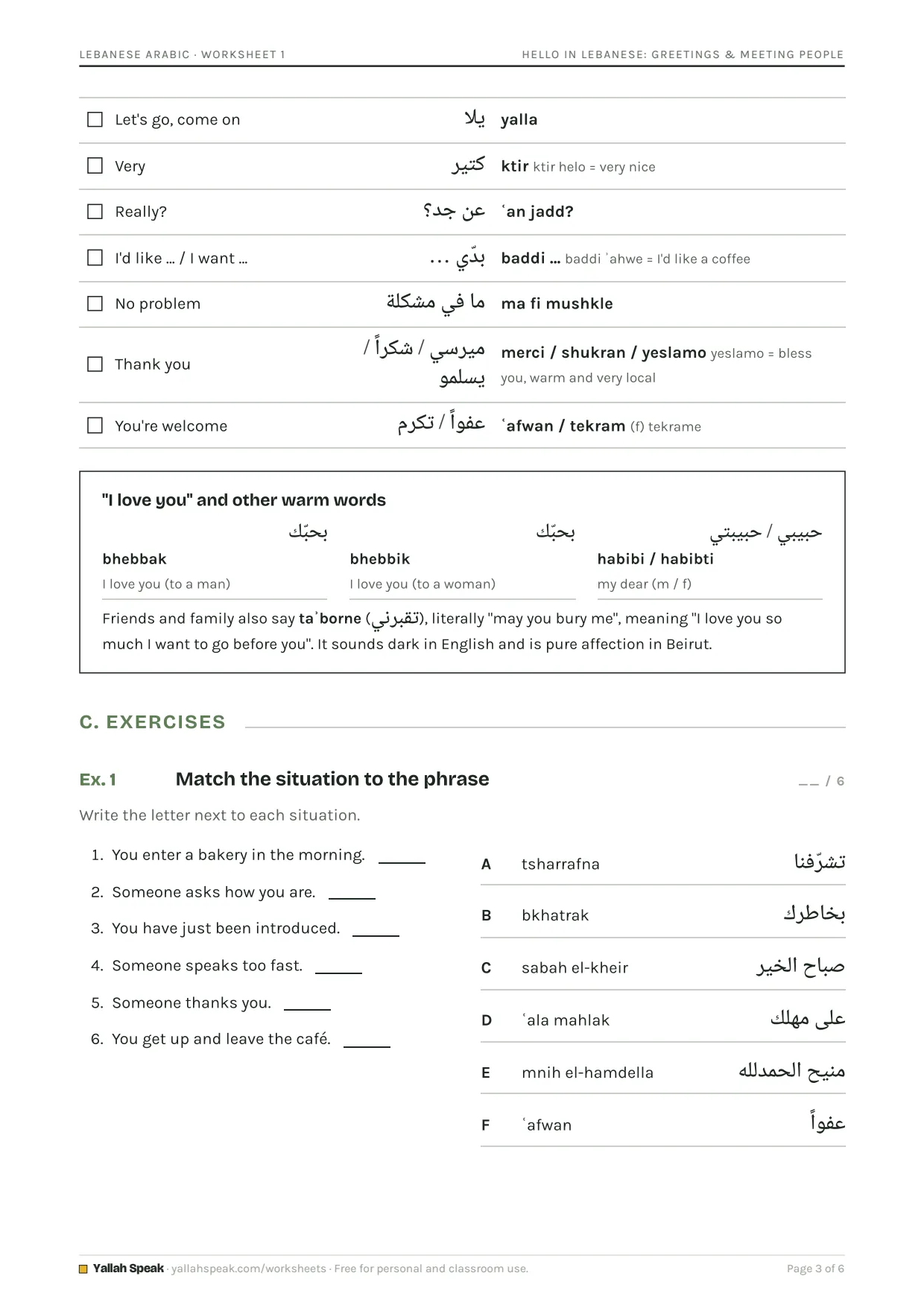
Thank you is merci for most people in Beirut, shukran in Arabic, and yeslamo when you want to sound warm and local. The answer is ʿafwan, or tekram (to a man) and tekrame (to a woman). I love you is bhebbak to a man and bhebbik to a woman (بحبّك). Families also say taʾborne, "may you bury me", a dark-sounding phrase that means "I love you more than my own life".
How is Lebanese different from Standard Arabic and the other dialects?
Modern Standard Arabic says kayfa haluka and ma ismuka; Lebanese says kifak and shu esmak. Three sounds give Lebanese away: ج is soft like the s in "pleasure", ق is a glottal stop (ʾahwe, coffee), and many words end in -e (maʿ es-salame). Syrian Arabic is very close; Palestinian sounds similar but often keeps a clear -a, and Egyptian uses a hard g and different words (izzayyak for how are you). The PDF has all 28 phrases, a café dialogue in Beirut, five exercises and the answer key. For greetings across all dialects, read Arabic greetings and responses; next, learn to count and pay with Lebanese numbers, or see all Levantine Arabic worksheets.
What's inside the PDF
28 phrases in three groups: greetings and goodbyes, meeting someone, small words you use every hour. Arabic script, pronunciation and the (m)/(f) forms side by side
Every greeting with its reply: marhaba / marhabtein, sabah el-kheir / sabah en-nur, tsharrafna / w-ana aktar
Pronunciation box: the three sounds that make Lebanese sound Lebanese (soft j, ق as a glottal stop, final -a turning into -e) plus the French words Beirut mixes in
A box with "I love you" (bhebbak / bhebbik) and other warm words, and a café dialogue in Beirut to read in pairs
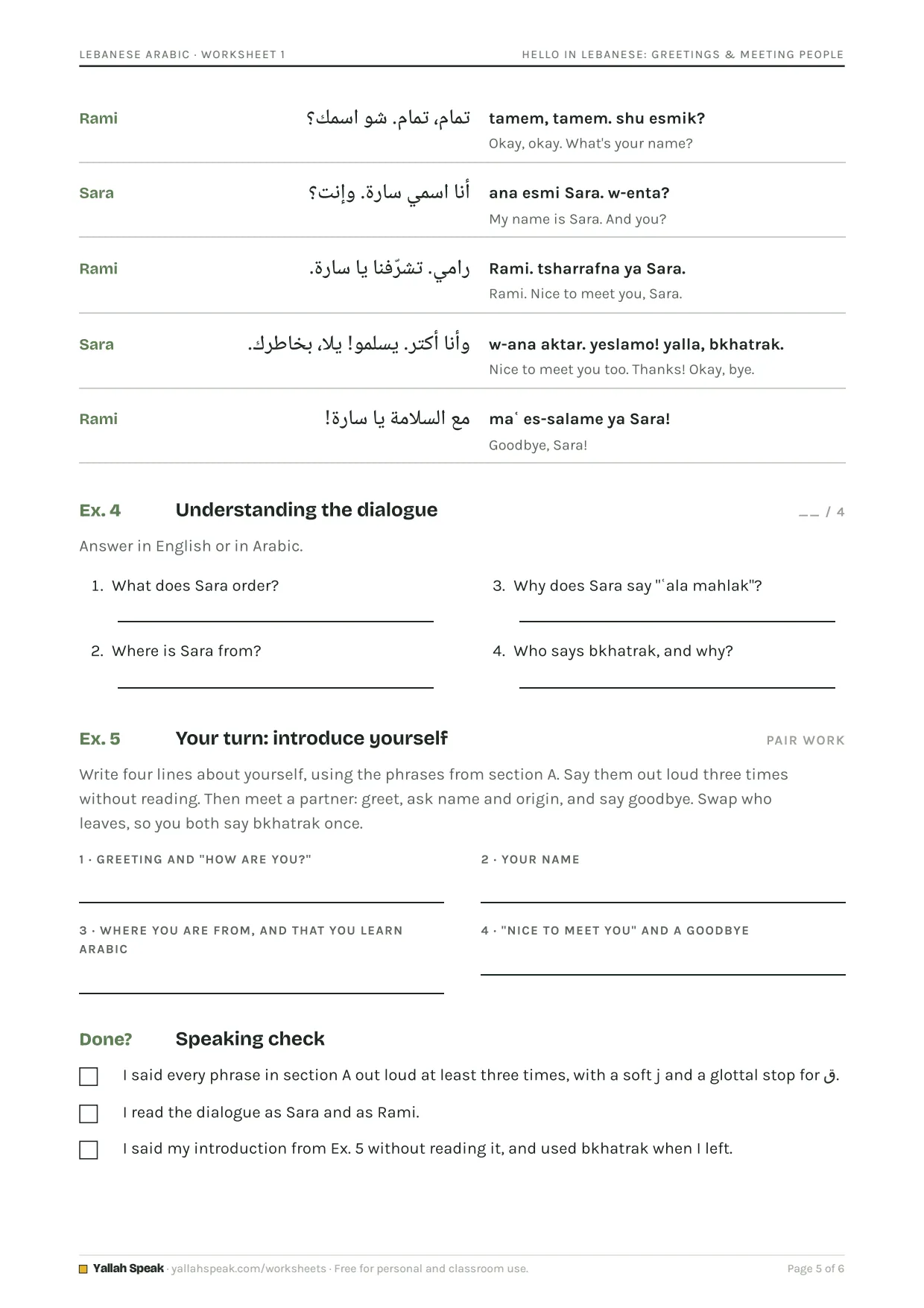
Five exercises: matching, gap fill, rewriting (m) to (f), comprehension questions, introduce yourself to a partner
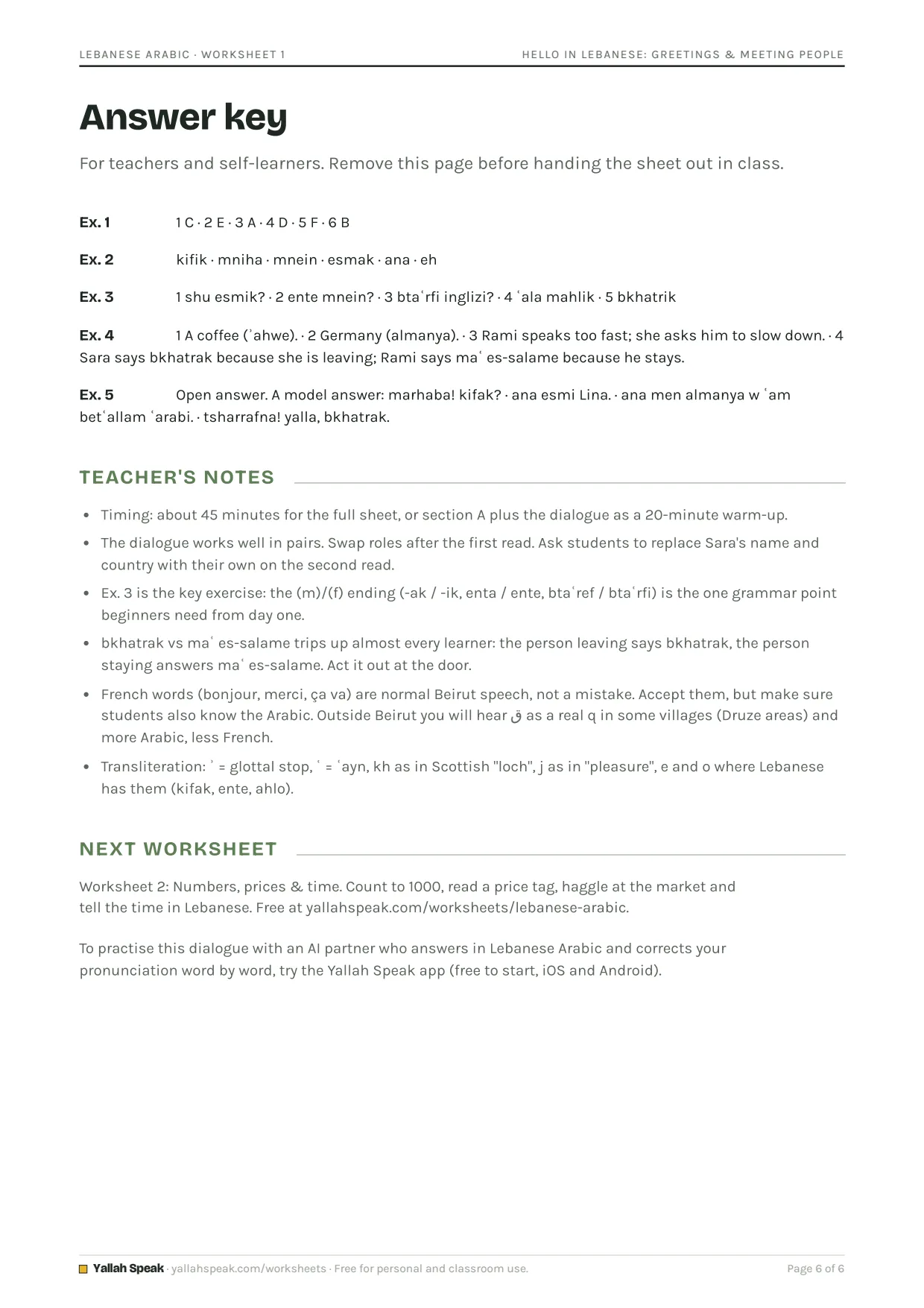
Speaking check, answer key and teacher notes on a separate page you can remove before handing out
How to use it on your own
Work through section A out loud, not silently, and tick a phrase only when you can say it from the English alone. Say every reply together with its greeting, because in Lebanon the reply is half the phrase. Read the dialogue twice, once as each speaker, then record your own introduction (Ex. 5) and listen back once.
How to use it in class
Fits a 45-minute lesson or a 20-minute warm-up (section A plus the dialogue). The dialogue works in pairs; swap roles on the second read and let students use their own names and countries. Ex. 3 (man or woman) is the key exercise, because the (m)/(f) ending is the one grammar point beginners need from day one. Act out bkhatrak and maʿ es-salame at the door: the one leaving and the one staying say different things. Points fields on every exercise, answer key on the last page.
Worksheets teach you the words. Someone still has to answer back. Practise this exact dialogue with an AI partner who speaks Lebanese Arabic, stays in character and shows you word by word where your pronunciation slips. Try Yallah Speak free
Preview
Page 1 is above. Here are the other pages; click one to open it full size.
Frequently asked questions
How do you say hello in Lebanese?
The everyday hello is marhaba (مرحبا), and the classic reply is marhabtein, "two hellos". ahla w sahla means welcome and is answered with ahla fik (to a man) or ahla fiki (to a woman). Many people in Beirut simply say hi or bonjour, often in one breath: hi, kifak, ça va?
How do you say how are you in Lebanese?
kifak? to a man, kifik? to a woman and kifkon? to a group. The usual answer is mnih, el-hamdella (good, thank God), mniha if you are a woman, followed by w-enta? or w-ente? (and you?). You will also hear shu el-akhbar? (what's new?) and the French ça va?
How do you say thank you in Lebanese?
merci is the most common thank you in Beirut, used by everyone. shukran is the Arabic word, and yeslamo is a warm, very Lebanese thanks that literally means "may they be kept safe". The answer is ʿafwan (you're welcome) or tekram / tekrame, "you deserve it".
How do you say good morning in Lebanese Arabic?
sabah el-kheir (صباح الخير), "morning of goodness". The reply is sabah en-nur, "morning of light", or the playful sabah el-ward, "morning of roses". Good evening is masa el-kheir, answered with masa en-nur. Many people also say bonjour and bonsoir.
How do you say I love you in Lebanese?
bhebbak (بحبّك) to a man and bhebbik to a woman; the Arabic spelling is the same. Close friends and family also say taʾborne, literally "may you bury me", which means "I love you so much I want to go before you". habibi and habibti (my dear) are used all day long.
Is this worksheet free?
Yes. Download the PDF, print it and share it as often as you like for personal use and in class. Please keep the Yallah Speak credit in the footer.
Stop studying Arabic. Start speaking it.
AI conversations in 10 real dialects, honest pronunciation feedback and a course from A1.