After this sheet you can put the 25 most useful Lebanese verbs into past, present and future, say what you did yesterday and what you will do tomorrow, and say no the Beirut way.
No sign-up. Print and copy for personal and classroom use. Please keep the credit in the footer.
By Fouad El Ajouaoui, founder of Yallah Speak · · Free worksheet, no sign-up
Quick answer Lebanese Arabic verbs have three tenses built on one set of person prefixes and endings: the past (katabt, katab, katabet… "wrote"), the present with the prefix b- (bektob, byektob, mnektob… "write") and the future with rah (rah ektob, "I will write"). Put ʿam in front for right now: ʿam bektobعم بكتب, "I'm writing". Negation is ma before the verb: ma baʿrefما بعرف, "I don't know".
How do you conjugate Lebanese Arabic verbs?
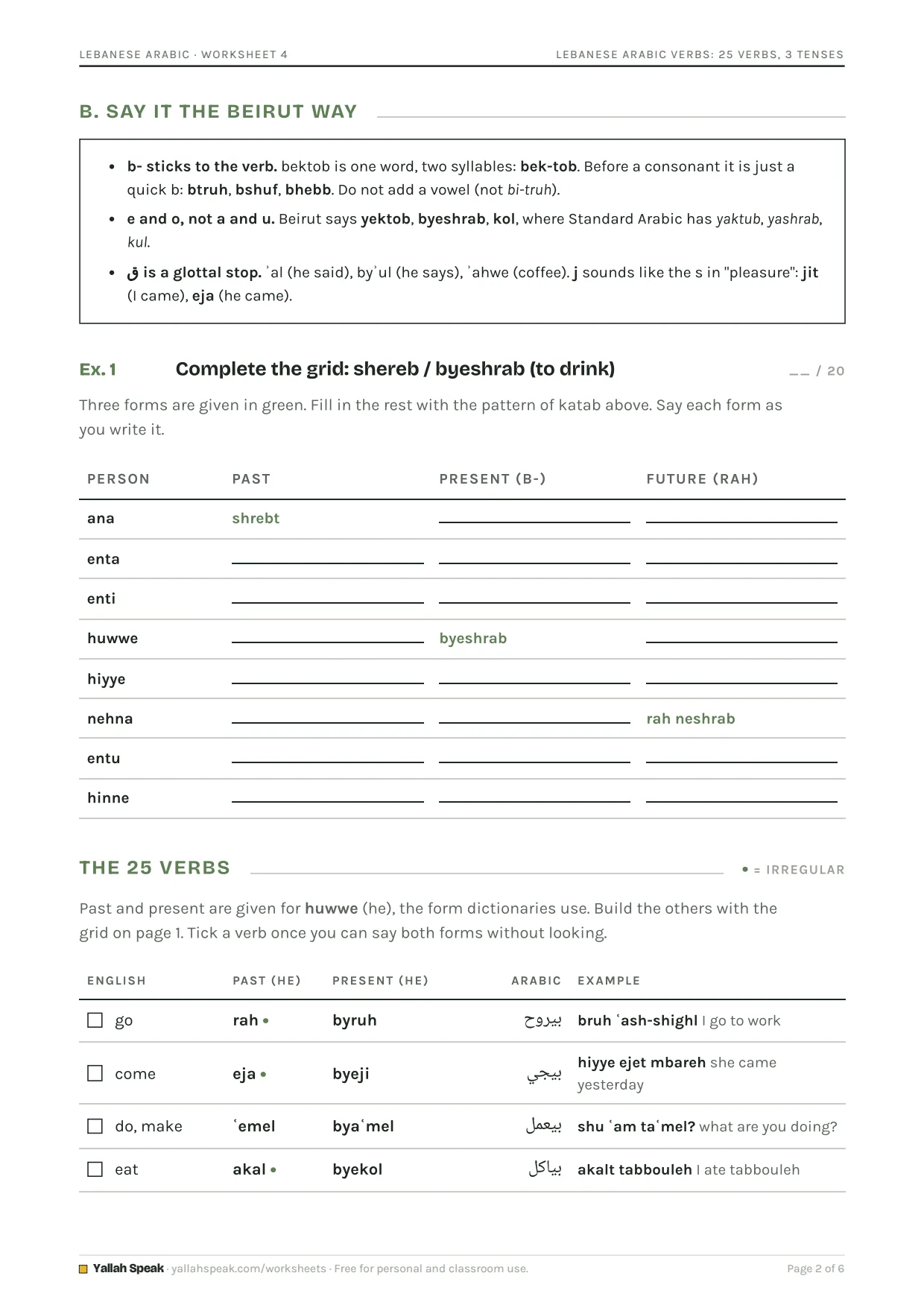
Lebanese Arabic has three tenses you need as a beginner, and all three use the same eight persons. The past adds endings to the stem; the present puts b- in front of the present stem (mn- for "we"); the future drops the b- and puts rah in front. Learn one verb all the way through and you own the pattern. Here is katab, to write, as it is said in Beirut:
Person
Past
Present (b-)
Future (rah)
Arabic (present)
ana · I
katabt
bektob
rah ektob
بكتب
enta · you (m)
katabt
btektob
rah tektob
بتكتب
enti · you (f)
katabti
btektbi
rah tektbi
بتكتبي
huwwe · he
katab
byektob
rah yektob
بيكتب
hiyye · she
katabet
btektob
rah tektob
بتكتب
nehna · we
katabna
mnektob
rah nektob
منكتب
entu · you (pl)
katabtu
btektbu
rah tektbu
بتكتبوا
hinne · they
katabu
byektbu
rah yektbu
بيكتبوا
Two shortcuts help. "I" and "you (m)" are identical in the past (katabt), and "you (m)" and "she" are identical in the present (btektob), so context does the work. And there is only one plural "you": entu covers any group, men or women.
What does ʿam mean in Lebanese?
ʿam is the Lebanese "-ing". The plain b- form means both "I write" and "I'm writing"; put ʿam in front and it can only mean right now: ʿam bektob, I'm writing at the moment. You will hear it all day in questions like shu ʿam taʿmel? (what are you doing?). In fast speech the b- after ʿam often disappears.
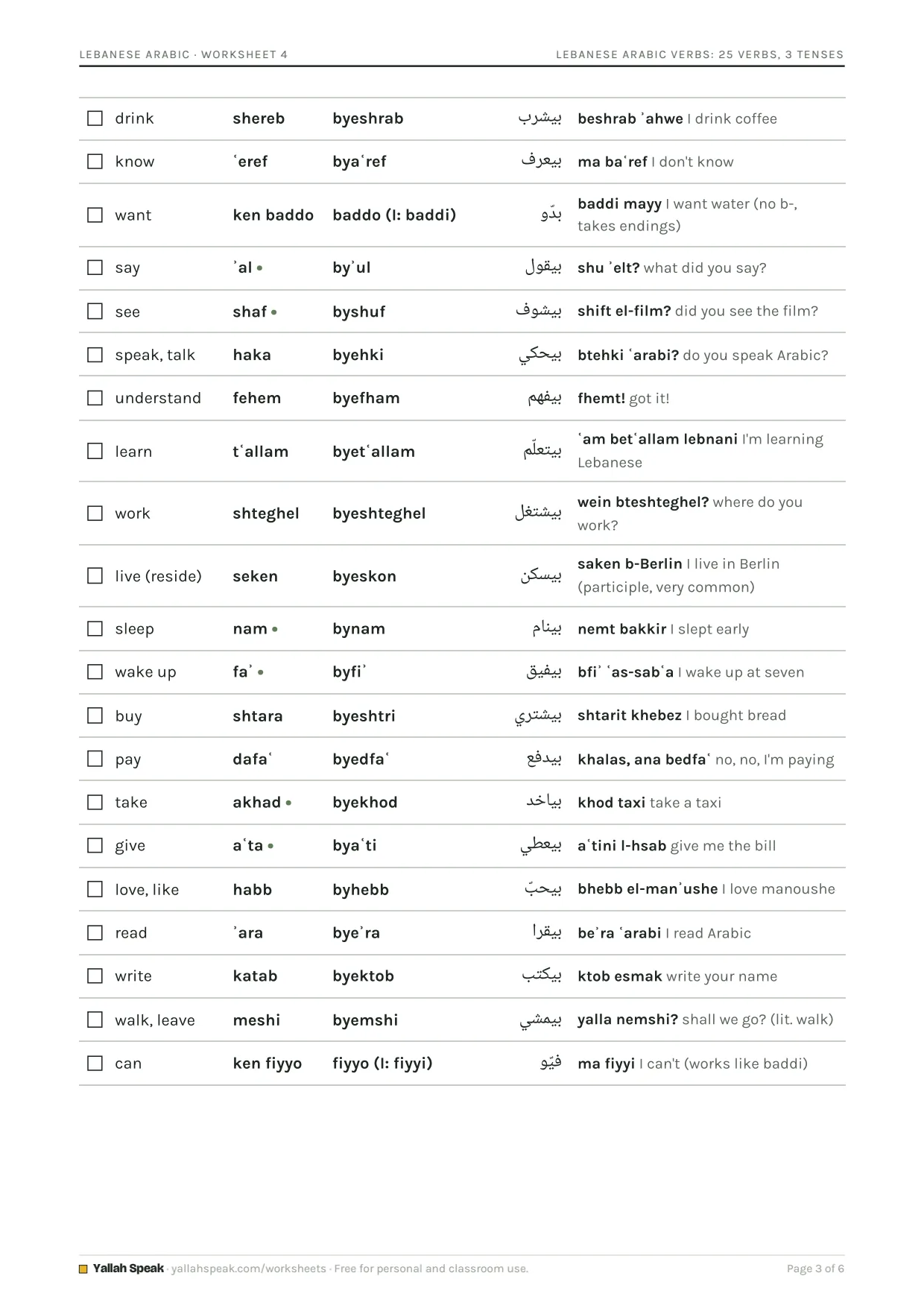
Lebanese verb chart: the 25 most useful verbs
These are the verbs the worksheet drills, picked for how often you hear them in Beirut, not for a textbook chapter. The chart gives the he form, because that is the form dictionaries list and the one the other persons are built from. Verbs marked with a dot are irregular in the past; the PDF explains each group.
English
Past (he)
Present (he)
Arabic
go
rah •
byruh
بيروح
come
eja •
byeji
بيجي
do, make
ʿemel
byaʿmel
بيعمل
eat
akal •
byekol
بياكل
drink
shereb
byeshrab
بيشرب
know
ʿeref
byaʿref
بيعرف
want
ken baddo
baddo (I: baddi, no b-)
بدّو
say
ʾal •
byʾul
بيقول
see
shaf •
byshuf
بيشوف
speak, talk
haka
byehki
بيحكي
understand
fehem
byefham
بيفهم
learn
tʿallam
byetʿallam
بيتعلّم
work
shteghel
byeshteghel
بيشتغل
live (reside)
seken
byeskon
بيسكن
sleep
nam •
bynam
بينام
wake up
faʾ •
byfiʾ
بيفيق
buy
shtara
byeshtri
بيشتري
pay
dafaʿ
byedfaʿ
بيدفع
take
akhad •
byekhod
بياخد
give
aʿta •
byaʿti
بيعطي
love, like
habb
byhebb
بيحبّ
read
ʾara
byeʾra
بيقرا
write
katab
byektob
بيكتب
walk, leave
meshi
byemshi
بيمشي
can
ken fiyyo
fiyyo (I: fiyyi, no b-)
فيّو
How do you say no in Lebanese Arabic?
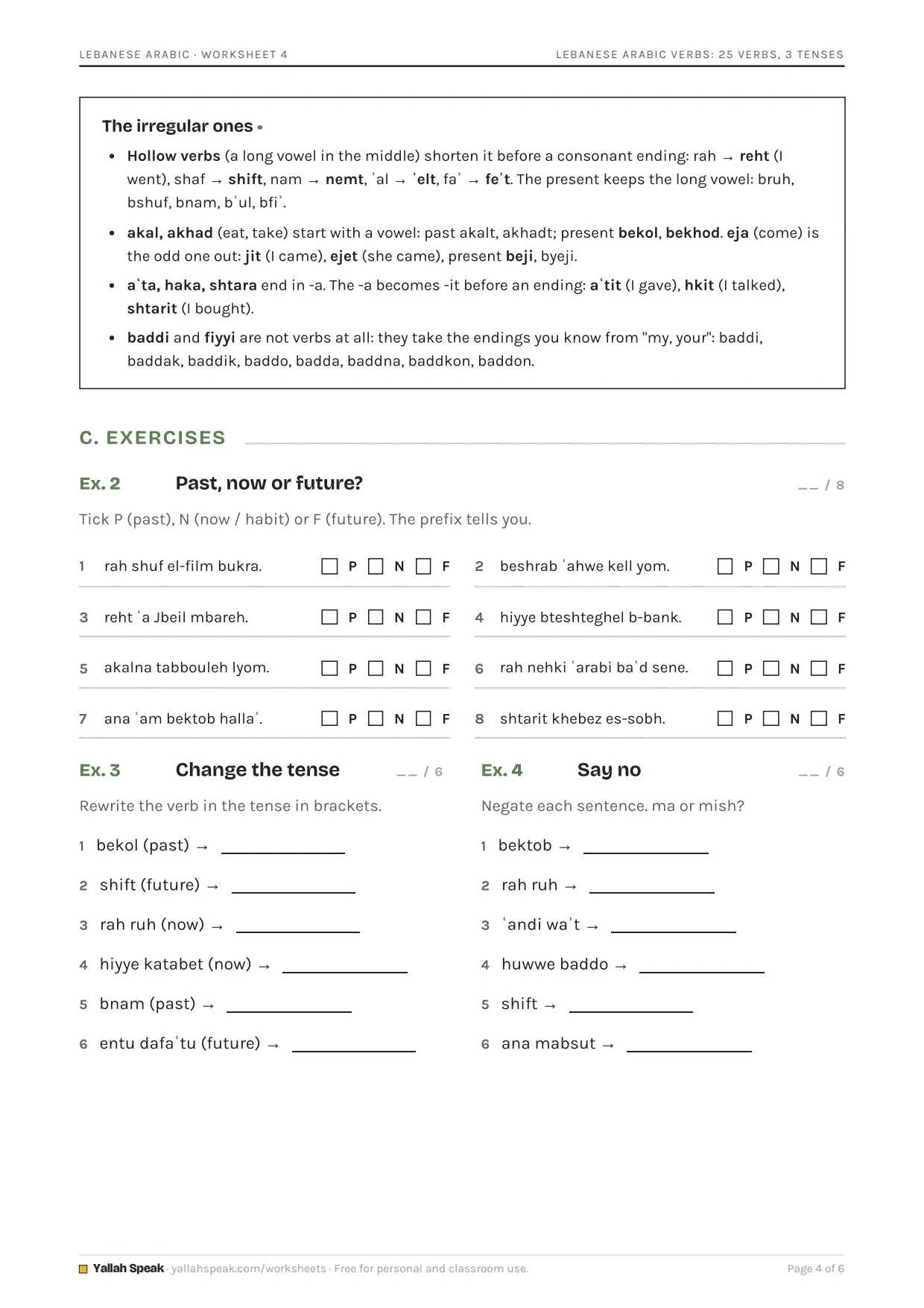
Put ma in front of the verb: ma baʿref, I don't know; ma fhemt, I didn't understand; ma rah ruh, I won't go. The verb-like words baddi (I want), fiyyi (I can) and ʿandi (I have) also take ma: ma baddi, ma fiyyi, ma ʿandi waʾt. Adjectives, nouns and places take mish instead: mish mabsut, not happy; mish hon, not here. Unlike Egyptian, Beirut speech usually has no -sh at the end of the verb.
How are Lebanese verbs different from Standard Arabic and other dialects?
Standard Arabic has no b- prefix; its plain present yaktubu is close to what Lebanese uses only after another verb or after baddi and lazem (baddi ektob, I want to write). Standard Arabic marks the future with sa- or sawfa, Lebanese with rah. The vowels change too: yaktub becomes yektob, yashrab becomes byeshrab. Syrian Arabic works the same way as Lebanese, with b-, ʿam and rah, and differs mostly in vowels (Damascus byektob or byiktob) and in a few words. Palestinian is close as well. Egyptian is the odd one out: ha- for the future, bi- without ʿam, and negation wrapped in ma…sh. For the bigger picture, read Egyptian vs Levantine Arabic or browse all Levantine Arabic worksheets.
The PDF has the full chart, a second grid to complete, the 25 verbs with example sentences, exercises on b-, ʿam, rah and negation, and a "my day" pair interview. The pronouns behind the chart are on worksheet 3; the core words and everyday expressions are on worksheet 5.
What's inside the PDF
One full conjugation grid (katab, to write) in past, present with b- and future with rah, for all eight persons, with Arabic script
Three short rules that carry you far: b- and ʿam for the present, rah for the future, ma in front of verbs and mish in front of everything else
The 25 verbs table: past and present, Arabic script, a short example each, irregular verbs marked and explained, plus baddi (want) and fiyyi (can)
Six everyday commands (ruh, taʿa, kol, eshrab, esmaʿ, ʾol) with the feminine forms, and a Beirut pronunciation box
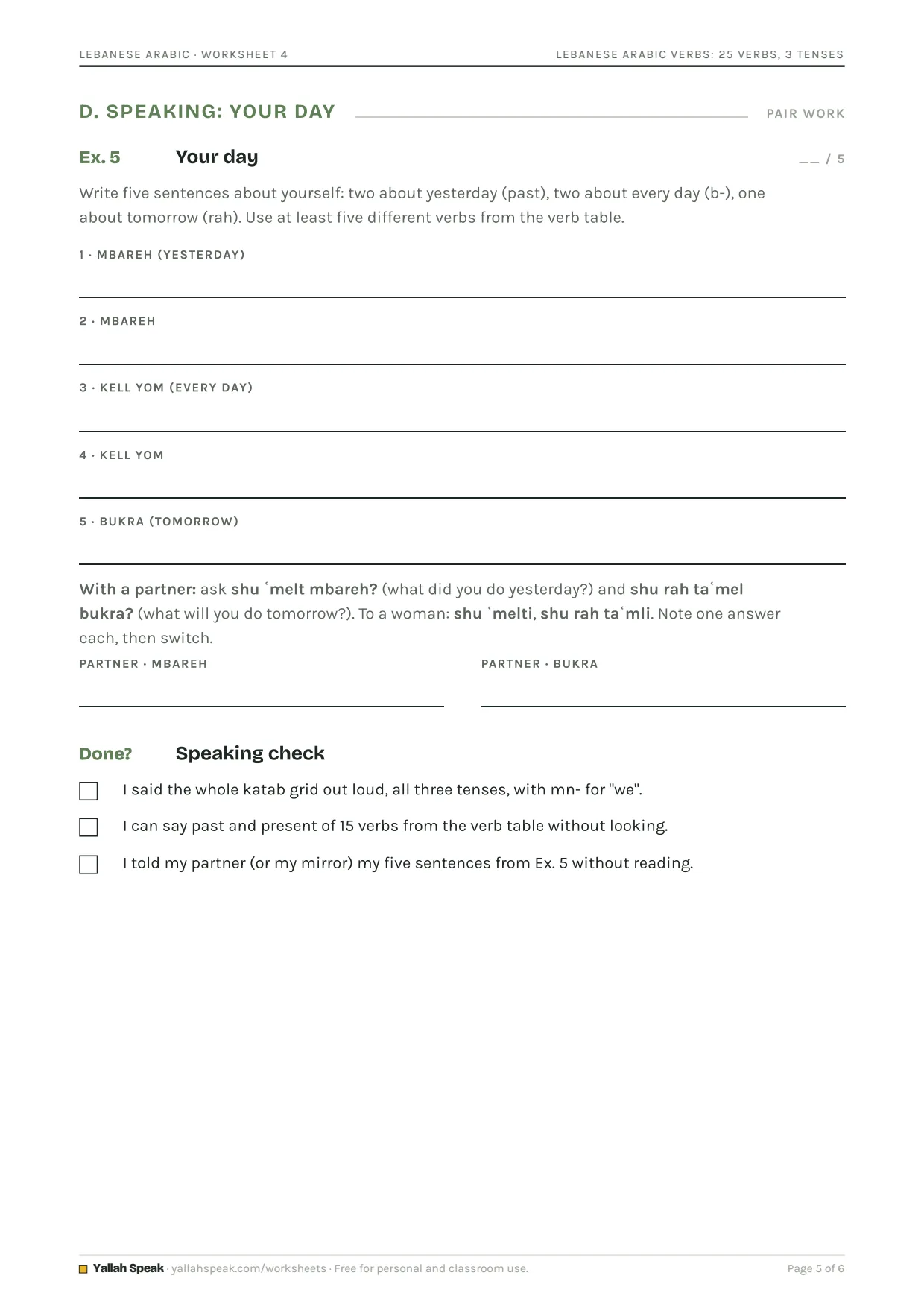
Five exercises: complete a grid, past-now-future, change the tense, say no, write and tell your day to a partner
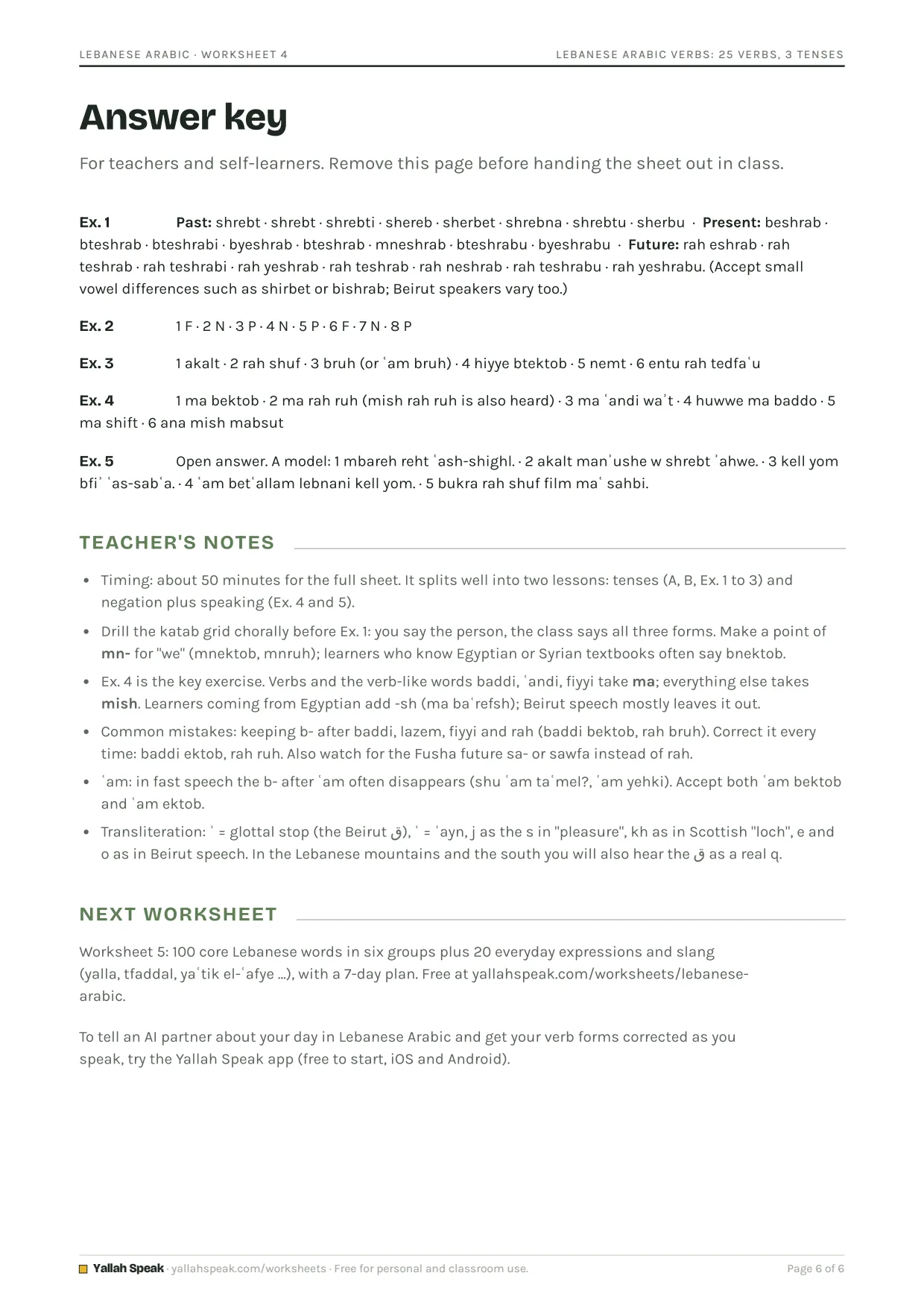
Answer key and teacher notes on a separate page you can remove before handing out
How to use it on your own
Say the katab grid out loud until the prefixes come without thinking, especially mn- for "we", then do Ex. 1 without looking back. Work through the 25 verbs five at a time and tick a verb only when you can say both forms. Finish with Ex. 5: write your five sentences, then say them to a mirror or record yourself and listen once.
How to use it in class
About 50 minutes, or two shorter lessons: tenses (A, B, Ex. 1 to 3) and negation plus speaking (Ex. 4 and 5). Drill the katab grid chorally before anyone writes, then let pairs conjugate shereb aloud. Ex. 4 is the key exercise: ma before verbs and before baddi, ʿandi, fiyyi, mish before everything else. Ex. 5 ends in a pair interview (what did you do yesterday, what will you do tomorrow) that forces real tense choices. Points fields on every exercise, answer key on the last page.
Worksheets teach you the words. Someone still has to answer back. Practise this exact dialogue with an AI partner who speaks Lebanese Arabic, stays in character and shows you word by word where your pronunciation slips. Try Yallah Speak free
Preview
Page 1 is above. Here are the other pages; click one to open it full size.
Frequently asked questions
How do you conjugate verbs in Lebanese Arabic?
Add the person endings to the past stem: katabt, katabt, katabti, katab, katabet, katabna, katabtu, katabu. For the present, put b- in front of the present stem with its person prefix: bektob, btektob, btektbi, byektob, btektob, mnektob, btektbu, byektbu. For the future, drop the b- and put rah in front: rah ektob, I will write.
What does ʿam mean in Lebanese Arabic?
ʿam marks something happening right now, like the English -ing. ʿam bektob means I am writing at this moment, and shu ʿam taʿmel? means what are you doing? The plain b- form also covers the present, but ʿam makes it clear you mean now and not in general.
How do you say "I want" and "I can" in Lebanese?
I want is baddi and I can is fiyyi. Neither is a real verb: they take the same endings as possessives, so you get baddak (you want), baddo (he wants), fiyyik (you, f, can). The verb that follows has no b-: baddi ruh, I want to go. To say no, put ma in front: ma baddi, ma fiyyi.
Are Lebanese verbs different from Syrian and Egyptian verbs?
Lebanese and Syrian verbs are very close: both use b- for the present, ʿam for right now and rah for the future, with small vowel differences. Egyptian uses bi- for the present but ha- for the future, and negates with ma…sh around the verb. Standard Arabic has no b- prefix at all and uses sa- or sawfa for the future.
Is this worksheet free?
Yes. Download the PDF, print it and copy it as often as you like for personal use and in class. Please keep the Yallah Speak credit in the footer.
Stop studying Arabic. Start speaking it.
AI conversations in 10 real dialects, honest pronunciation feedback and a course from A1.