After this sheet you can count to 1000, read a price tag in dollars or lira, haggle at a market stall and say what time it is, in Lebanese Arabic and out loud.
No sign-up. Print and copy for personal and classroom use. Please keep the credit in the footer.
By Fouad El Ajouaoui, founder of Yallah Speak · · Free worksheet, no sign-up
Quick answer In Lebanese Arabic you count 1 to 10 as wahad, tnein, tlete, arbaʿa, khamse, sette, sabʿa, tmene, tesʿa, ʿashra (واحد، تنين، تلاتة، أربعة، خمسة، ستة، سبعة، تمانية، تسعة، عشرة). From 21 on the unit comes first: 21 is wahad w ʿeshrin, "one and twenty", and 100 is miyye. To ask a price, say ʾaddesh hayda? The full list to 1000, the counting rule and prices are below; the PDF adds a market dialogue and exercises.
How do you count from 1 to 10 in Lebanese numbers?
These are the numbers you will hear in Beirut, with the Arabic-Indic digits you see on banknotes and some signs. Lebanon also uses the Western digits 1, 2, 3 on most menus and price tags, so you need to read both. Say the words out loud until they come without thinking; every larger number is built from these ten.
Number
Digit
Lebanese Arabic
Arabic
0
٠
sefr
صفر
1
١
wahad (f. wahde)
واحد
2
٢
tnein
تنين
3
٣
tlete
تلاتة
4
٤
arbaʿa
أربعة
5
٥
khamse
خمسة
6
٦
sette
ستة
7
٧
sabʿa
سبعة
8
٨
tmene
تمانية
9
٩
tesʿa
تسعة
10
١٠
ʿashra
عشرة
Two traps with the digits: ٦ looks like a 7 but is 6, and ٠ is a dot while ٥ is a small circle. Multi-digit numbers are written left to right exactly like ours, so ٢٥ is 25.
Lebanese numbers from 11 to 100 and beyond
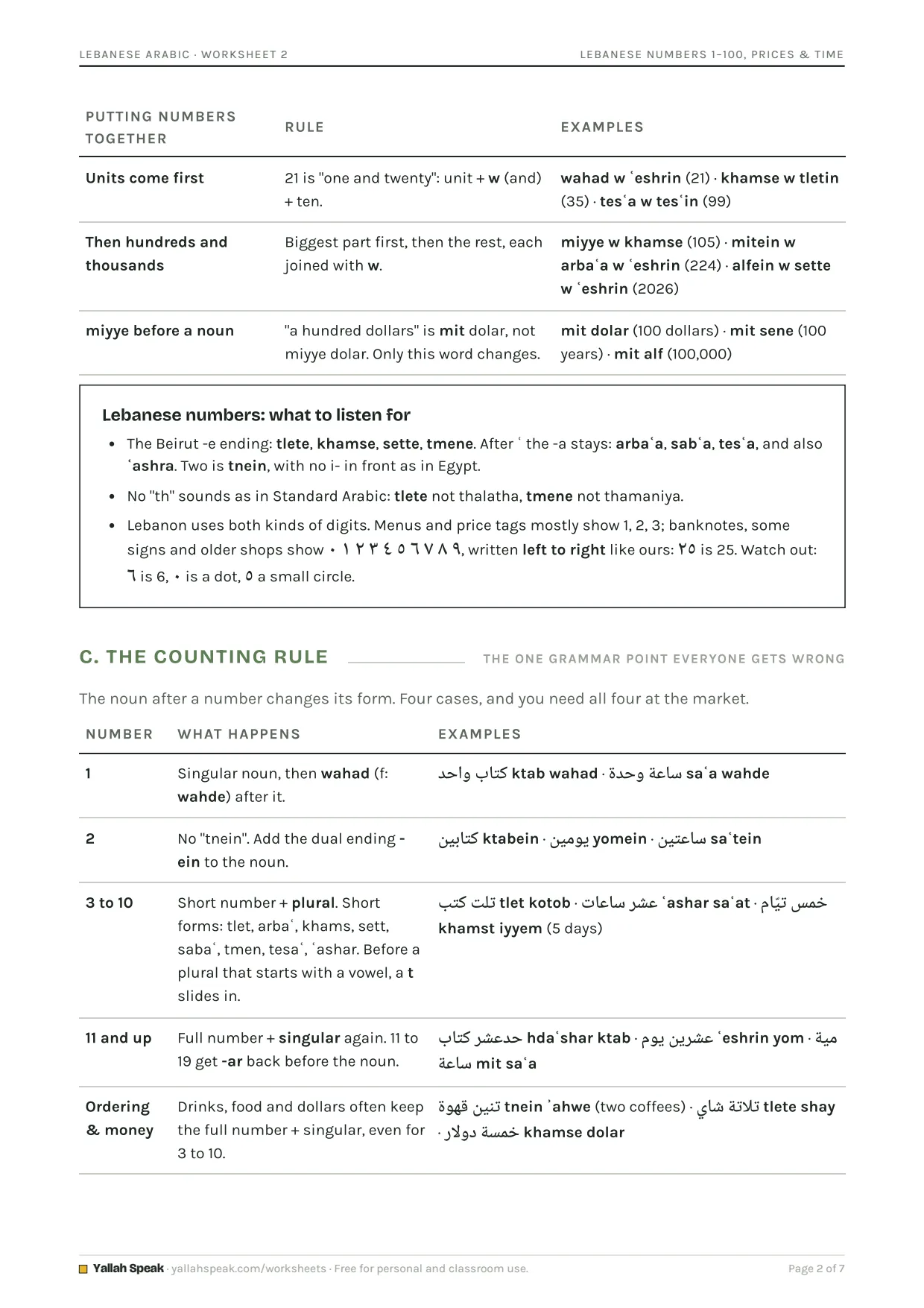
Eleven to nineteen all end in -ʿsh, and they take -ʿshar when a noun follows (tnaʿshar saʿa, twelve hours). The tens all end in -in. From 21 upwards the unit comes first: 21 is literally "one and twenty", wahad w ʿeshrin.
11–19
Tens
Hundreds
11 hdaʿshحدعش
20 ʿeshrinعشرين
100 miyyeمية
12 tnaʿshطنعش
30 tletinتلاتين
200 miteinميتين
13 tlettaʿshتلطعش
40 arbʿinأربعين
300 tlet miyyeتلت مية
14 arbaʿtaʿshأربعطعش
50 khamsinخمسين
400 arbaʿ miyyeأربع مية
15 khamstaʿshخمسطعش
60 settinستين
500 khams miyyeخمس مية
16 settaʿshسطعش
70 sabʿinسبعين
600 sett miyyeست مية
17 sabaʿtaʿshسبعطعش
80 tmeninتمانين
700 sabaʿ miyyeسبع مية
18 tmentaʿshتمنطعش
90 tesʿinتسعين
800 tmen miyyeتمن مية
19 tesaʿtaʿshتسعطعش
99 tesʿa w tesʿin
1000 alfألف · 2000 alfein
Examples: 35 is khamse w tletin, 105 is miyye w khamse, 224 is mitein w arbaʿa w ʿeshrin, 2026 is alfein w sette w ʿeshrin. Before a noun, 100 shortens to mit: mit dolar, a hundred dollars, and mit alf, a hundred thousand.
How is Lebanese different from Standard Arabic and other dialects?
Like the other spoken dialects, Lebanese drops the "th" of Modern Standard Arabic: Standard thalatha becomes tlete, thamaniya becomes tmene, ithnan becomes tnein. The typical Beirut sound is the final -e in tlete, khamse, sette and tmene, where Egyptians say talata, khamsa, sitta, tamanya. Syrian numbers are almost identical to Lebanese, and Palestinian ones differ only in small vowel details (tlate for tlete). If a textbook taught you the standard forms, you will be understood, but you will hear these forms everywhere, from taxi drivers to football scores.
How do you ask how much something costs in Lebanese?
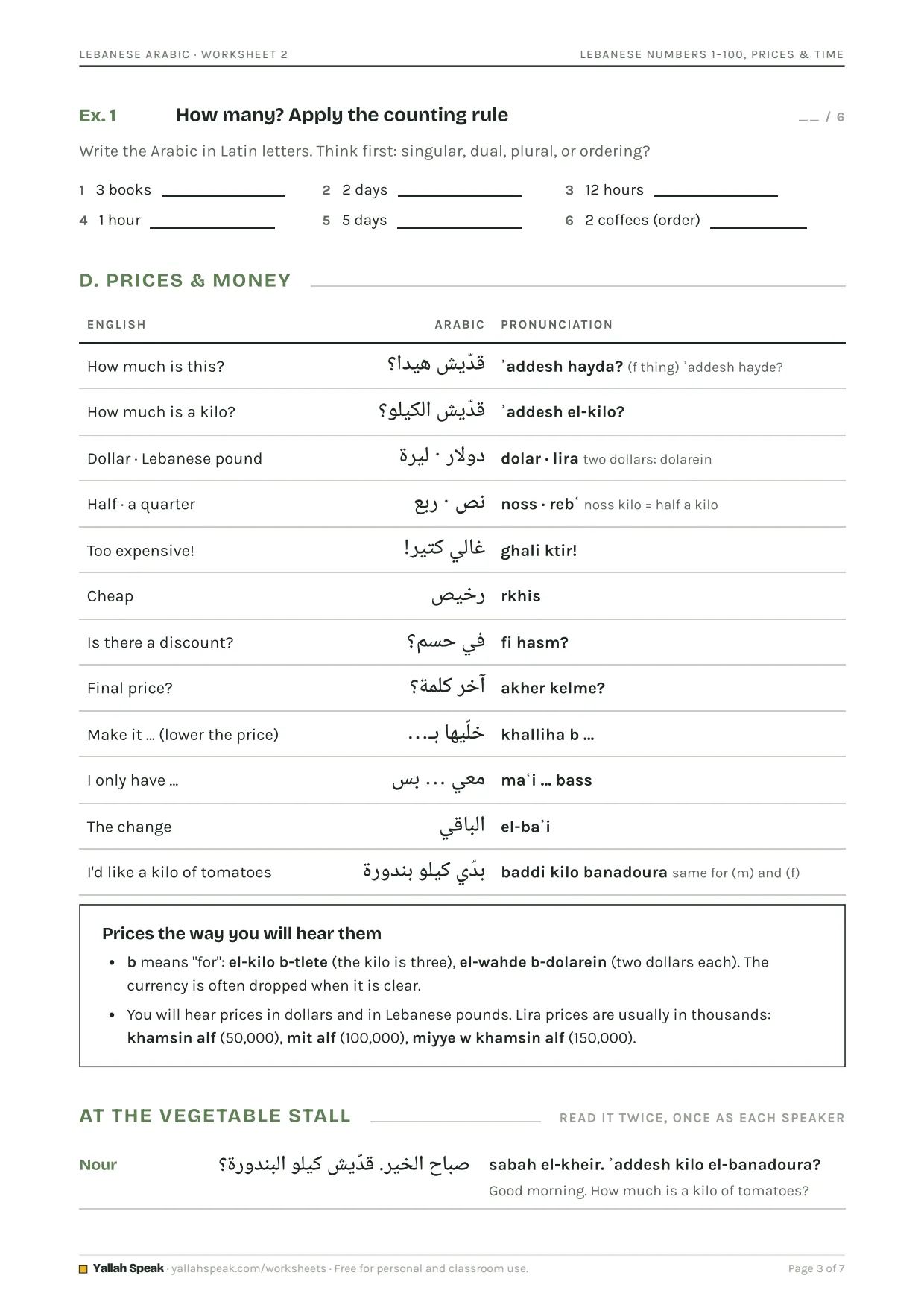
The key word is ʾaddesh? (how much?): ʾaddesh hayda? is "how much is this?", ʾaddesh el-kilo? "how much is a kilo?". The answer uses b for "for": el-kilo b-tlete dolar. Then the market phrases: ghali ktir! (too expensive!), khalliha b-tnein (make it two), akher kelme? (final price?). Prices are quoted in dollars and in Lebanese pounds; lira prices come in thousands, such as khamsin alf (50,000).
The counting rule decides what the noun does after a number: one book is ktab wahad, two books ktabein, three to ten take the plural (tlet kotob, and with a sliding t, khamst iyyem, five days), and from eleven the noun is singular again (ʿeshrin yom). Ordering is the friendly exception: tnein ʾahwe, two coffees. The worksheet drills all of this, plus telling the time with w and illa, a vegetable-stall dialogue and a haggling role-play. Before numbers, make sure you have the greetings; next, ask "how many?" and "where?" with pronouns and question words. For more travel phrases, see essential Arabic phrases for travelers.
What's inside the PDF
Numbers 0 to 10, 11 to 19, tens, hundreds and thousands as a visual grid: Arabic-Indic digit, Arabic script and Beirut pronunciation side by side
How compound numbers are built (units first: wahad w ʿeshrin) and the Lebanese -e ending in tlete, khamse, sette, tmene
The counting rule in one table: singular, dual, plural after 3 to 10 (with the sliding t in khamst iyyem), singular again after 11, plus the ordering exception (tnein ʾahwe)
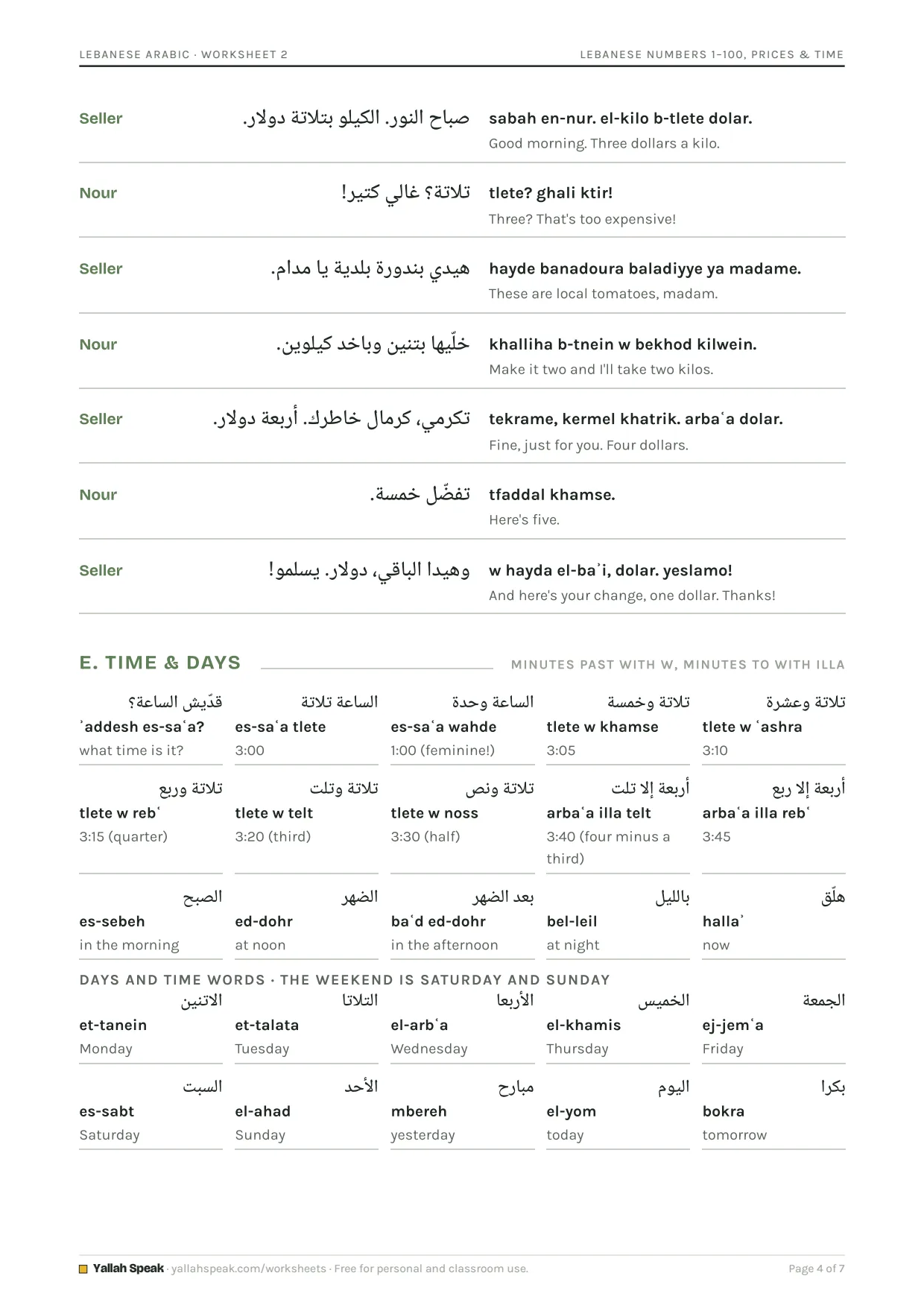
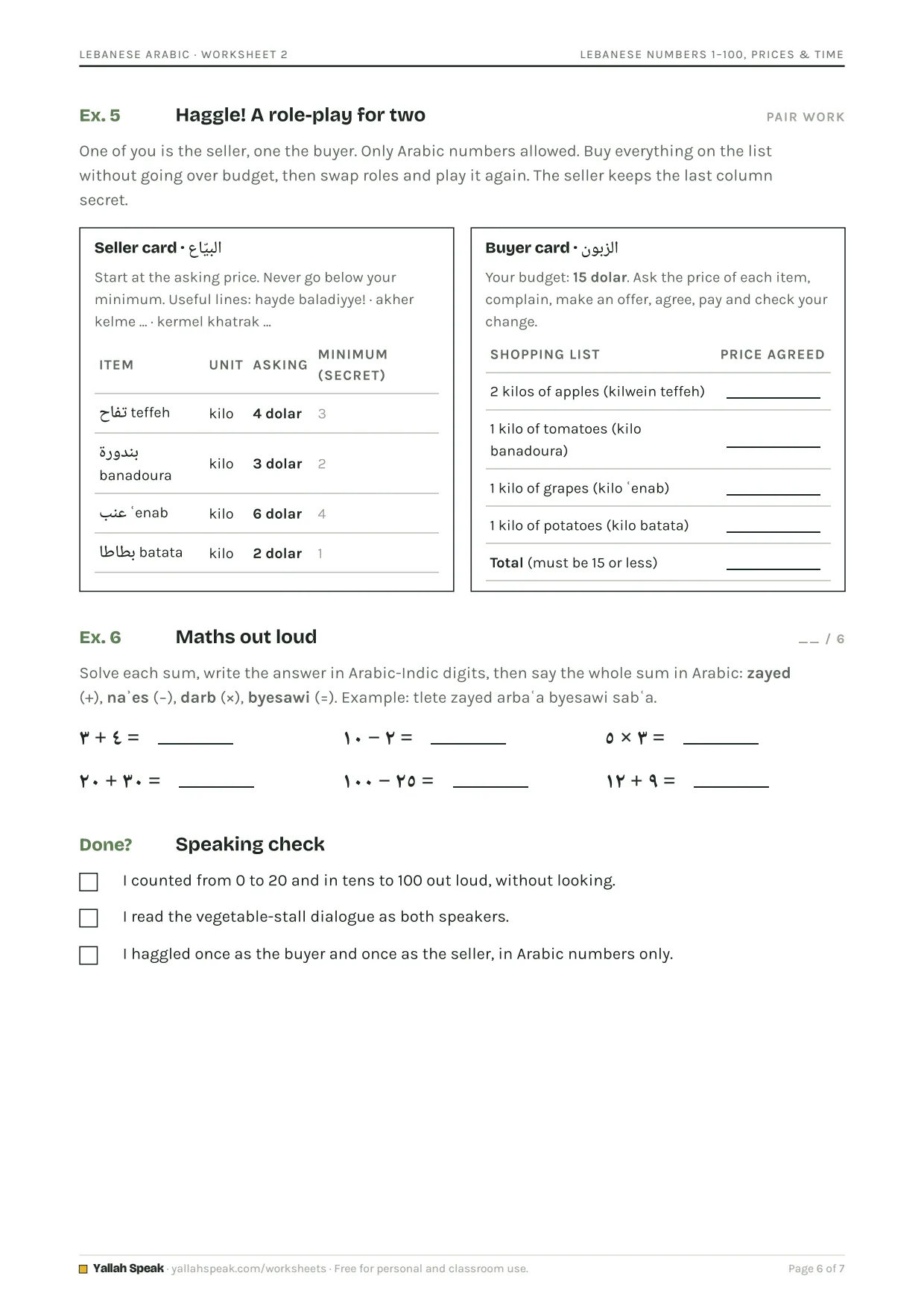
Prices and money vocabulary (ʾaddesh?, ghali ktir!, khalliha b…) and a haggling dialogue at a Beirut vegetable stall to read in pairs
Telling the time with w and illa, the days of the week and everyday time words like hallaʾ (now) and bokra (tomorrow)
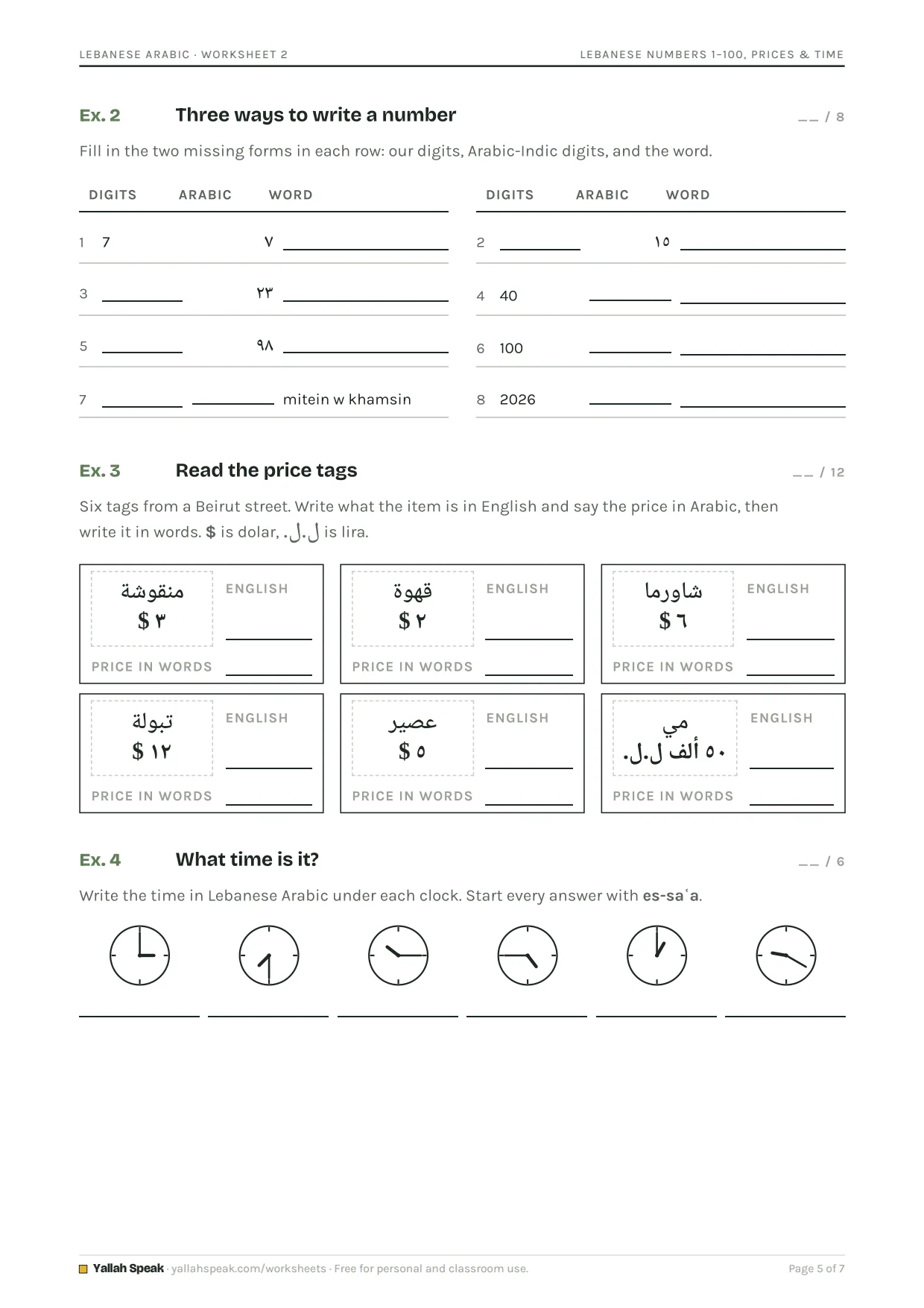
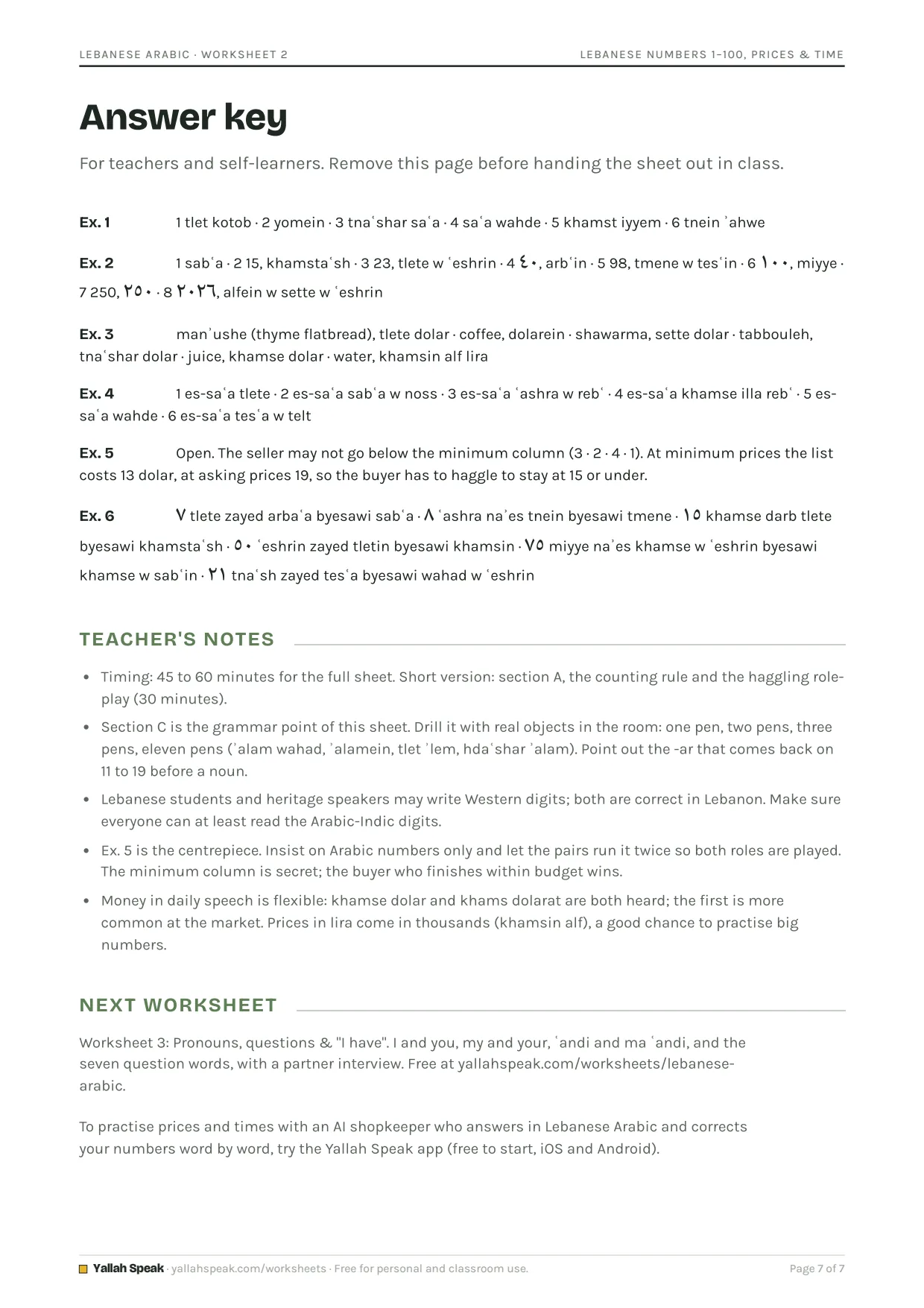
Six exercises: the counting rule, three ways to write a number, price tags, clock faces, a haggling role-play with seller and buyer cards, maths out loud. Answer key and teacher notes on a separate page
How to use it on your own
Say every number in sections A and B out loud until you can count to 20 and in tens to 100 without looking. Read the counting rule, then test yourself with objects on your desk. Read the vegetable-stall dialogue as both speakers. For the role-play, play both parts yourself out loud if you have no partner; it feels silly and works. Finish with the clocks and the maths, always speaking the answer before you write it.
How to use it in class
Fits a 45 to 60 minute lesson, or a 30-minute version with section A, the counting rule and the role-play. The counting rule (section C) is the grammar point of this sheet: drill it with real objects in the room before Ex. 1. Ex. 5, the haggling role-play, is the centrepiece: pairs play it twice so both roles are covered, Arabic numbers only, and the seller keeps the minimum column secret. Points fields on every exercise, answer key on the last page.
Worksheets teach you the words. Someone still has to answer back. Practise this exact dialogue with an AI partner who speaks Lebanese Arabic, stays in character and shows you word by word where your pronunciation slips. Try Yallah Speak free
Preview
Page 1 is above. Here are the other pages; click one to open it full size.
Frequently asked questions
How do you count from 1 to 10 in Lebanese?
wahad (1), tnein (2), tlete (3), arbaʿa (4), khamse (5), sette (6), sabʿa (7), tmene (8), tesʿa (9), ʿashra (10). Zero is sefr. The typical Beirut touch is the -e ending in tlete, khamse, sette and tmene; Modern Standard Arabic says thalatha, khamsa, sitta and thamaniya.
How do you say numbers 11 to 100 in Lebanese Arabic?
11 to 19 end in -ʿsh: hdaʿsh, tnaʿsh, tlettaʿsh and so on, and they take -ʿshar before a noun (tnaʿshar saʿa, twelve hours). The tens end in -in: ʿeshrin, tletin, arbʿin, khamsin, settin, sabʿin, tmenin, tesʿin, and 100 is miyye. In between, the unit comes first: 21 is wahad w ʿeshrin, "one and twenty".
How do you ask how much something costs in Lebanese?
ʾaddesh hayda? (how much is this?) or ʾaddesh el-kilo? (how much is a kilo?). Answers use b for "for": el-kilo b-tlete dolar, three dollars a kilo. Useful follow-ups are ghali ktir! (too expensive!) and khalliha b-tnein (make it two).
Does Lebanon use Arabic numerals or Western digits?
Both. Menus, price tags and phone numbers mostly use Western digits (1, 2, 3), while banknotes, some signs and older shops use the Arabic-Indic digits ٠ ١ ٢ ٣ ٤ ٥ ٦ ٧ ٨ ٩. They are written left to right like ours, so ٢٥ is 25. The worksheet trains you to read both.
How do you tell the time in Lebanese Arabic?
Ask ʾaddesh es-saʿa? (what time is it?) and answer with es-saʿa plus the number: es-saʿa tlete is three o'clock, tlete w noss is half past three, tlete w rebʿ is quarter past, arbaʿa illa rebʿ is quarter to four. One o'clock is es-saʿa wahde, with the feminine form.
Is this numbers worksheet free?
Yes. Download the PDF, print it and copy it as often as you like for personal use and in class. Please keep the Yallah Speak credit in the footer.
Stop studying Arabic. Start speaking it.
AI conversations in 10 real dialects, honest pronunciation feedback and a course from A1.