After this sheet you can say who you are talking about, say what is yours and what you have, and ask the seven basic questions in Lebanese Arabic without a phrasebook.
No sign-up. Print and copy for personal and classroom use. Please keep the credit in the footer.
By Fouad El Ajouaoui, founder of Yallah Speak · · Free worksheet, no sign-up
Quick answer Lebanese Arabic has eight personal pronouns: ana (I), enta / ente (you m/f), huwwe (he), hiyye (she), nehna (we), entu (you pl.), hinne (they). "I have" is ʿandi (عندي), and "I don't have" is ma ʿandi. The seven question words are shu (what), wein (where), emta (when), leish (why), min (who), kif (how) and kam / ʾaddesh (how many / how much), and they usually come first: shu esmak?
What are the Lebanese pronouns?
Eight pronouns cover everything in Lebanese Arabic. "You" has a form for a man and one for a woman, but there is no dual and no feminine plural: entu and hinne work for every group. Standard Arabic has thirteen pronouns; you will not need the extra five in Beirut. Notice the typical Lebanese vowels: ente, huwwe, hiyye, hinne.
English
Lebanese Arabic
Arabic
"I have …" (ʿand + ending)
I
ana
أنا
ʿandiعندي
you (m)
enta
إنتَ
ʿandakعندَك
you (f)
ente
إنتِ
ʿandikعندِك
he
huwwe
هوّي
ʿandoعندو
she
hiyye
هيّي
ʿandaعندا
we
nehna
نحنا
ʿannaعنّا
you (plural)
entu
إنتو
ʿandkonعندكن
they
hinne
هنّي
ʿandonعندن
How do you say "I have" in Lebanese Arabic?
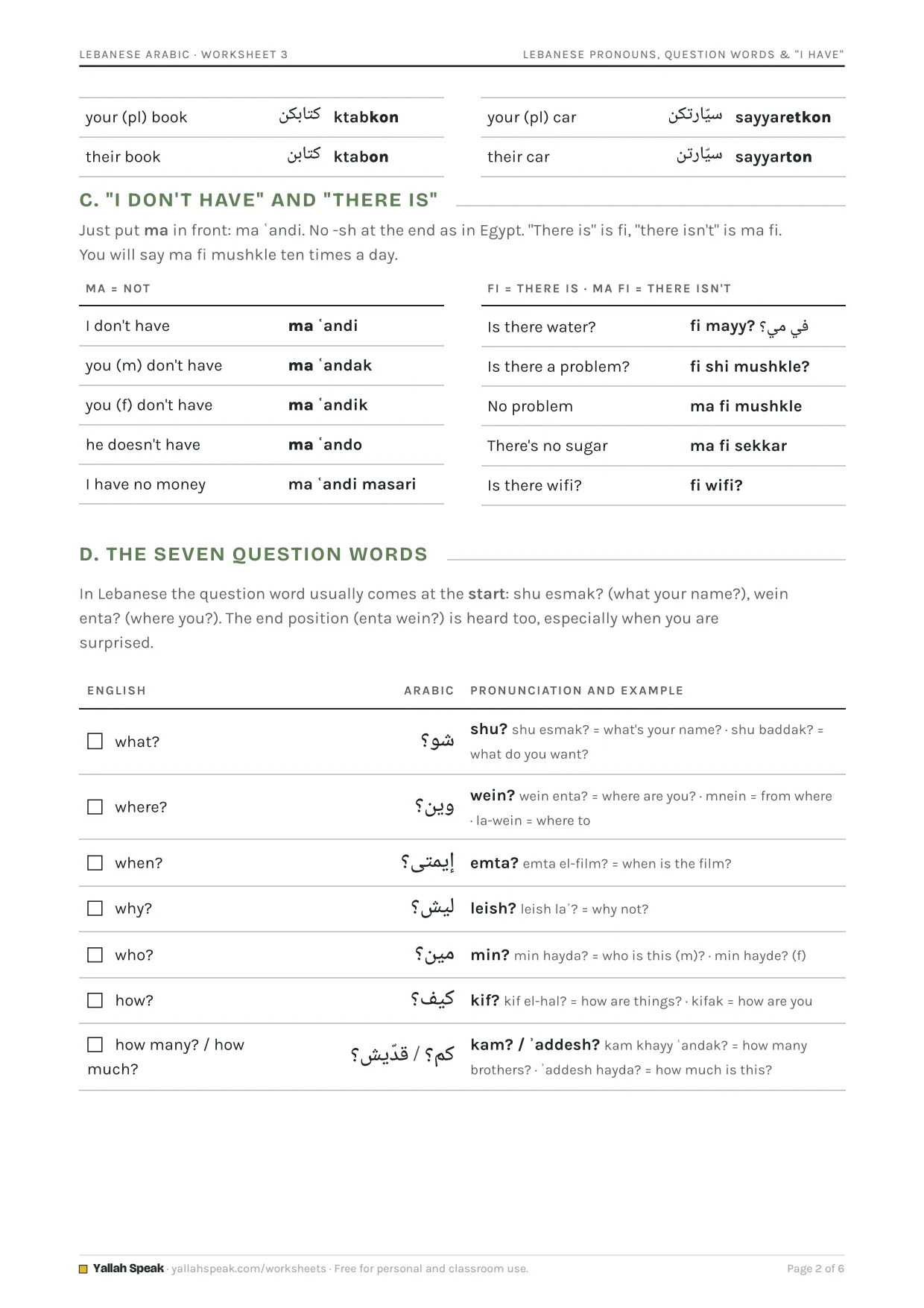
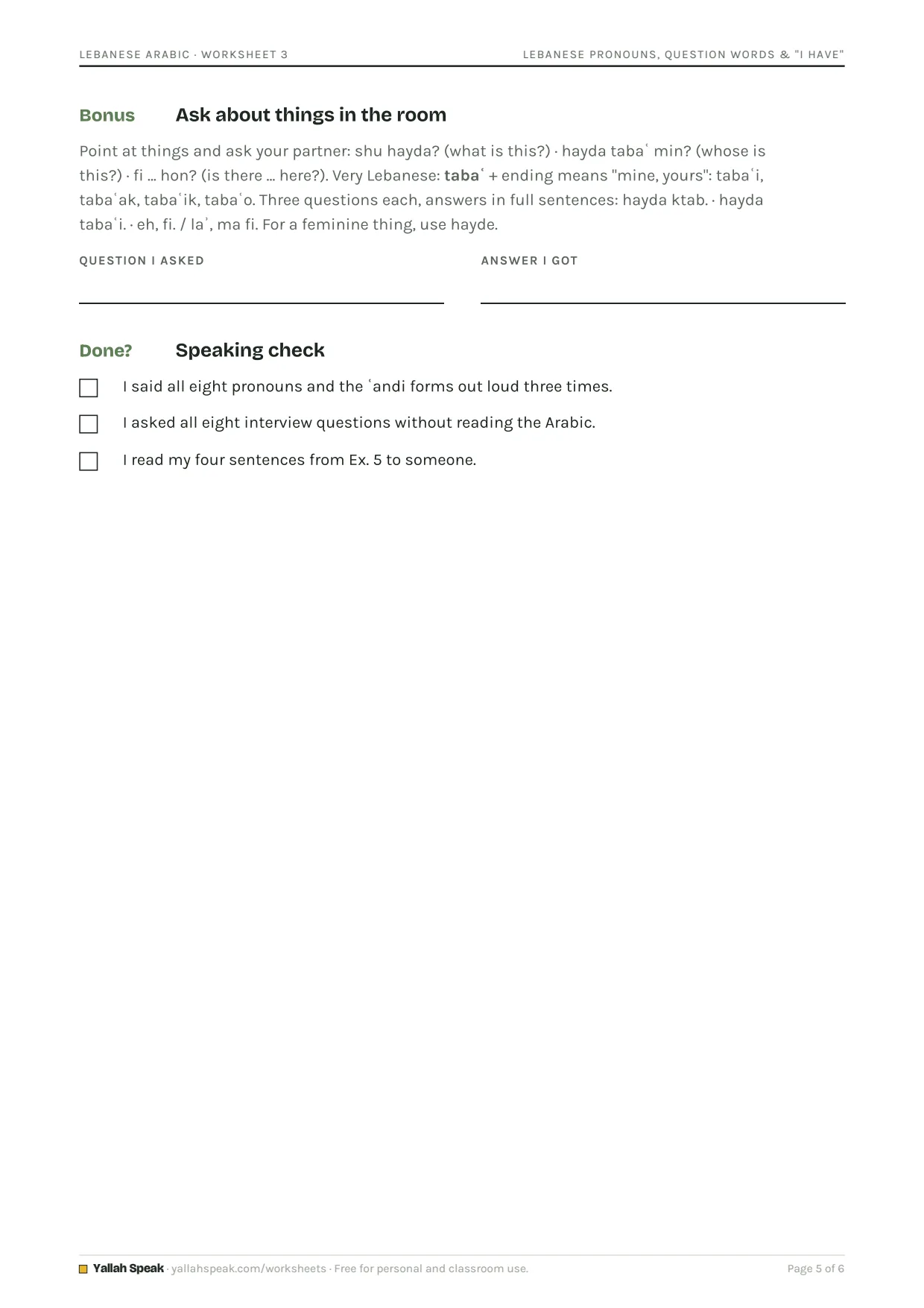
Arabic has no verb "to have". Instead you say "at me": ʿandi does the job of "I have". ʿandi sayyara, I have a car; ʿandak waʾt?, do you have time? The same endings turn any noun into "my, your, his": ktabi (my book), ktabak (your book, to a man), ktabik (to a woman), ktabo (his), ktaba (her), ktabna (our), ktabkon (your, plural), ktabon (their). Feminine nouns insert a -t- first: sayyarti, my car. Lebanese also loves tabaʿ for "mine, yours": hayda tabaʿi, this is mine.
The negative is simple: put ma in front. ma ʿandi masari, I have no money. For "there is" you need fi, and for "there isn't" ma fi: fi mayy? is there water? ma fi mushkle, no problem. Learners who started with Egyptian tend to add -sh (maʿandish, mafish); in Beirut that sounds Egyptian, so drop it.
What are the question words in Lebanese?
Seven question words, and in Lebanese they usually come at the start of the question, like in English: shu esmak? is "what's your name?". This is one of the clearest differences from Egyptian, which says ismak eh? with the question word at the end, and from Standard Arabic, which uses ma, ayna, mata, limadha. Syrian and Palestinian Arabic use almost the same set.
English
Lebanese Arabic
Arabic
Example
what?
shu?
شو؟
shu esmak? · what's your name?
where?
wein? (from where: mnein?)
وين؟
wein enta? · where are you?
when?
emta?
إيمتى؟
emta el-film? · when is the film?
why?
leish?
ليش؟
leish laʾ? · why not?
who?
min?
مين؟
min hayda? · who is this?
how?
kif?
كيف؟
kif el-hal? · how are things?
how many? / how much?
kam? / ʾaddesh?
كم؟ / قدّيش؟
ʾaddesh hayda? · how much is this?
How do you ask questions to a man, a woman or a group?
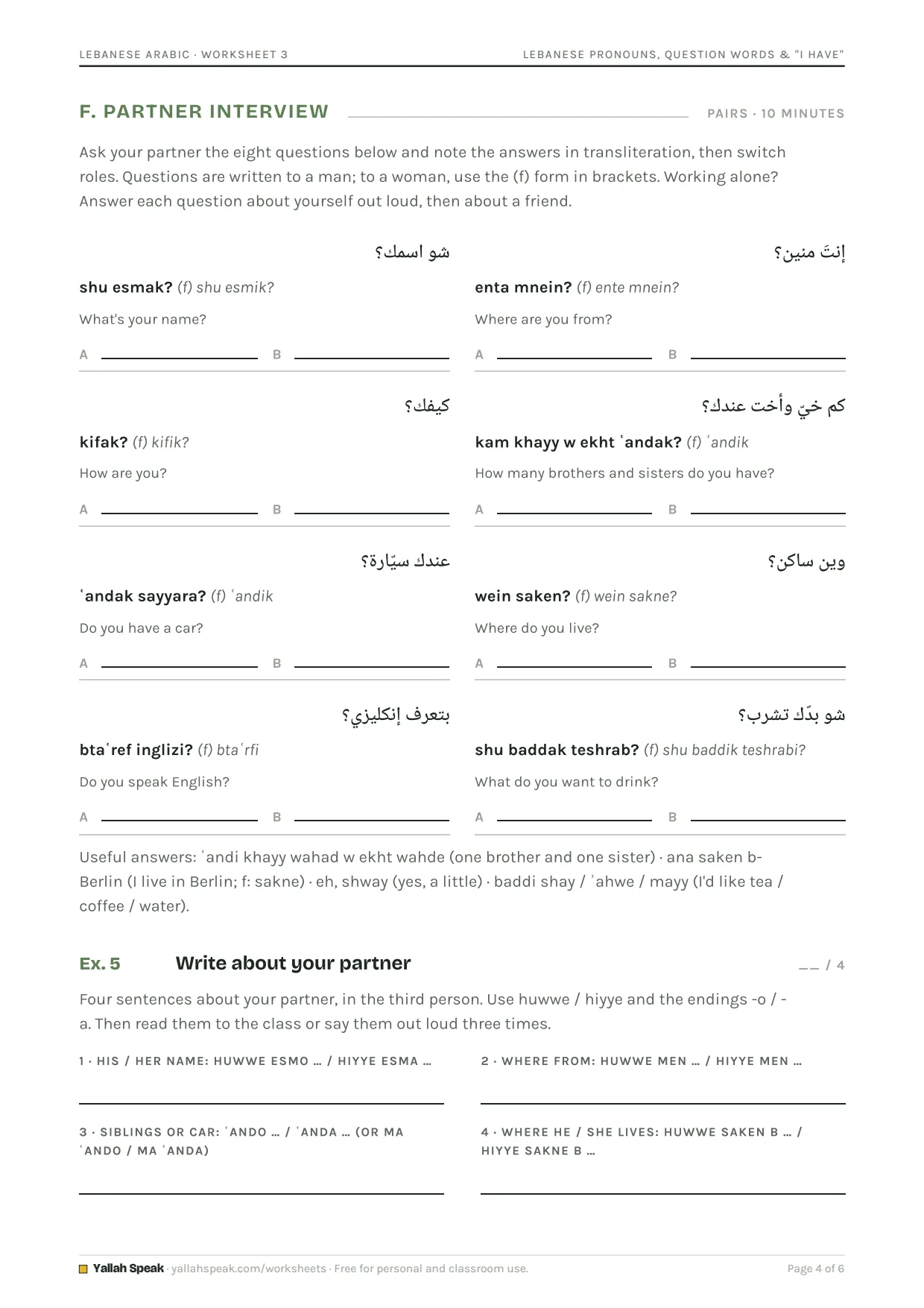
The question word stays the same; only the ending that points at "you" changes. To a man: shu esmak?, wein saken?, shu baddak teshrab? To a woman: shu esmik?, wein sakne?, shu baddik teshrabi? To a group: shu esmkon?, wein sakenin?, shu baddkon teshrabo? If you are unsure, use the plural; it sounds polite and nobody will mind. The same goes for "how many": kam khayy ʿandak? (how many brothers do you have?) becomes kam khayy ʿandik? for a woman.
Yes/no questions need no question word at all: raise your voice at the end. enta lebnene? are you Lebanese? fi wifi? is there wifi? The worksheet turns all of this into a partner interview where students ask each other name, origin, siblings and where they live, then report back in the third person, which is why teachers use it as a first-week speaking activity. If you need the greetings that come before these questions, start with worksheet 1; to put verbs after your pronouns, continue with Lebanese Arabic verbs. For practice beyond the page, read learn Arabic through conversation.
What's inside the PDF
The eight personal pronouns (ana, enta, ente, huwwe, hiyye, nehna, entu, hinne) with Arabic script and example sentences
Possessive endings on a masculine and a feminine noun (ktabi, ktabak, ktabik … / sayyarti, sayyartak …), plus the very Lebanese tabaʿi (mine) in the bonus task
"I have" with ʿandi, ʿando, ʿanna and its negation ma ʿandi, plus fi / ma fi for "there is" and "there isn't"
The seven question words (shu, wein, emta, leish, min, kif, kam / ʾaddesh) with natural example questions and a note on word order
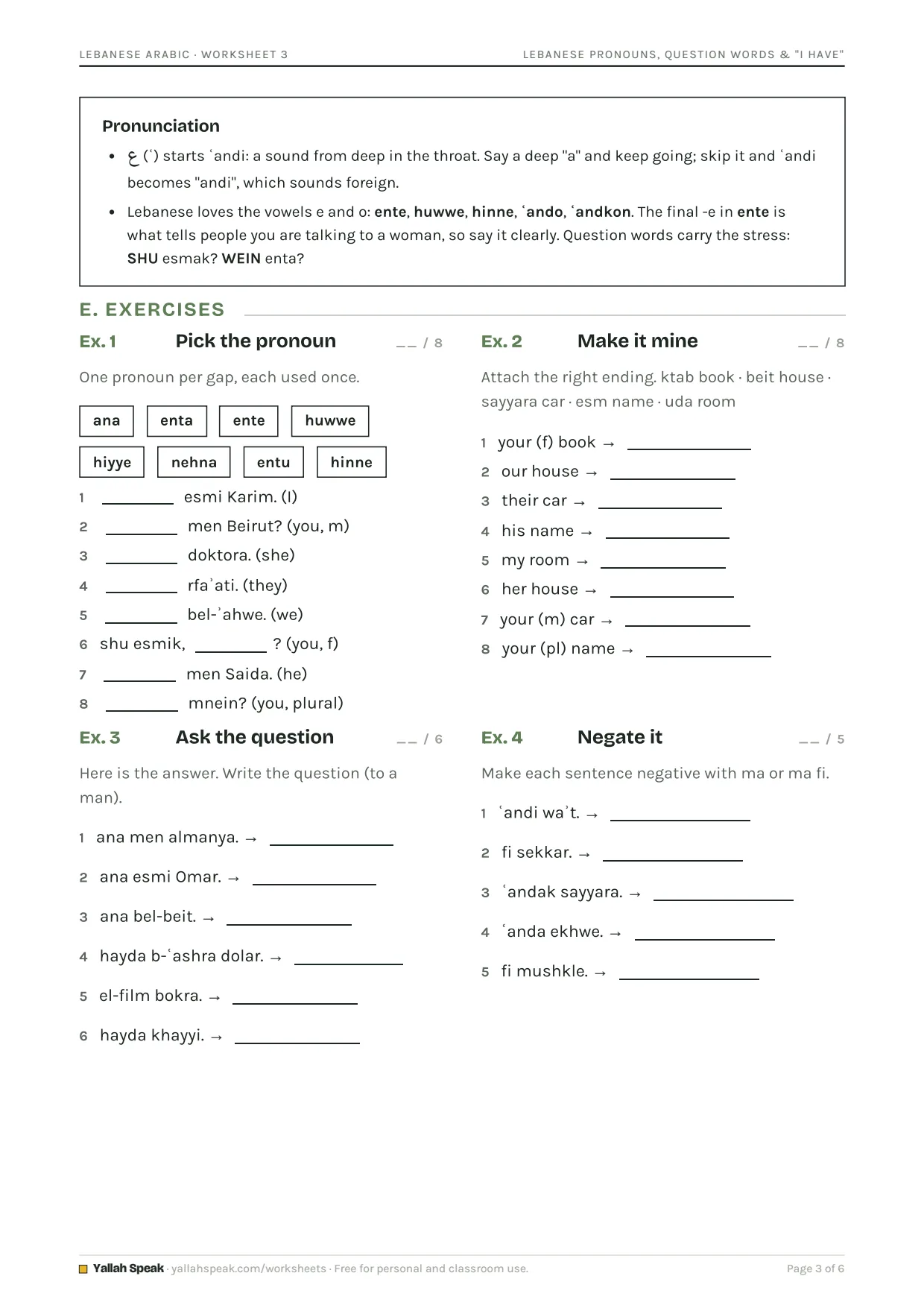
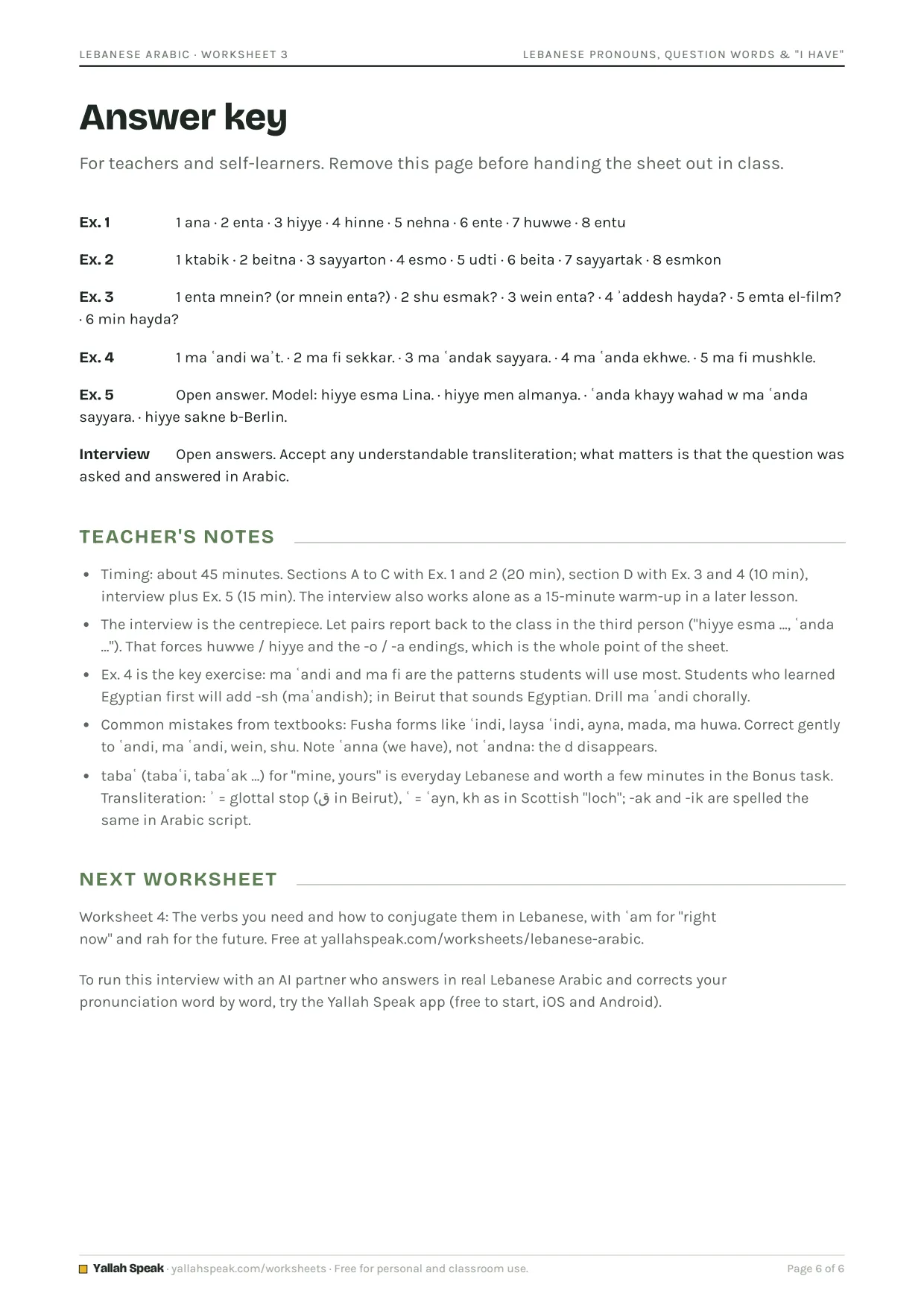
Four exercises with points: pick the pronoun, attach the ending, build the question, negate the sentence
A partner interview with eight questions, a writing task in the third person, a speaking check, and an answer key with teacher notes on a separate page
How to use it on your own
Read sections A to D out loud, one table at a time, and tick a row only when you can produce it from the English alone. Do the four exercises without looking back, then check the key. For the interview, answer every question about yourself out loud, then again about a friend or family member so you get to use huwwe, hiyye and the -o / -a endings. Finish with Ex. 5 and say your four sentences three times without reading.
How to use it in class
Fits a 45-minute lesson: sections A to C with Ex. 1 and 2 (20 min), the question words with Ex. 3 and 4 (10 min), the partner interview with Ex. 5 (15 min). The interview is the centrepiece: pairs ask and note answers, then report to the class in the third person, which forces huwwe / hiyye and the possessive endings. Ex. 4 is the key exercise: ma ʿandi and ma fi are the patterns students use most, and learners who know Egyptian keep adding -sh. Points fields on every exercise, answer key on the last page.
Worksheets teach you the words. Someone still has to answer back. Practise this exact dialogue with an AI partner who speaks Lebanese Arabic, stays in character and shows you word by word where your pronunciation slips. Try Yallah Speak free
Preview
Page 1 is above. Here are the other pages; click one to open it full size.
Frequently asked questions
What are the question words in Lebanese Arabic?
shu (what), wein (where), mnein (from where), emta (when), leish (why), min (who), kif (how), kam (how many) and ʾaddesh (how much). They usually come at the start of the question: shu esmak? is "what's your name?", wein enta? is "where are you?". Standard Arabic uses different words (ma, ayna, mata, limadha), so MSA learners have to relearn this set.
How do you say "I have" in Lebanese?
ʿandi (عندي), literally "at me". ʿandi sayyara is I have a car, ʿandak waʾt? is do you have time (to a man), ʿandik to a woman. The negative simply adds ma in front: ma ʿandi masari, I have no money. Note ʿanna for "we have"; there is no verb "to have" in Arabic.
What are the personal pronouns in Lebanese Arabic?
ana (I), enta (you, to a man), ente (you, to a woman), huwwe (he), hiyye (she), nehna (we), entu (you, plural) and hinne (they). Only "you" changes for men and women in the singular, and the plural forms are the same for everyone. The e and o vowels are typical of Lebanese; Egyptians say enti, ehna and humma.
How is Lebanese different from Egyptian for "I don't have"?
Egyptian wraps the word: maʿandish. Lebanese only puts ma in front: ma ʿandi, ma ʿando, ma fi. Lebanese also uses shu for "what" and puts it first (shu esmak?), where Egyptian says ismak eh? with the question word at the end.
Is this worksheet free?
Yes. Download the PDF, print it and copy it as often as you like for personal use and in class. Please keep the Yallah Speak credit in the footer.
Stop studying Arabic. Start speaking it.
AI conversations in 10 real dialects, honest pronunciation feedback and a course from A1.