Palestinian Words and Phrases: 100 Words + 20 Slang
After this sheet you know the 100 words and 20 expressions that carry most everyday Palestinian conversations, can say them from the English without looking, and know which phrase to use in the shop, at the table and with friends.
No sign-up. Print and copy for personal and classroom use. Please keep the credit in the footer.
By Fouad El Ajouaoui, founder of Yallah Speak · · Free worksheet, no sign-up
Quick answer The most useful Palestinian Arabic words are short everyday ones: shu (what), wein (where), biddi (I want, بدّي), mnih (good), hallaʾ (now), ktir (a lot, very), fi / ma fi (there is / there isn't). The expressions you hear most are yalla (let's go), khalas (done), tfaddal (here you are), yislamu idek (thanks, يسلمو إيديك) and yaʿtik el-ʿafye, said to anyone at work. The first 40 words and all 20 expressions are below; the PDF has all 100 words with a 7-day plan.
What are the most common Palestinian words?
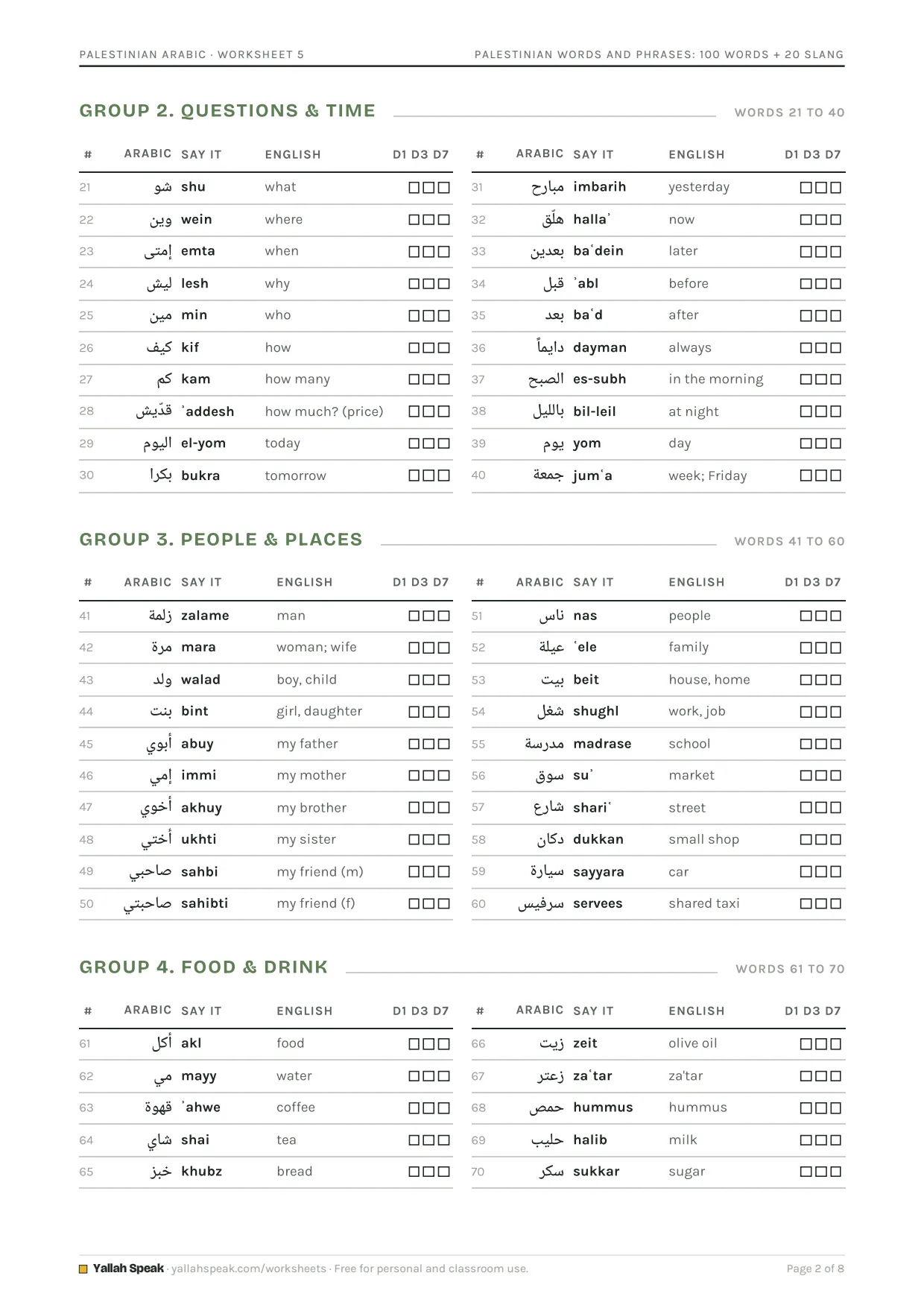
The 100 words on this sheet are grouped by what they do in a sentence, not by alphabet: little words and pronouns, questions and time, people and places, food and drink, verbs, and describing words. Here are the first forty in their Jerusalem and Ramallah pronunciation, the ones you will hear in your first hour in any Palestinian home or café.
English
Palestinian
Arabic
English
Palestinian
Arabic
I
ana
أنا
what
shu
شو
you (m)
inta
إنت
where
wein
وين
you (f)
inti
إنتِ
when
emta
إمتى
he
huwwe
هو
why
lesh
ليش
she
hiyye
هي
who
min
مين
we
ihna
إحنا
how
kif
كيف
you (pl.)
intu
إنتو
how many
kam
كم
they
humme
همّ
how much (price)
ʾaddesh
قدّيش
this (m)
hada
هاد
today
el-yom
اليوم
this (f)
hadi
هادي
tomorrow
bukra
بكرا
these
hadol
هدول
yesterday
imbarih
مبارح
here
hon
هون
now
hallaʾ
هلّق
there
hunak
هناك
later
baʿdein
بعدين
yes
ah
آه
before
ʾabl
قبل
no
la
لا
after
baʿd
بعد
not
mish
مش
always
dayman
دايماً
and
w
و
in the morning
es-subh
الصبح
only, but
bass
بس
at night
bil-leil
بالليل
also, more
kaman
كمان
day
yom
يوم
because
ʿashan
عشان
week; Friday
jumʿa
جمعة
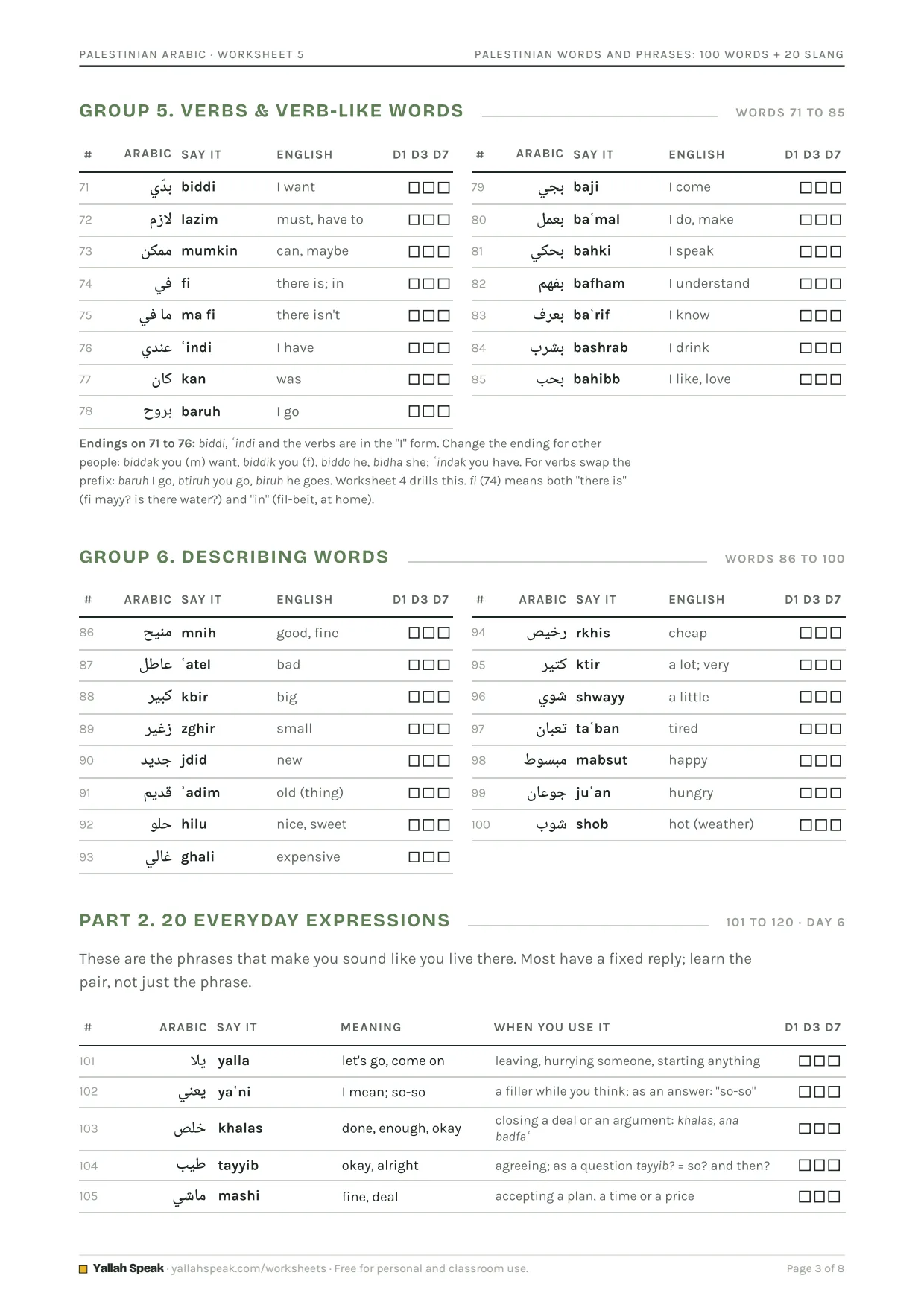
The other sixty words (family, places, food, the verbs you need first and the adjectives) are in the PDF in the same layout, with three tick boxes next to every word for the 7-day plan.
Palestinian phrases, expressions and slang you hear every day
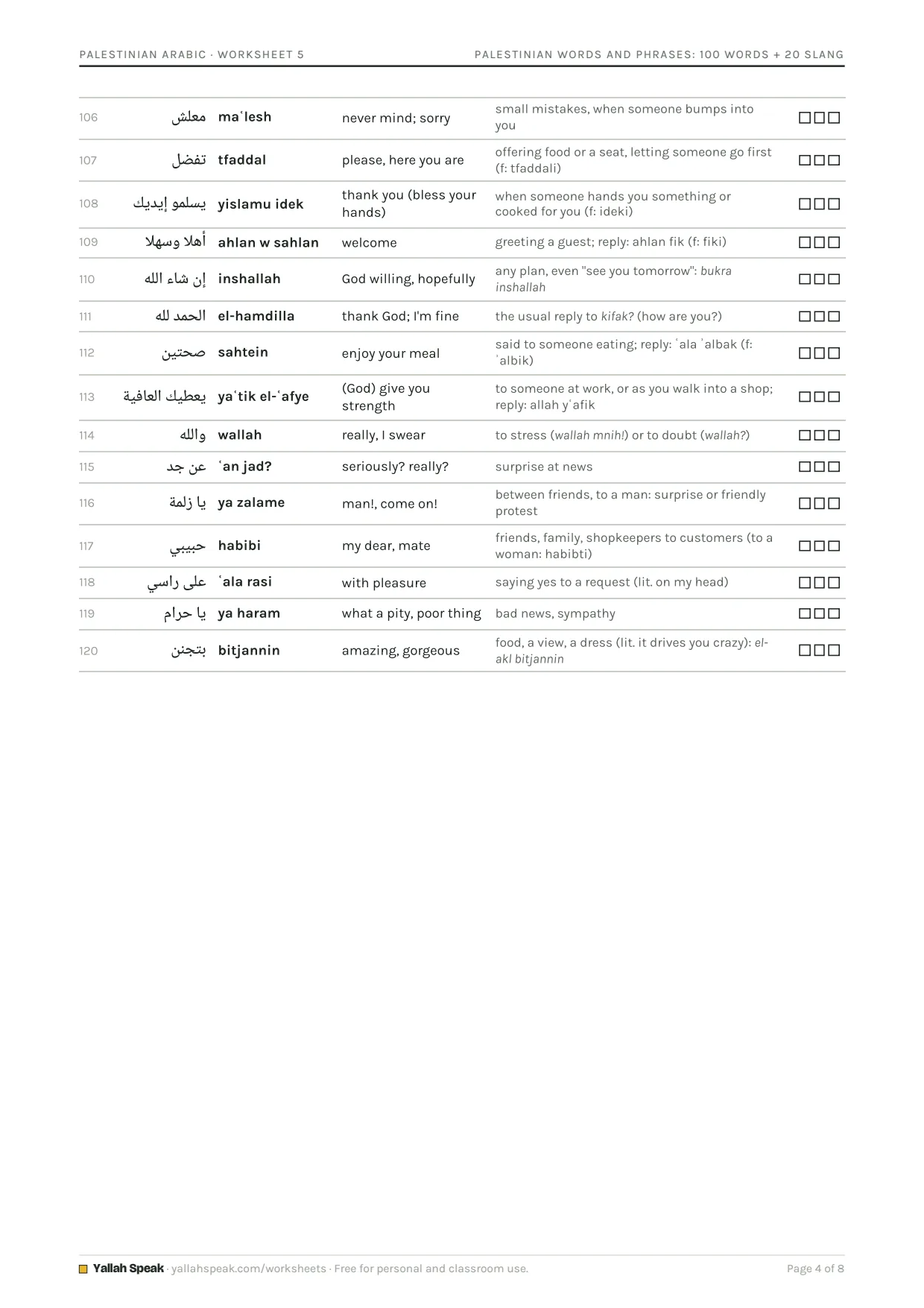
Words get you understood; expressions make you sound like you belong. These twenty come up constantly in Palestinian conversation. Many of them have a fixed reply, and using the reply is what really impresses people: say sahtein to someone eating and they answer ʿala ʾalbak; say yaʿtik el-ʿafye to a shopkeeper and you will hear allah yʿafik.
Arabic
Say it
Meaning
When you use it
يلا
yalla
let's go, come on
leaving, hurrying someone, starting anything
يعني
yaʿni
I mean; so-so
a filler while you think
خلص
khalas
done, enough, okay
closing a deal or an argument
طيب
tayyib
okay, alright
agreeing; as a question: so?
ماشي
mashi
fine, deal
accepting a plan, a time or a price
معلش
maʿlesh
never mind; sorry
small mistakes and bumps
تفضل
tfaddal (f: tfaddali)
please, here you are
offering food or a seat
يسلمو إيديك
yislamu idek
thank you (bless your hands)
someone hands you something or cooked for you
أهلا وسهلا
ahlan w sahlan
welcome
greeting a guest; reply: ahlan fik
إن شاء الله
inshallah
God willing, hopefully
any plan for the future
الحمد لله
el-hamdilla
thank God; I'm fine
the usual answer to kifak?
صحتين
sahtein
enjoy your meal
to someone eating; reply: ʿala ʾalbak
يعطيك العافية
yaʿtik el-ʿafye
(God) give you strength
to anyone at work; reply: allah yʿafik
والله
wallah
really, I swear
to stress or to doubt
عن جد
ʿan jad?
seriously? really?
surprise at news
يا زلمة
ya zalame
man!, come on!
between friends, to a man
حبيبي
habibi (f: habibti)
my dear, mate
friends, family, shopkeepers
على راسي
ʿala rasi
with pleasure
saying yes to a request
يا حرام
ya haram
what a pity, poor thing
bad news, sympathy
بتجنن
bitjannin
amazing, gorgeous
food, a view, a dress
How is Palestinian different from Standard Arabic and other dialects?
Compared with Modern Standard Arabic, a good share of the everyday words change: "what" is madha in MSA and shu in Palestinian, "now" is al-an versus hallaʾ, "I want" is uridu versus biddi, "there isn't" is la yujad versus ma fi. The sounds shift too: in Jerusalem the letter ق becomes a glottal stop (ʾahwe, coffee), and many words end in -e (madrase, school). Villagers often say k for ق and ch for k, and in the south you hear g. Within the Levant, Palestinian is closest to Jordanian city speech and very close to Lebanese and Syrian: you will meet small differences like biddi versus Lebanese baddi, hada versus hayda, and a hard English j in Palestine where Beirut and Damascus soften it. Egyptian is further away (eh for "what", ʿayiz for "want"), but these 120 words will carry you through most conversations anywhere in the Levant.
How the 7-day plan on the sheet works
About 20 minutes a day. Days 1 to 5 take the 100 words in blocks of 15 to 25, with built-in reviews on day 3 and day 5. Day 6 is the 20 expressions, each learned together with its reply. Day 7 is the whole list plus the sentence page: 15 sentences built only from the list, to read aloud and translate. Every word has three tick boxes, D1, D3 and D7: cover the pronunciation and English, say the word, then tick. To turn the words into sentences, use worksheet 4 on verbs; if you are just starting, begin with worksheet 1 on greetings. For more vocabulary across dialects see common Arabic words and Arabic greetings and responses, or compare all three dialects on the Levantine Arabic worksheets page.
What's inside the PDF
100 numbered words in six groups: little words and pronouns, questions and time, people and places, food and drink, verbs, describing words. Arabic script, Palestinian pronunciation and English side by side
20 everyday expressions and slang (yalla, khalas, tfaddal, yislamu idek, yaʿtik el-ʿafye, ya zalame, bitjannin …) with when to use them and the fixed replies
A 7-day plan (about 20 minutes a day) with tick boxes and two built-in review days, plus three tick boxes per word for spaced repetition
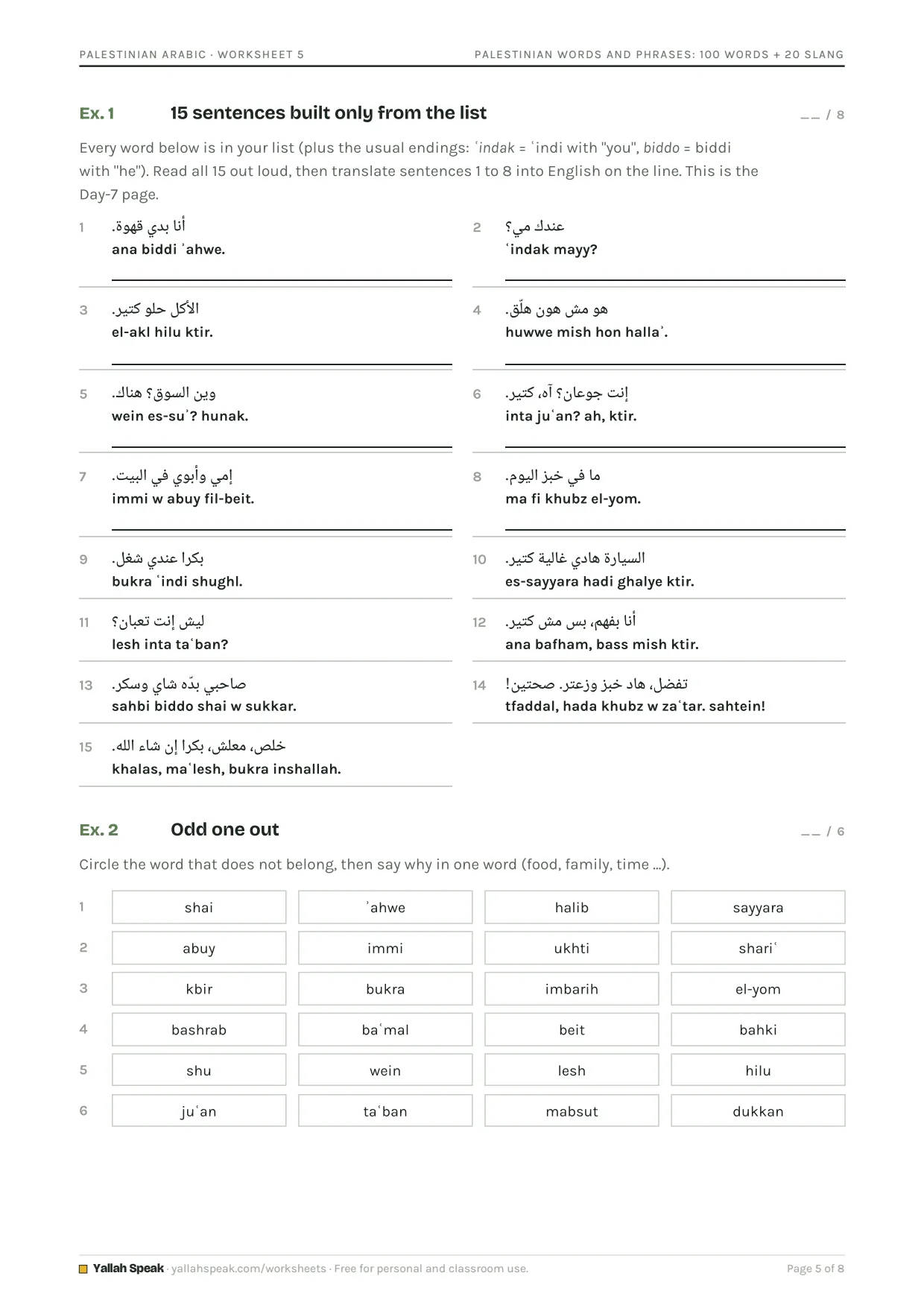
15 sentences built only from words in the list, with Arabic script, to read aloud and translate
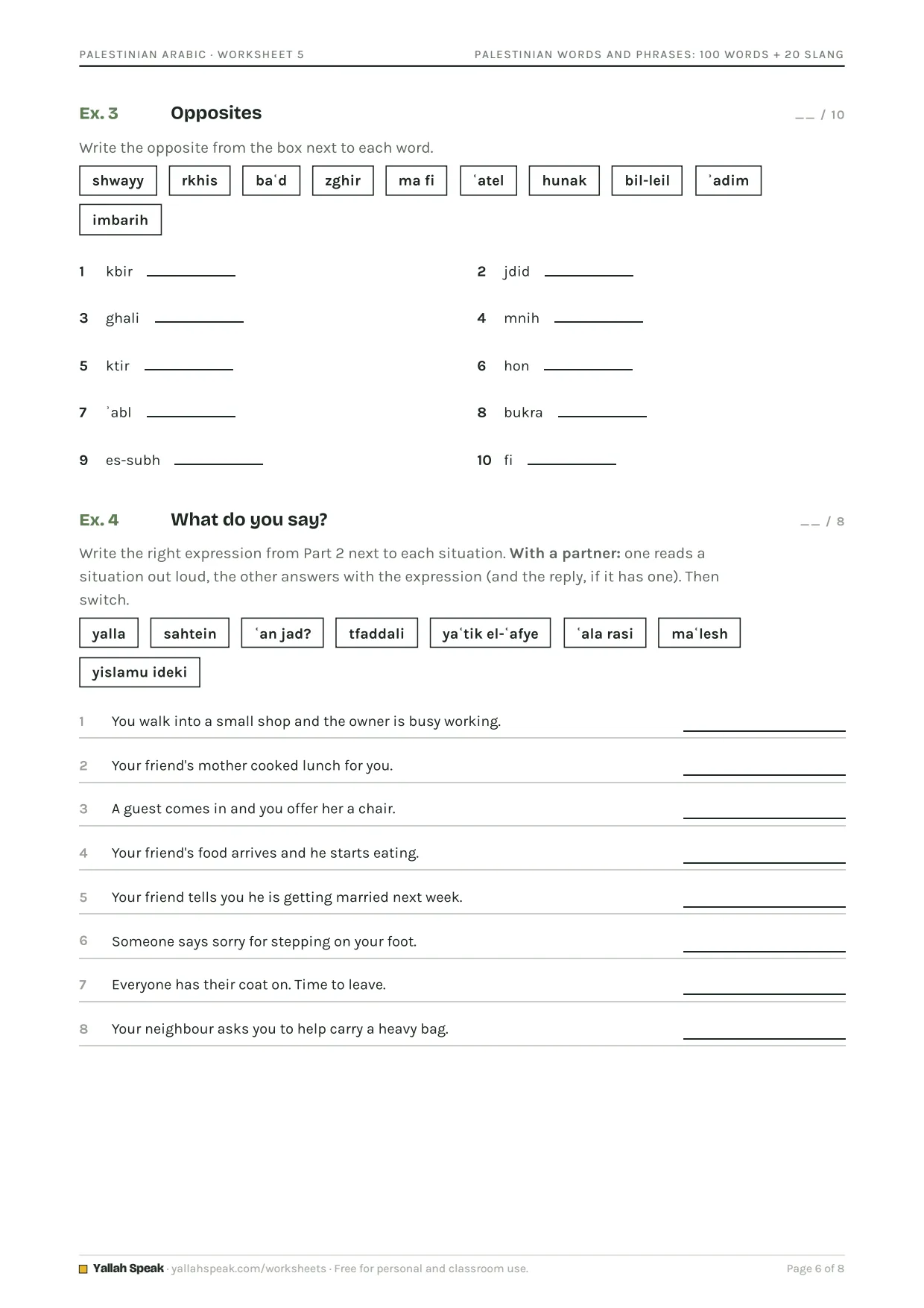
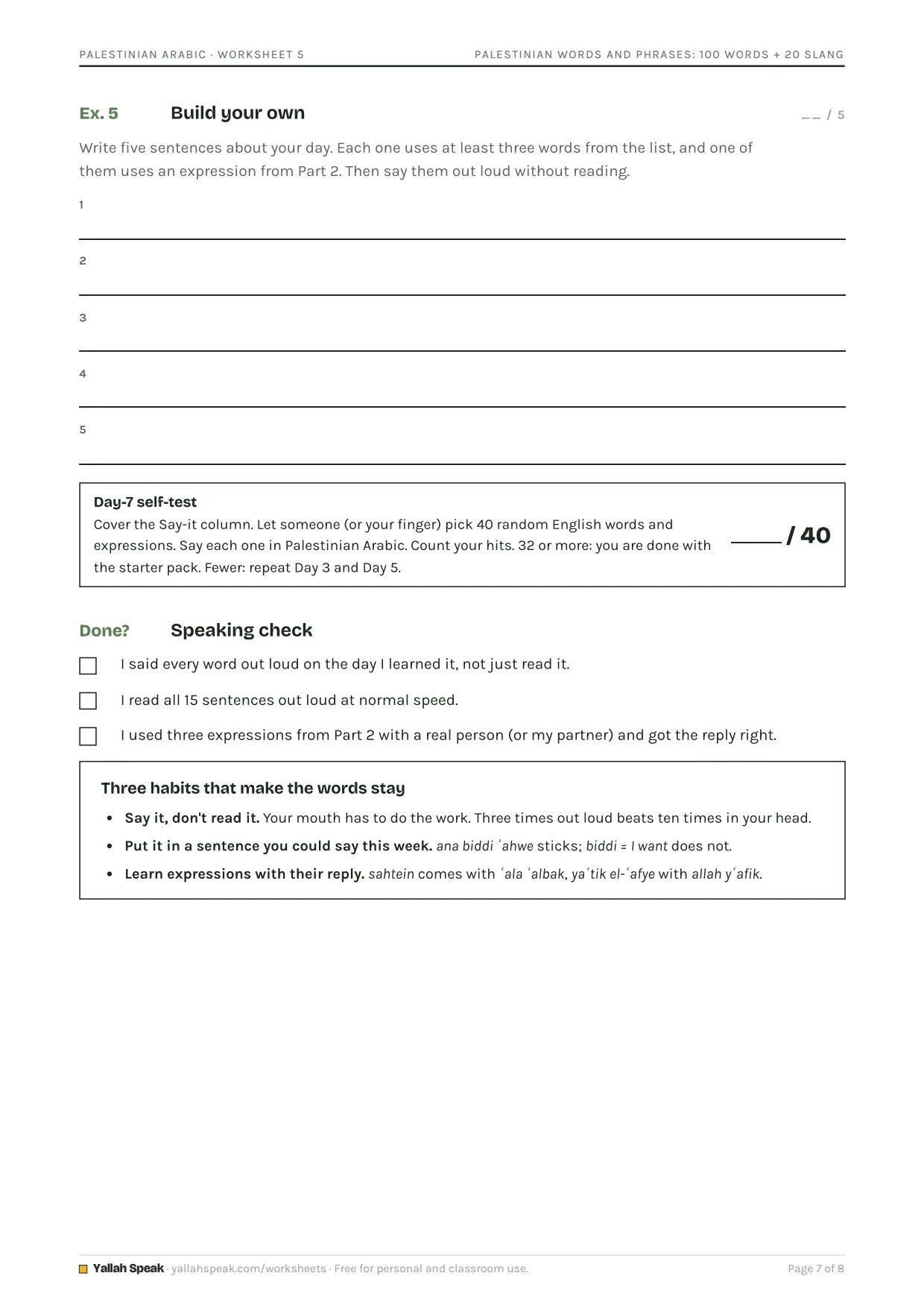
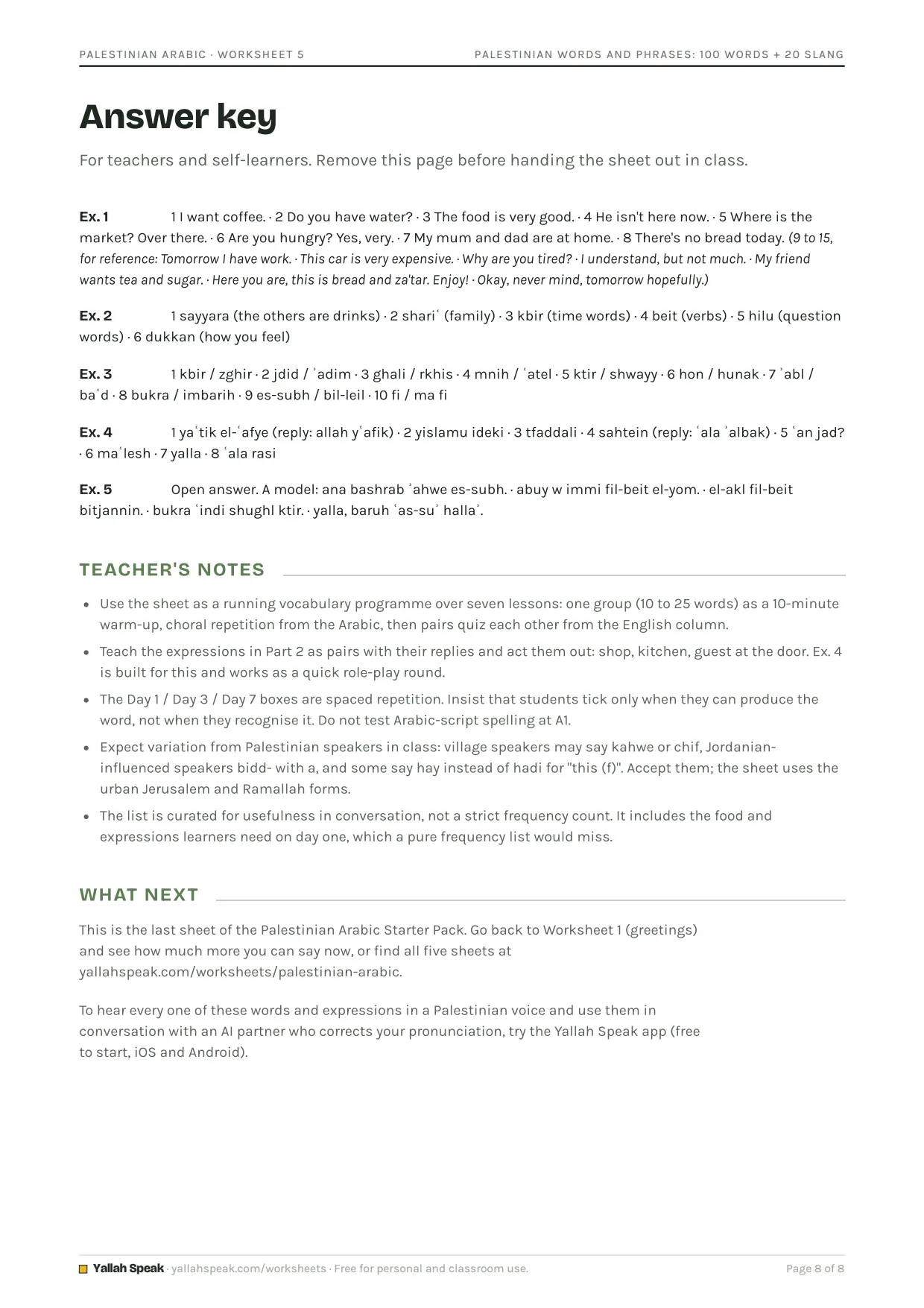
Exercises: opposites, odd one out, "what do you say?" situations for pair work, build your own sentences, a Day-7 self-test out of 40
A Jerusalem pronunciation box with the village and southern variants, and an answer key with teacher notes on a separate page
How to use it on your own
Follow the plan on page 1: about 20 words a day, each said out loud three times and put into one sentence you could use this week. Day 6 is the 20 expressions; learn each with its reply. On Day 7 read the 15 sentences and do the 40-word self-test; 32 hits or more means the starter pack is done.
How to use it in class
Works as a running vocabulary programme over seven lessons: one group as a 10-minute warm-up with choral repetition, then pairs quiz each other from the English column. Part 2 (expressions) is best taught as role-play: shop, kitchen, guest at the door. Ex. 4 turns that into a pair exercise with eight situations. The sentence page (Ex. 1) is the test: reading all 15 fluently and translating eight shows the core vocabulary is in place. Answer key and teacher notes on the last page.
Worksheets teach you the words. Someone still has to answer back. Practise this exact dialogue with an AI partner who speaks Palestinian Arabic, stays in character and shows you word by word where your pronunciation slips. Try Yallah Speak free
Preview
Page 1 is above. Here are the other pages; click one to open it full size.
Frequently asked questions
What are the most common Palestinian Arabic words?
The top of the list is small everyday words: ana (I), inta / inti (you), shu (what), wein (where), lesh (why), hallaʾ (now), bukra (tomorrow), biddi (I want), fi (there is), mish (not), mnih (good), ktir (a lot, very), shwayy (a little). Most of them differ from Standard Arabic, which is why a dialect list is worth learning separately. The first 40 are on this page.
What are common Palestinian slang words and expressions?
The ones you hear every day are yalla (let's go), khalas (done, enough), yaʿni (I mean), wallah (really), ʿan jad? (seriously?), ya zalame (man!, between friends), habibi (mate, dear) and bitjannin (amazing). Politeness phrases matter just as much: tfaddal (here you are), yislamu idek (thank you, lit. bless your hands), sahtein (enjoy your meal) and yaʿtik el-ʿafye, said to anyone who is working.
How do you say "I want" in Palestinian Arabic?
biddi, as in biddi ʾahwe, I want coffee. It changes its ending for other people: biddak (you, m), biddik (you, f), biddo (he), bidha (she). After biddi a verb loses its b-: biddi ashrab, I want to drink. In Lebanon you will hear baddi with a.
Is Palestinian Arabic the same as Jordanian or Lebanese?
They are close relatives in the Levantine family and speakers understand each other easily. Urban Palestinian and Jordanian city speech are nearly the same. Differences with Lebanese are mostly small words and sounds: biddi vs baddi, hada vs hayda, and a hard j in Palestine where Beirut has the s of "pleasure". Most words on this sheet are understood across the whole Levant.
Is this word list free?
Yes. Download the PDF, print it and copy it as often as you like for personal use and in class. Please keep the Yallah Speak credit in the footer.
Stop studying Arabic. Start speaking it.
AI conversations in 10 real dialects, honest pronunciation feedback and a course from A1.