After this sheet you can put the 25 most useful Palestinian verbs into past, present and future, say what you did yesterday and what you will do tomorrow, and say no the Palestinian way.
No sign-up. Print and copy for personal and classroom use. Please keep the credit in the footer.
By Fouad El Ajouaoui, founder of Yallah Speak · · Free worksheet, no sign-up
Quick answer Palestinian Arabic verbs have three tenses on one set of endings: the past (shribt, shirib, shirbat… "drank"), the present with the prefix b- (بشرب bashrab, bishrab, btishrab… "drinks") and the future with rah (rah ashrab, "I will drink"). To say no, put ma before the verb: ما بعرف ma baʿrif, "I don't know". The full chart and the 25 most useful verbs are below; the PDF adds grids to complete and exercises.
How do you conjugate Palestinian Arabic verbs?
Palestinian Arabic has three tenses you need at the start, and all three use the same eight persons. The past adds endings to the stem; the present puts b- in front (ba- for "I"); the future drops the b- and puts rah before the verb. Learn one verb all the way through and you have the pattern. Here is shirib, to drink, as it is said in Jerusalem and Ramallah:
Person
Past
Present (b-)
Future (rah)
Arabic (present)
ana · I
shribt
bashrab
rah ashrab
بشرب
inta · you (m)
shribt
btishrab
rah tishrab
بتشرب
inti · you (f)
shribti
btishrabi
rah tishrabi
بتشربي
huwwe · he
shirib
bishrab
rah yishrab
بيشرب
hiyye · she
shirbat
btishrab
rah tishrab
بتشرب
ihna · we
shribna
binishrab
rah nishrab
بنشرب
intu · you (pl)
shribtu
btishrabu
rah tishrabu
بتشربوا
humme · they
shirbu
bishrabu
rah yishrabu
بيشربوا
Two things to notice. "I" and "you (m)" sound the same in the past (shribt), and "you (m)" and "she" sound the same in the present (btishrab); context does the rest. And the short i of shirib drops as soon as an ending is added, which is why you hear shribt and shirbat rather than shiribt. Palestinian has one plural "you", intu, for any group.
The 25 most useful Palestinian verbs
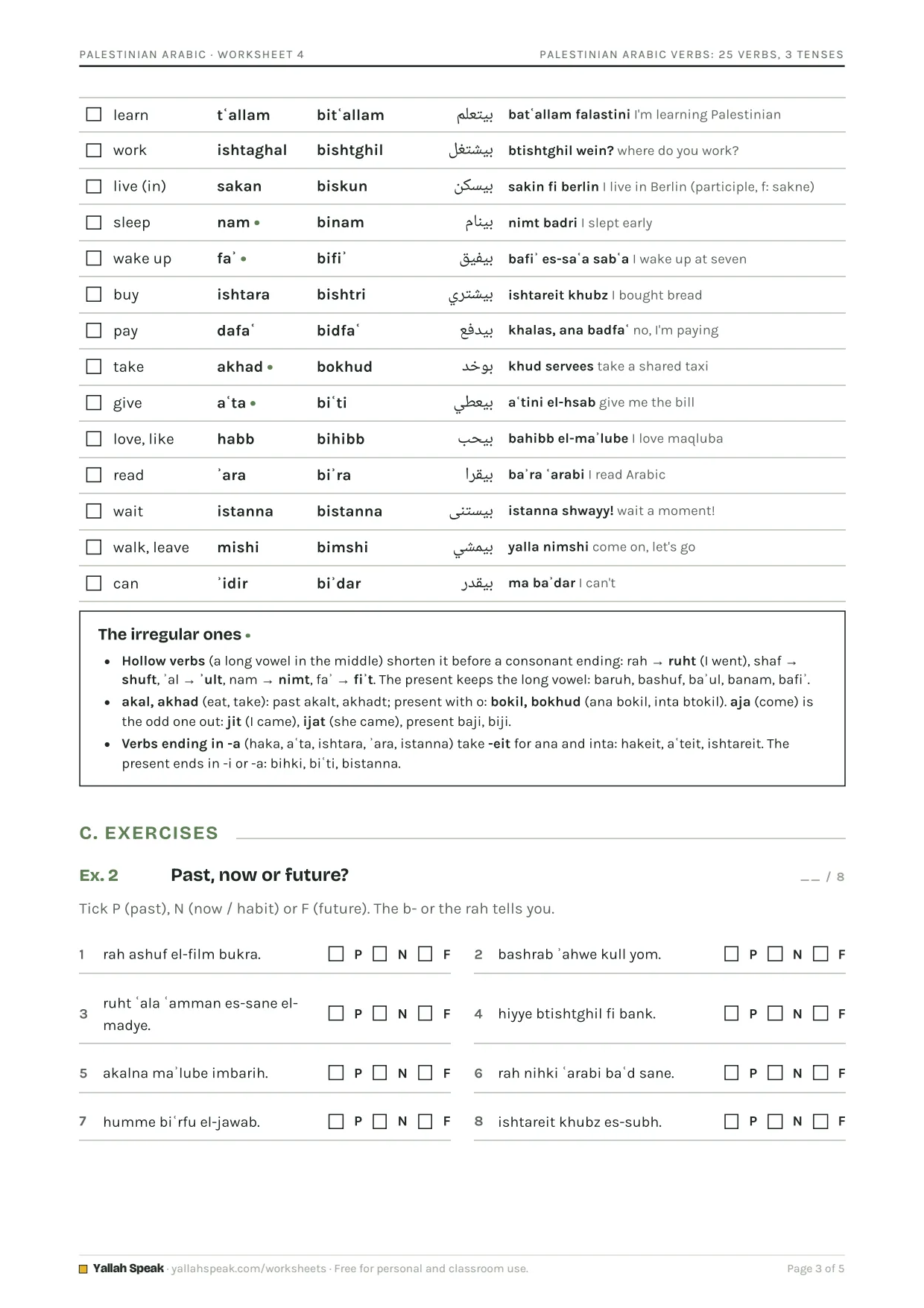
These are the verbs the worksheet drills, picked for how often they come up in everyday speech: at home, in the café, in a shared taxi. The chart gives the he-form, because that is how dictionaries list verbs and the other persons are built from it. Verbs marked with a dot are irregular in the past; the PDF explains each group.
English
Past (he)
Present (he)
Arabic
go
rah •
biruh
بيروح
come
aja •
biji
بيجي
do, make
ʿimil
biʿmal
بيعمل
eat
akal •
bokil
بوكل
drink
shirib
bishrab
بيشرب
know
ʿirif
biʿrif
بيعرف
want
kan biddo
biddo (no b-; I want = biddi)
بدّه
say
ʾal •
biʾul
بيقول
see
shaf •
bishuf
بيشوف
speak, talk
haka •
bihki
بيحكي
understand
fihim
bifham
بيفهم
learn
tʿallam
bitʿallam
بيتعلم
work
ishtaghal
bishtghil
بيشتغل
live (in a place)
sakan
biskun
بيسكن
sleep
nam •
binam
بينام
wake up
faʾ •
bifiʾ
بيفيق
buy
ishtara
bishtri
بيشتري
pay
dafaʿ
bidfaʿ
بيدفع
take
akhad •
bokhud
بوخد
give
aʿta •
biʿti
بيعطي
love, like
habb
bihibb
بيحب
read
ʾara
biʾra
بيقرا
wait
istanna
bistanna
بيستنى
walk, leave
mishi
bimshi
بيمشي
can, be able
ʾidir
biʾdar
بيقدر
How do you say no with a verb in Palestinian Arabic?
Put ma in front of the verb: ma baʿrif, I don't know; ma baʾdar, I can't; ma shuft, I didn't see. In fast speech you will often hear an extra -sh at the end (ma bashrabsh, biddish), but ma alone is always correct. Words that are not verbs take mish: mish fahim, I don't understand; mish hon, not here. The future is negated with mish too: mish rah aruh, I won't go.
How are Palestinian verbs different from Standard Arabic, Lebanese and Egyptian?
Compared with Modern Standard Arabic, three things change. MSA has no b- prefix: the plain form yashrabu survives in Palestinian only after another verb or after biddi (biddi ashrab, I want to drink). MSA marks the future with sa- or sawfa, Palestinian with rah. And the dual and feminine plural forms of MSA are not used, so the table has eight forms instead of thirteen. Within the Levant the differences are small but easy to hear: Palestinians say binishrab (we drink) where Beirut and Damascus say mnishrab, the past "she" ends in -at (shirbat) instead of -it, and "want" is biddi rather than Lebanese baddi. Egyptian uses the same b- for the present but ha- for the future and wraps negation in ma… sh.
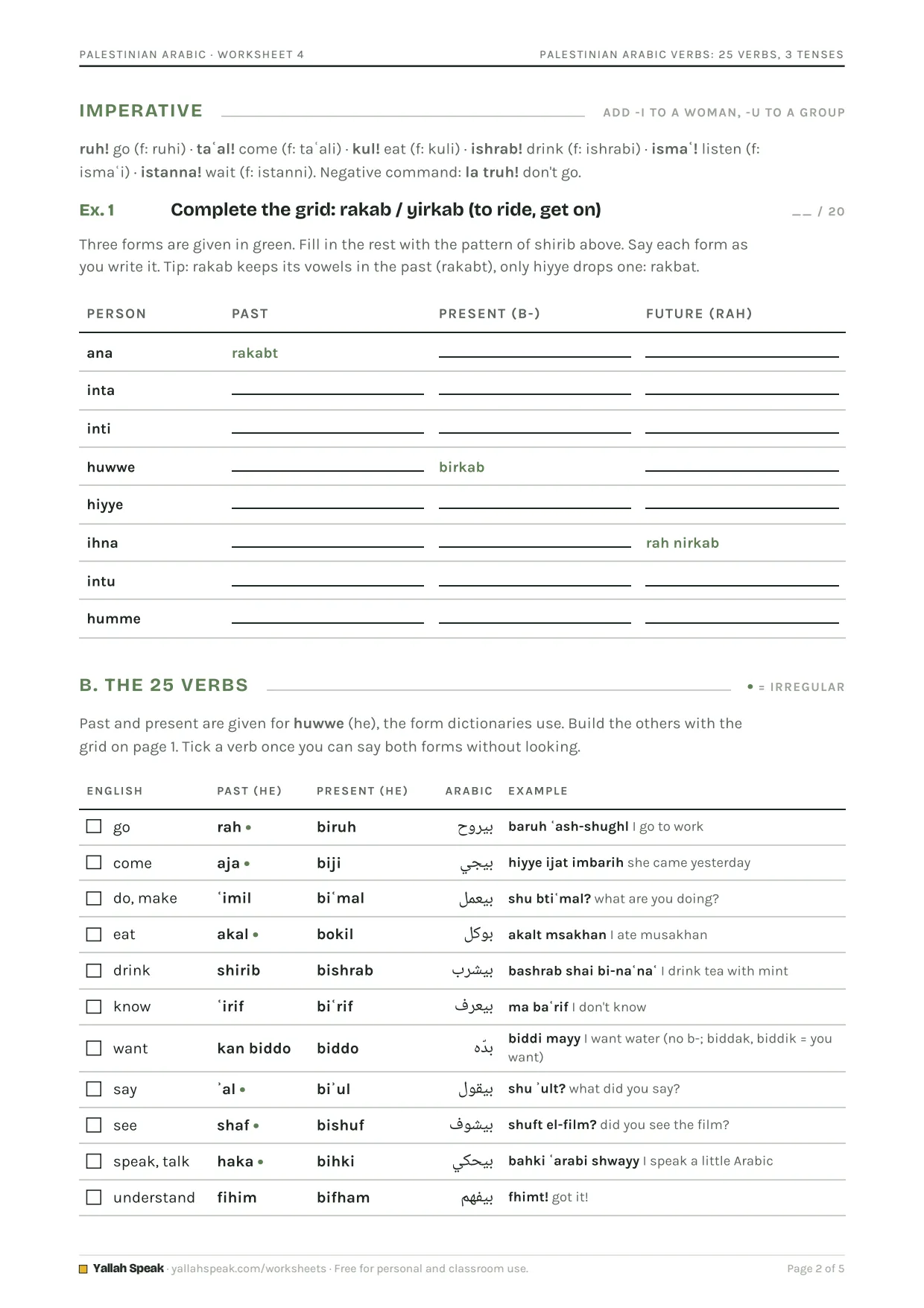
The PDF has the full chart, a second grid to complete (rakab, to ride), the 25 verbs with example sentences, exercises on b-, rah and negation, and a "my day" pair interview. The pronouns you need for the chart are on worksheet 3; the core words and everyday expressions are on worksheet 5. To compare the three Levantine dialects, see the Levantine Arabic worksheets or read Egyptian Arabic vs Levantine Arabic.
What's inside the PDF
One full conjugation grid (shirib, to drink) in past, present with b- and future with rah, for all eight persons, with Arabic script
Three short rules: when b- is dropped (after biddi, lazim, mumkin), how rah makes the future, and the two ways to negate (ma before verbs, mish before everything else)
The 25 verbs table: past and present, Arabic script, a short example each, 10 irregular verbs marked and explained
A Jerusalem pronunciation box: ق as a glottal stop, j as in "jam", binishrab instead of mnishrab, plus the village and southern variants you will hear
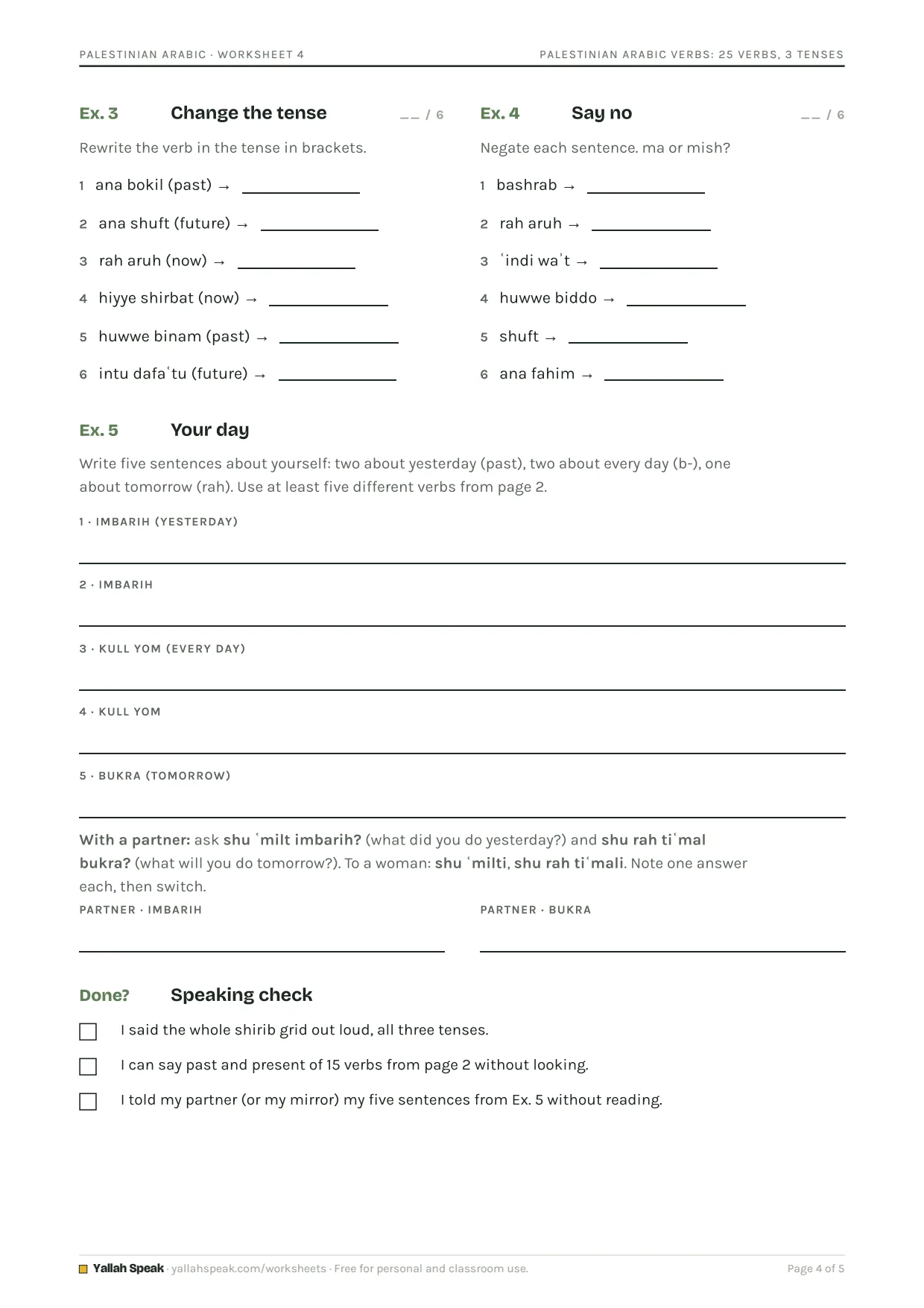
Five exercises: complete a grid, past-now-future, change the tense, say no, write and tell your day with a partner
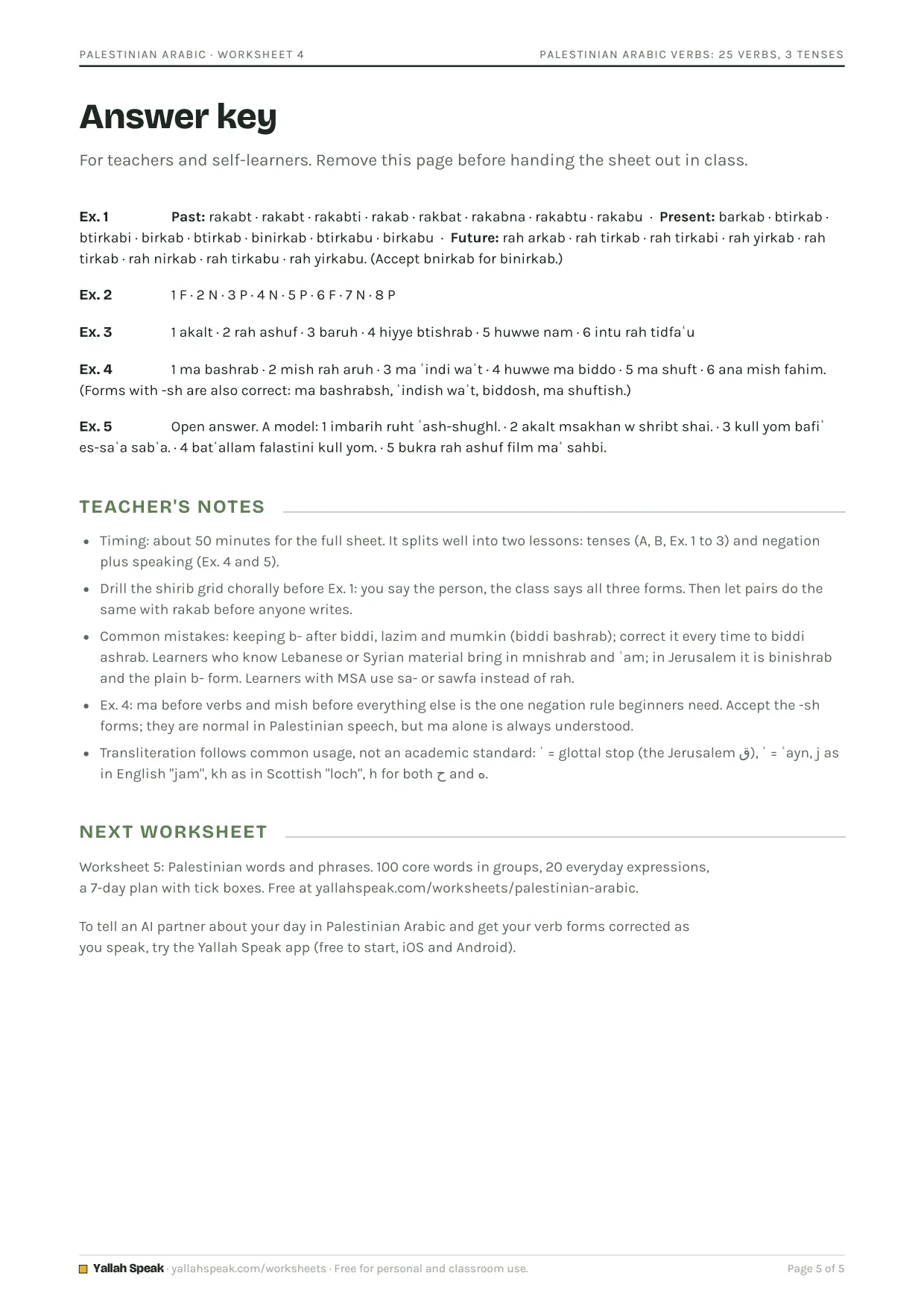
Answer key and teacher notes on a separate page you can remove before handing out
How to use it on your own
Say the shirib grid out loud until b- and rah come without thinking, then do Ex. 1 without looking back at page 1. Work through the 25 verbs five at a time and tick a verb only when you can say both forms. Finish with Ex. 5: write your five sentences, then say them to a mirror or record yourself and listen once.
How to use it in class
About 50 minutes, or two shorter lessons: tenses (A, B, Ex. 1 to 3) and negation plus speaking (Ex. 4 and 5). Drill the shirib grid chorally before anyone writes, then let pairs conjugate rakab aloud. Watch for b- after biddi and lazim, and for Lebanese or Syrian forms (mnishrab, ʿam) creeping in. Ex. 5 ends in a pair interview (shu ʿmilt imbarih? shu rah tiʿmal bukra?) that forces real tense choices. Points fields on every exercise, answer key on the last page.
Worksheets teach you the words. Someone still has to answer back. Practise this exact dialogue with an AI partner who speaks Palestinian Arabic, stays in character and shows you word by word where your pronunciation slips. Try Yallah Speak free
Preview
Page 1 is above. Here are the other pages; click one to open it full size.
Frequently asked questions
How do you conjugate verbs in Palestinian Arabic?
Take the past stem and add the person endings (shribt, shribt, shribti, shirib, shirbat, shribna, shribtu, shirbu). For the present, put b- in front of the present stem with its person prefix (bashrab, btishrab, btishrabi, bishrab, btishrab, binishrab, btishrabu, bishrabu). For the future, drop b- and put rah in front: rah ashrab, rah tishrab. The chart on this page shows all eight persons.
What does the b- prefix mean in Palestinian Arabic?
b- marks the present: habits and things happening now. bashrab shai means I drink tea or I am drinking tea. Without b- the verb is the plain form you use after biddi (I want), lazim (must) and mumkin (can): biddi ashrab shai, I want to drink tea. Standard Arabic has no b- at all, so learners coming from MSA have to get used to it.
How do you say "I will" in Palestinian Arabic?
Put rah before the verb without b-: rah aruh (I will go), rah ashrab (I will drink), rah adfaʿ (I will pay). The negative is mish rah: mish rah aruh, I won't go. Standard Arabic uses sa- or sawfa, and Egyptian uses ha-, so rah is one of the first things that marks you as speaking Levantine.
How are Palestinian verbs different from Lebanese and Syrian verbs?
The system is the same, but a few forms differ. Palestinians say binishrab (we drink) where Beirut and Damascus say mnishrab, and the past "she" ends in -at (shirbat) instead of -it. The progressive ʿam (ʿam bishrab) is typical of Lebanon and Syria; in Jerusalem the plain b- form covers "right now". "Want" is biddi in Palestine and baddi in Lebanon.
Is this worksheet free?
Yes. Download the PDF, print it and copy it as often as you like for personal use and in class. Please keep the Yallah Speak credit in the footer.
Stop studying Arabic. Start speaking it.
AI conversations in 10 real dialects, honest pronunciation feedback and a course from A1.