After this sheet you can say who you are talking about, say what is yours and what you have, and ask the basic questions in Palestinian Arabic without a phrasebook.
No sign-up. Print and copy for personal and classroom use. Please keep the credit in the footer.
By Fouad El Ajouaoui, founder of Yallah Speak · · Free worksheet, no sign-up
Quick answer Palestinian Arabic has eight personal pronouns: ana (I), inta / inti (you m/f), huwwe (he), hiyye (she), ihna (we), intu (you pl.), humme (they). "I have" is ʿindi (عندي), literally "at me". The question words are shu (what), wein (where), emta (when), leish (why), min (who), kif (how) and kam / ʾaddeish (how many / how much), and they usually come at the start of the question: shu ismak?
What are the personal pronouns in Palestinian Arabic?
Eight pronouns cover everything. Palestinian Arabic has a "you" for a man and a "you" for a woman, but no dual and no feminine plural: intu and humme work for every group. Standard Arabic has thirteen pronouns; in Jerusalem and Ramallah you will only need these eight.
English
Palestinian Arabic
Arabic
"I have …" (ʿind + ending)
I
ana
أنا
ʿindiعندي
you (m)
inta
إنت
ʿindakعندك
you (f)
inti
إنتي
ʿindikعندك
he
huwwe
هو
ʿindoعنده
she
hiyye
هي
ʿindhaعندها
we
ihna
إحنا
ʿinnaعنا
you (plural)
intu
إنتو
ʿindkumعندكم
they
humme
هم
ʿindhumعندهم
How do you say "I have" in Palestinian Arabic?
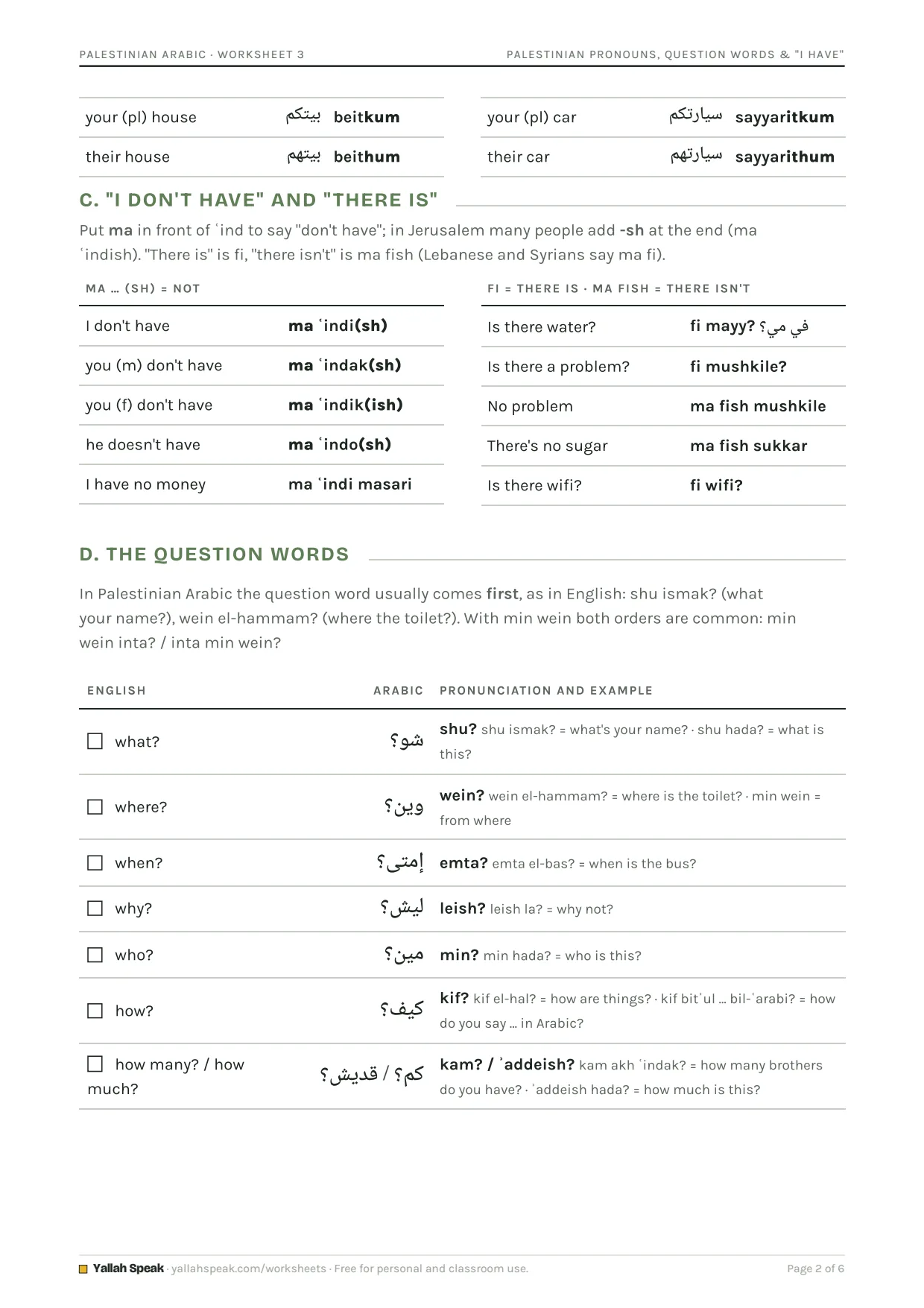
Arabic has no verb "to have". You say "at me": ʿindi does the job of "I have". ʿindi sayyara, I have a car; ʿindak waʾt?, do you have time? The same endings turn any noun into "my, your, his": beiti (my house), beitak (your house, to a man), beitik (to a woman), beito (his), beitha (her), beitna (our), beitkum (your, plural), beithum (their). Feminine nouns ending in -a change to -t: sayyarti, my car. The negative puts ma in front, and in Jerusalem often -sh at the end: ma ʿindi masari or ma ʿindish masari, I have no money.
For "there is" you need fi, and for "there isn't" ma fish: fi mayy? is there water? ma fish mushkile, no problem. Lebanese and Syrian speakers say ma fi; both are understood everywhere.
What are the question words in Palestinian Arabic?
The question words usually go at the start, as in English: shu ismak?, what's your name? This is one of the quickest ways to hear the difference from Egyptian, where the question word goes last (ismak eh?). They also differ sharply from Standard Arabic (ma, ayna, mata, limadha), so MSA learners should relearn this table.
English
Palestinian Arabic
Arabic
Example
what?
shu?
شو؟
shu ismak? · what's your name?
where?
wein? (from where: min wein?)
وين؟
wein el-hammam? · where is the toilet?
when?
emta?
إمتى؟
emta el-bas? · when is the bus?
why?
leish?
ليش؟
leish la? · why not?
who?
min?
مين؟
min hada? · who is this?
how?
kif?
كيف؟
kif el-hal? · how are things?
how many? / how much?
kam? / ʾaddeish?
كم؟ / قديش؟
ʾaddeish hada? · how much is this?
How is this different in other dialects?
The Levantine dialects share almost all of this. Small markers: Palestinians say hada (this) where Beirut says hayda, ma fish where Lebanese and Syrians say ma fi, and villagers may use eish for shu and kaddeish for ʾaddeish. Yes/no questions need no question word at all: raise your voice at the end. inta min hon? are you from here? fi wifi? is there wifi?
The worksheet turns all of this into a partner interview where students ask each other name, origin, siblings and possessions, then report back in the third person. Start with the greetings sheet if you need the phrases that come before these questions, and continue with Palestinian Arabic verbs to put actions after your pronouns. For more on learning through real conversations, read learn Arabic through conversation; the other Levantine dialects are on the Levantine Arabic page.
What's inside the PDF
The eight personal pronouns (ana, inta, inti, huwwe, hiyye, ihna, intu, humme) with Arabic script and example sentences
Possessive endings on a masculine and a feminine noun (beiti, beitak, beitik … / sayyarti, sayyartak, sayyaritha …), with the -a to -t rule
"I have" with ʿindi and its negation ma ʿindi(sh), plus fi / ma fish for "there is" and "there isn't"
The 7 question words (shu, wein, emta, leish, min, kif, kam / ʾaddeish) with natural example questions and a note on word order
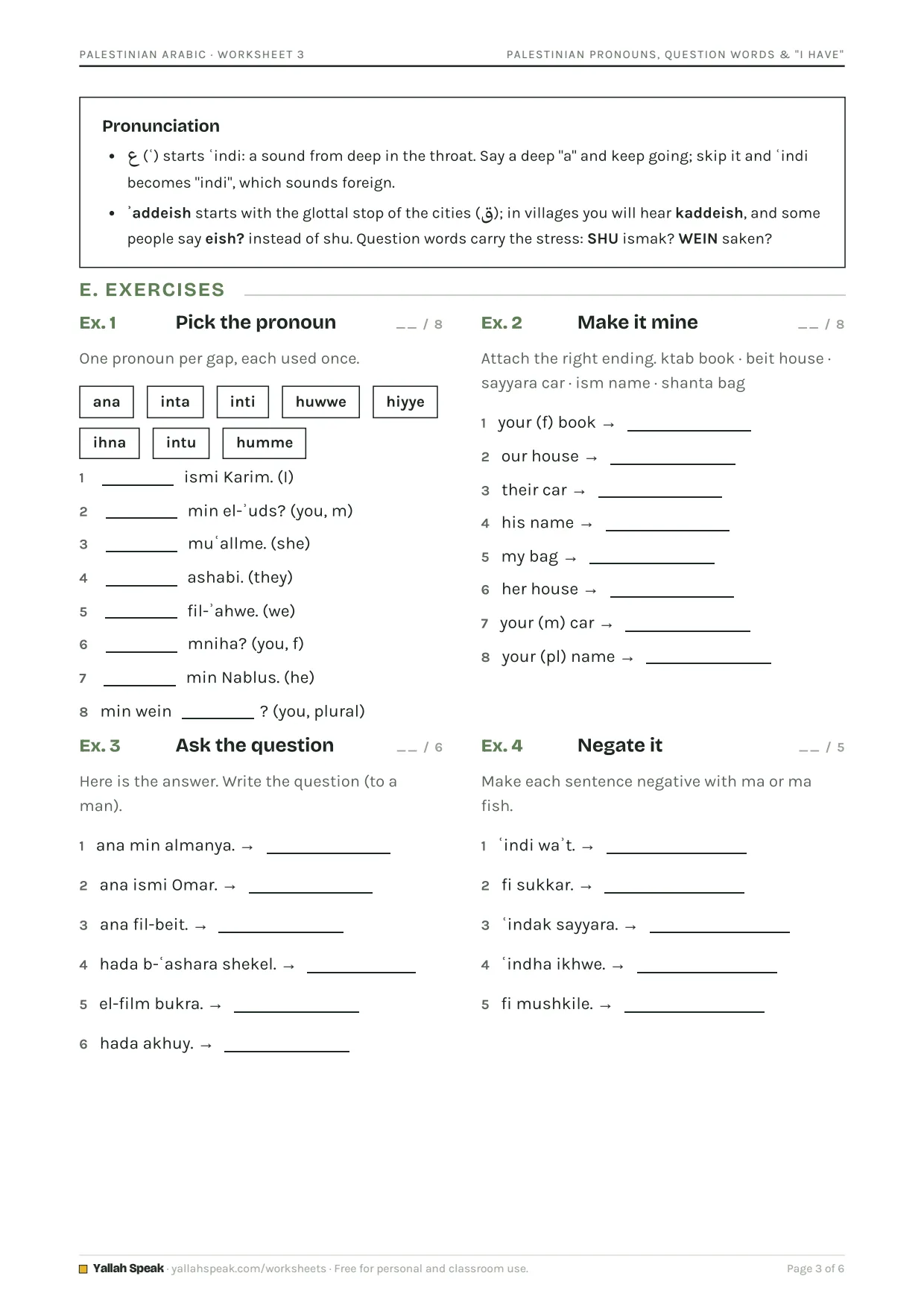
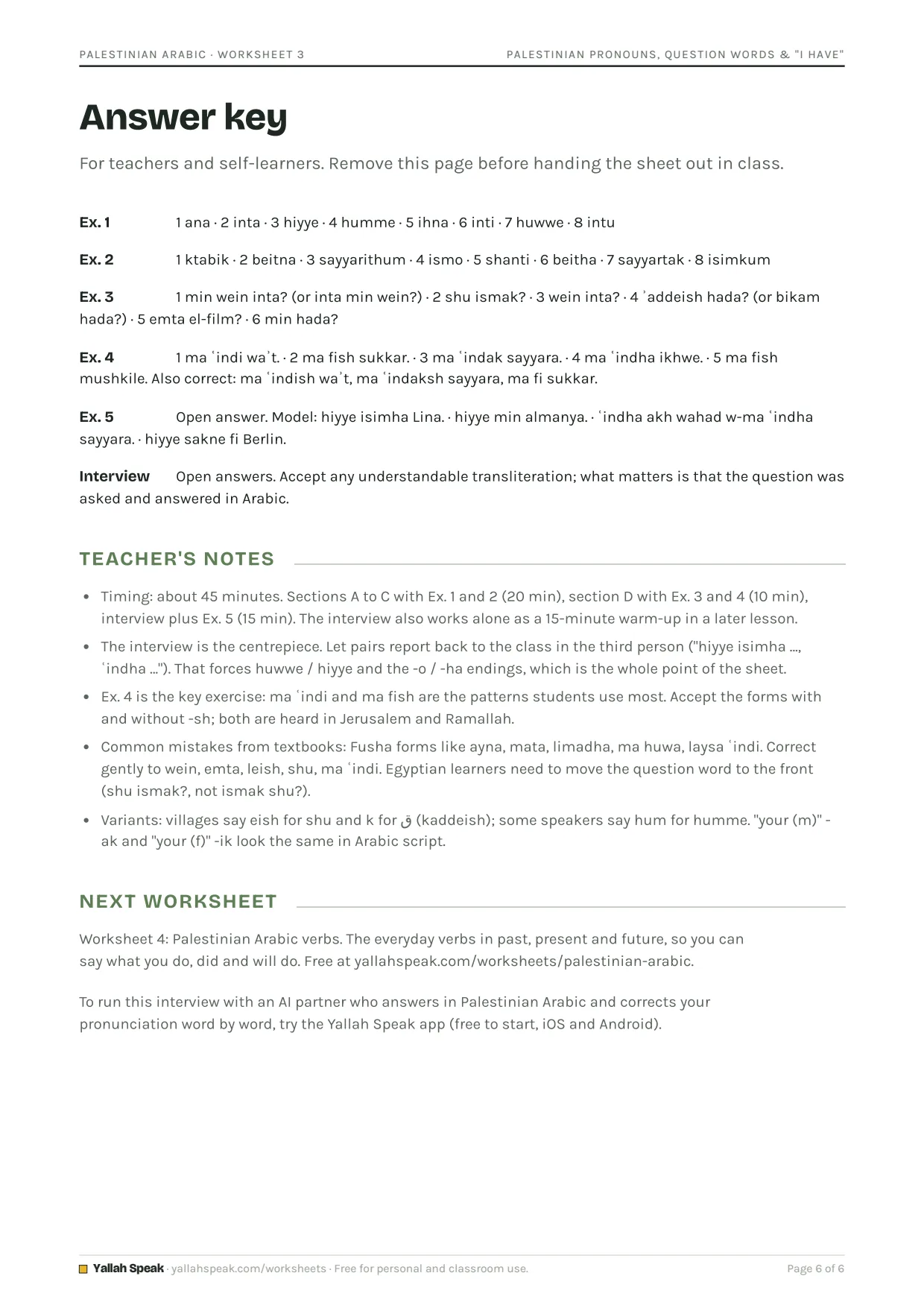
Four exercises with points: pick the pronoun, attach the ending, build the question, negate the sentence
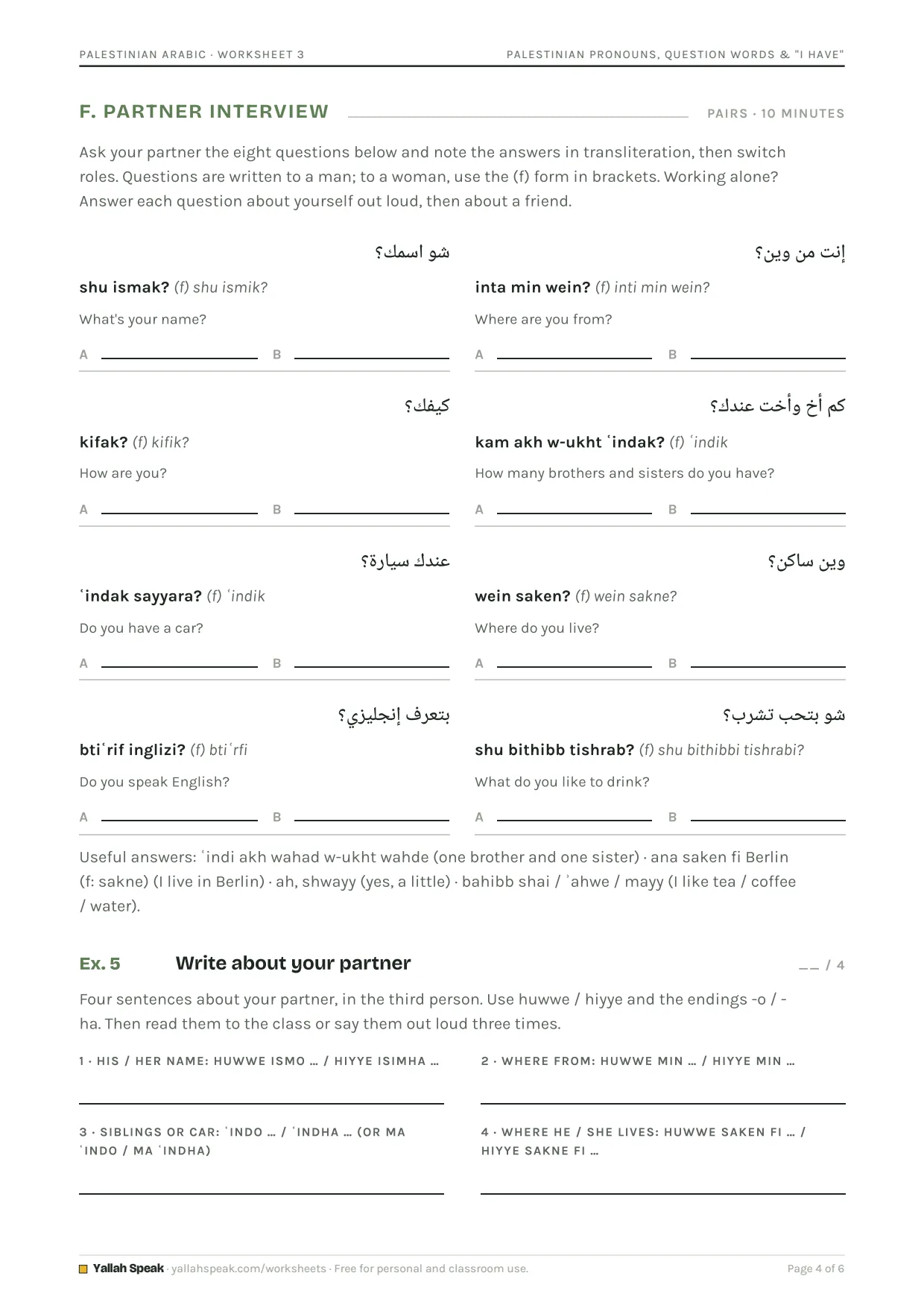
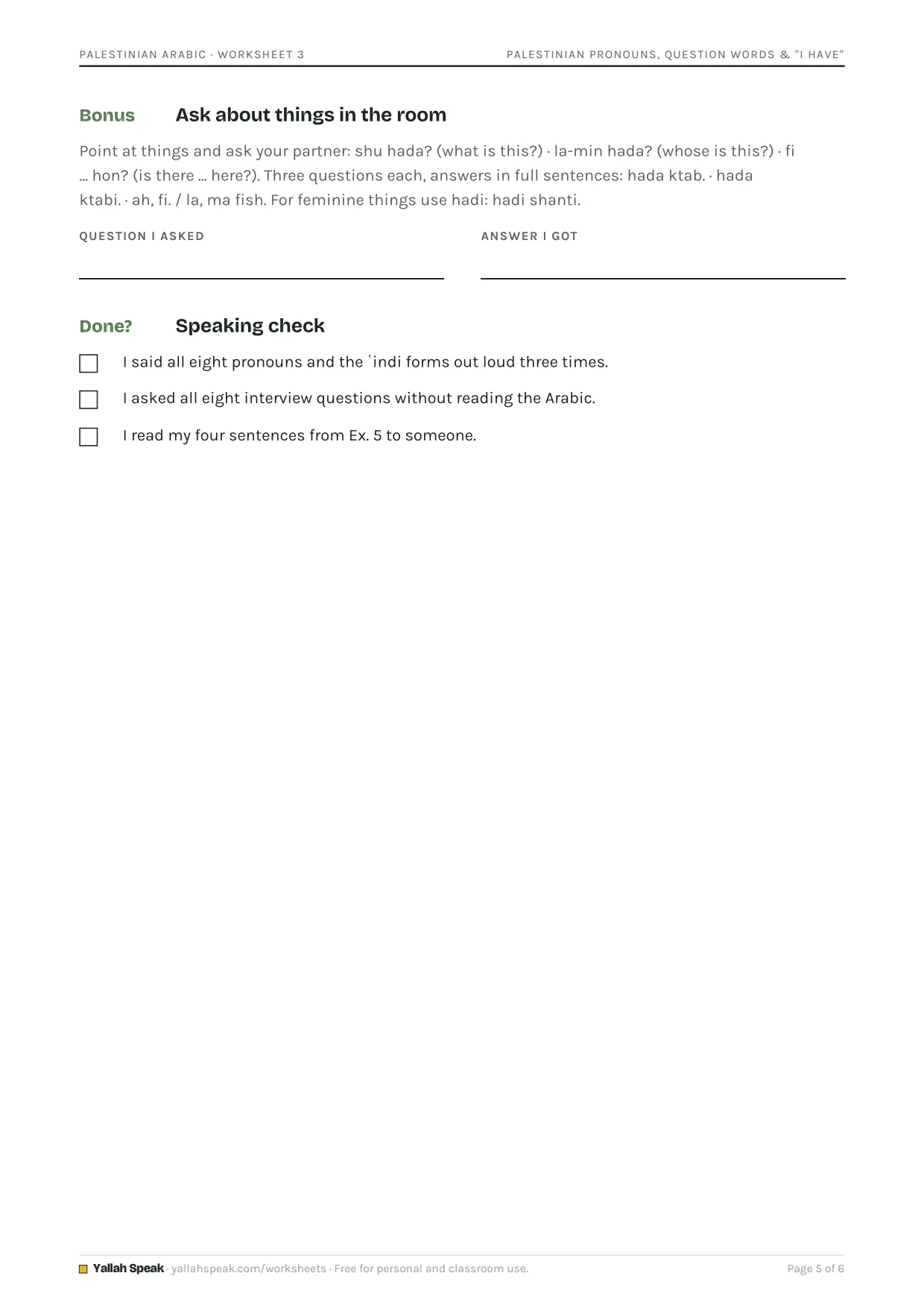
A partner interview with eight questions, a writing task in the third person, a speaking check, and an answer key with teacher notes
How to use it on your own
Read sections A to D out loud, one table at a time, and tick a row only when you can produce it from the English alone. Do the four exercises without looking back, then check the key. For the interview, answer every question about yourself out loud, then again about a friend so you use huwwe, hiyye and the -o / -ha endings. Finish with Ex. 5 and say your four sentences three times without reading.
How to use it in class
Fits a 45-minute lesson: sections A to C with Ex. 1 and 2 (20 min), the question words with Ex. 3 and 4 (10 min), the partner interview with Ex. 5 (15 min). The interview is the centrepiece: pairs ask and note answers, then report to the class in the third person, which forces huwwe / hiyye and the possessive endings. Ex. 4 drills ma ʿindi and ma fish, the patterns students use most. Points fields on every exercise, answer key on the last page.
Worksheets teach you the words. Someone still has to answer back. Practise this exact dialogue with an AI partner who speaks Palestinian Arabic, stays in character and shows you word by word where your pronunciation slips. Try Yallah Speak free
Preview
Page 1 is above. Here are the other pages; click one to open it full size.
Frequently asked questions
What are the question words in Palestinian Arabic?
shu (what), wein (where), min wein (from where), emta (when), leish (why), min (who), kif (how), kam (how many) and ʾaddeish (how much). They usually come first, as in English: shu ismak? is "what's your name?". Standard Arabic uses different words (ma, ayna, mata, limadha), so MSA learners need to relearn this set.
How do you say "I have" in Palestinian Arabic?
ʿindi (عندي), literally "at me". ʿindi sayyara is I have a car, ʿindak waʾt? is do you have time (to a man), ʿindik to a woman. The negative is ma ʿindi, often ma ʿindish in Jerusalem: ma ʿindi masari, I have no money. There is no verb "to have" in Arabic.
What are the personal pronouns in Palestinian Arabic?
ana (I), inta (you, to a man), inti (you, to a woman), huwwe (he), hiyye (she), ihna (we), intu (you, plural) and humme (they). There is no dual and no separate feminine plural, so intu and humme work for every group.
What is the difference between fi and ʿindi?
fi means "there is" and is impersonal: fi mayy? is there water? The negative in Palestinian is ma fish: ma fish mushkile, no problem. ʿindi means "I have" and takes a person ending: ʿindi mayy, I have water. Exercise 4 on the sheet drills both negatives.
Is Palestinian grammar different from Lebanese or Syrian?
Very little at this level. The pronouns and ʿindi work the same across the Levant. You will notice small words: Palestinians say hada (this) where Beirut says hayda, ma fish where Lebanese and Syrians say ma fi, and often add -sh to a negative (ma ʿindish).
Is this worksheet free?
Yes. Download the PDF, print it and copy it as often as you like for personal use and in class. Please keep the Yallah Speak credit in the footer.
Stop studying Arabic. Start speaking it.
AI conversations in 10 real dialects, honest pronunciation feedback and a course from A1.