After this sheet you can put the 25 most useful Egyptian verbs into past, present and future, say what you did yesterday and what you will do tomorrow, and say no the Egyptian way.
No sign-up. Print and copy for personal and classroom use. Please keep the credit in the footer.
By Fouad El Ajouaoui, founder of Yallah Speak · · Free worksheet, no sign-up
Quick answer Egyptian Arabic verbs have three tenses built on one set of endings: the past (katabt, katab, katabit… "wrote"), the present with the prefix bi- (baktib, biyiktib, bitiktib… "writes") and the future with ha- (haktib, hayiktib…). Negation wraps the verb in ma… sh: maʿrafsh, "I don't know". The full conjugation chart and the 25 most useful verbs are below; the PDF is the printable version with grids to complete.
How do you conjugate verbs in Egyptian Arabic?
Egyptian Arabic has three tenses you need, and all three are built on the same eight endings and prefixes. The past adds endings to the stem; the present puts bi- in front (ba- for "I"); the future swaps bi- for ha-. Learn one verb all the way through and you own the pattern. Here is katab, to write:
Person
Past
Present (bi-)
Future (ha-)
Arabic (present)
ana · I
katabt
baktib
haktib
بكتب
enta · you (m)
katabt
bitiktib
hatiktib
بتكتب
enti · you (f)
katabti
bitiktibi
hatiktibi
بتكتبي
huwwa · he
katab
biyiktib
hayiktib
بيكتب
hiyya · she
katabit
bitiktib
hatiktib
بتكتب
ehna · we
katabna
biniktib
haniktib
بنكتب
entu · you (pl)
katabtu
bitiktibu
hatiktibu
بتكتبوا
humma · they
katabu
biyiktibu
hayiktibu
بيكتبوا
Two things to notice. "I" and "you (m)" are identical in the past (katabt), and "you (m)" and "she" are identical in the present (bitiktib); context does the rest. Egyptian has no separate "you (f, plural)": entu covers every group.
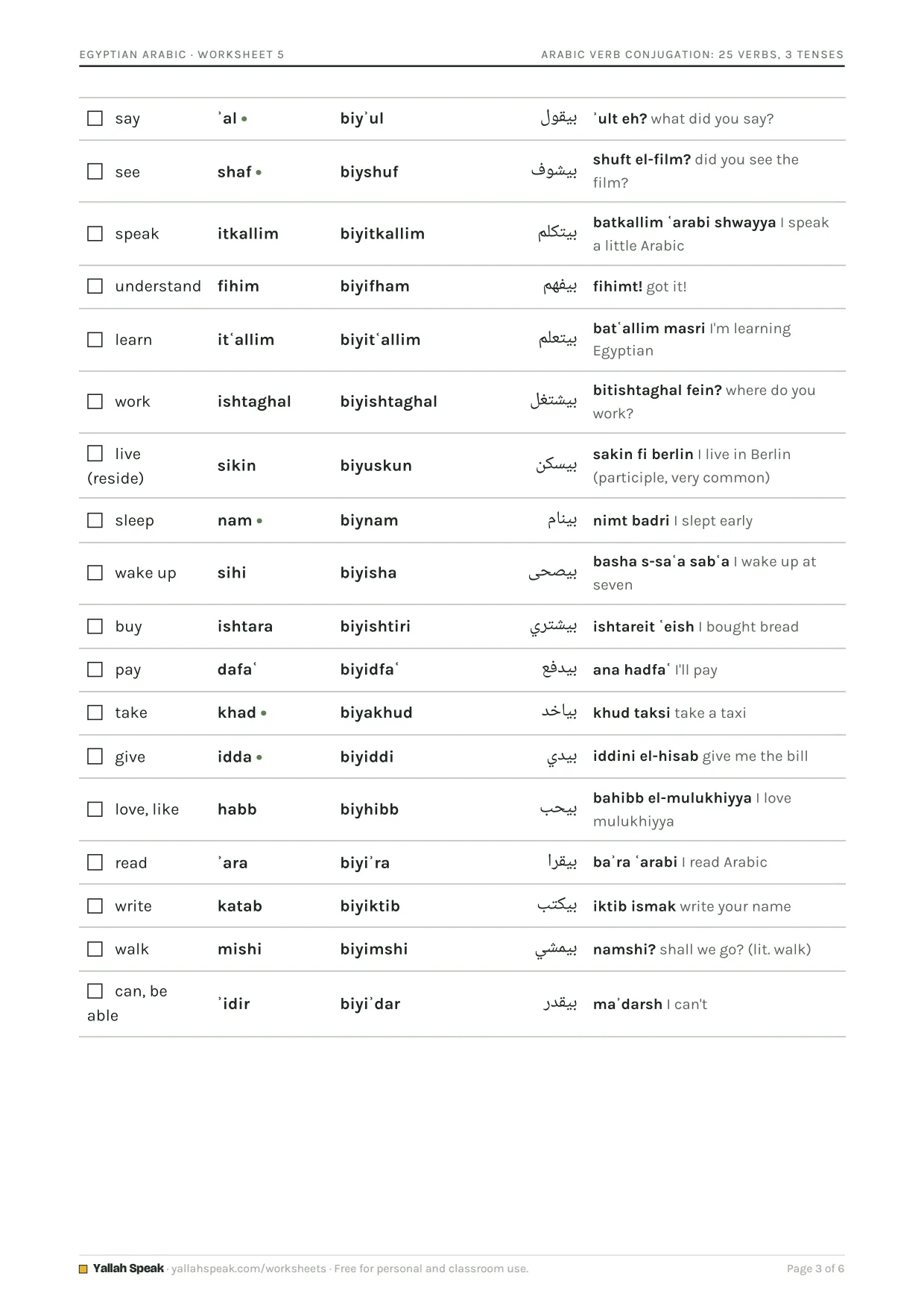
Arabic verb chart: the 25 most useful Egyptian verbs
These are the verbs the worksheet drills, chosen for frequency in everyday Cairo speech, not for a textbook chapter. The chart gives the he-form, because that is the form dictionaries list and the one the other persons are built from. Verbs marked with a dot are irregular in the past and are shown in full on page 2 of the PDF.
English
Past (he)
Present (he)
Arabic
go
rah •
biyruh
بيروح
come
gih •
biyigi
بييجي
do, make
ʿamal
biyiʿmil
بيعمل
eat
kal •
biyakul
بياكل
drink
shirib
biyishrab
بيشرب
know
ʿirif
biyiʿraf
بيعرف
want
kan ʿayiz
ʿayiz / ʿayza (no bi-)
عايز
say
ʾal •
biyʾul
بيقول
see
shaf •
biyshuf
بيشوف
speak
itkallim
biyitkallim
بيتكلم
understand
fihim
biyifham
بيفهم
learn
itʿallim
biyitʿallim
بيتعلم
work
ishtaghal
biyishtaghal
بيشتغل
live (reside)
sikin
biyuskun
بيسكن
sleep
nam •
biynam
بينام
wake up
sihi
biyisha
بيصحى
buy
ishtara
biyishtiri
بيشتري
pay
dafaʿ
biyidfaʿ
بيدفع
take
khad •
biyakhud
بياخد
give
idda •
biyiddi
بيدي
love, like
habb
biyhibb
بيحب
read
ʾara
biyiʾra
بيقرا
write
katab
biyiktib
بيكتب
walk, leave
mishi
biyimshi
بيمشي
can, be able
ʾidir
biyiʾdar
بيقدر
How do you make a verb negative in Egyptian Arabic?
Wrap the verb in ma… sh: maʿrafsh, I don't know; maʾdarsh, I can't; makaltsh, I didn't eat. Adjective-like words such as ʿayiz (wanting) and participles take mish in front instead: mish ʿayiz, I don't want; mish fahem, I don't understand. The future is negated with mish too: mish haruh, I won't go.
How is Egyptian verb conjugation different from Standard Arabic?
Three differences matter for a beginner. Standard Arabic has no bi- prefix; the plain present yaktubu is what Egyptians use only after another verb or "want" (ʿayiz aktib, I want to write). Standard Arabic marks the future with sa- or sawfa, Egyptian uses ha-. And Standard Arabic has dual and feminine-plural forms that Egyptian simply does not use, so the Egyptian conjugation table is shorter: eight forms instead of thirteen. If you learned MSA first, this sheet is the fastest way to switch your verbs to what people actually say.
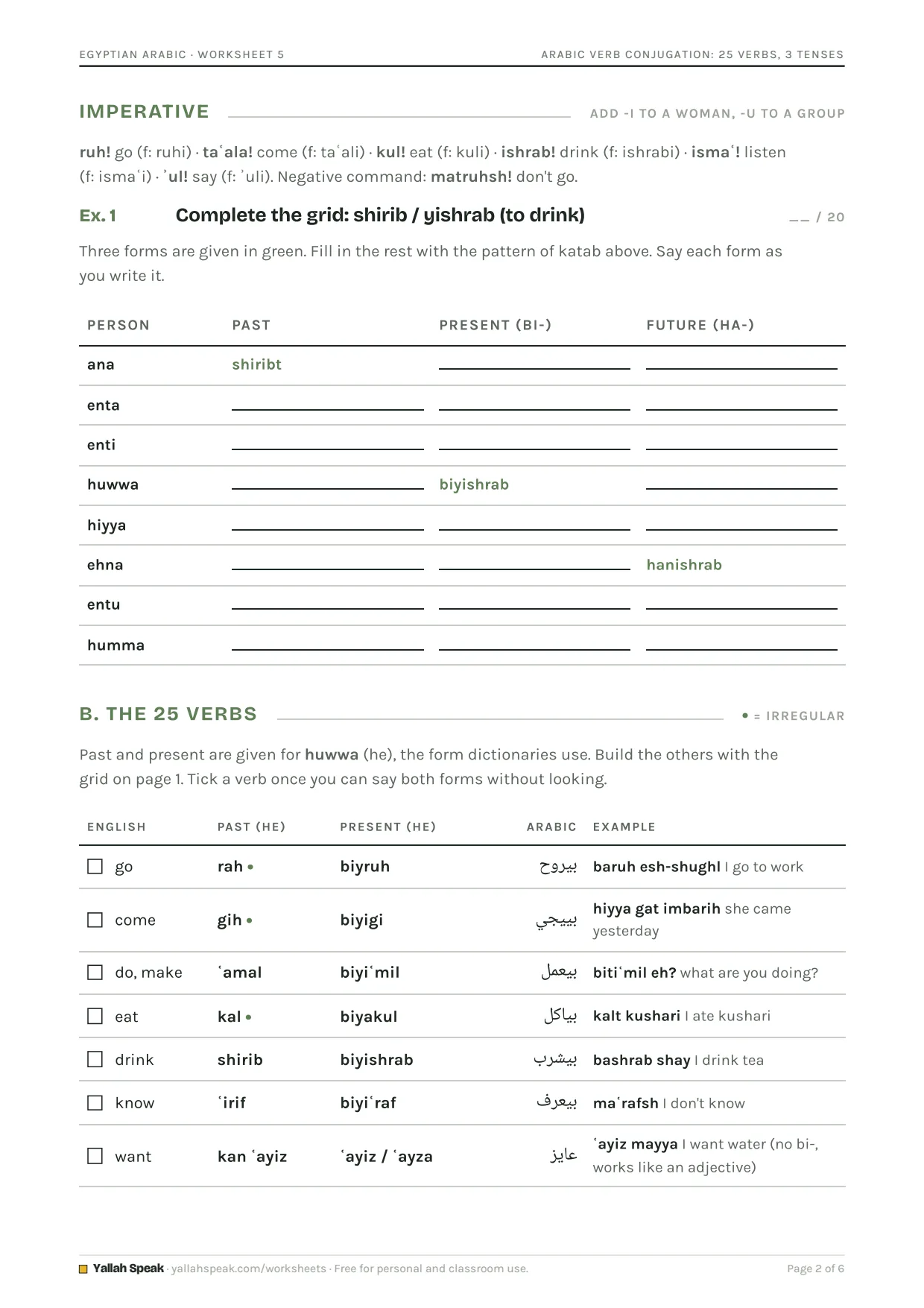
The PDF has the full chart, a second grid to complete yourself, 25 verbs with example sentences, exercises on bi-, ha- and negation, and a "my day" speaking task. The pronouns you need for the chart are on worksheet 3; the 200 most common words include the top verbs in context on worksheet 6.
What's inside the PDF
One full conjugation grid (katab, to write) in past, present with bi- and future with ha-, for all eight persons, with Arabic script
Three short rules that carry you a long way: when bi- is dropped, how ha- makes the future, and the two ways to negate (ma-…-sh around verbs, mish in front of everything else)
The 25 verbs table: past and present, Arabic script, a three-word example each, irregular verbs marked and explained
The six commands you hear most (ruh, taʿala, kul, ishrab, ismaʿ, ʾul) with the feminine forms
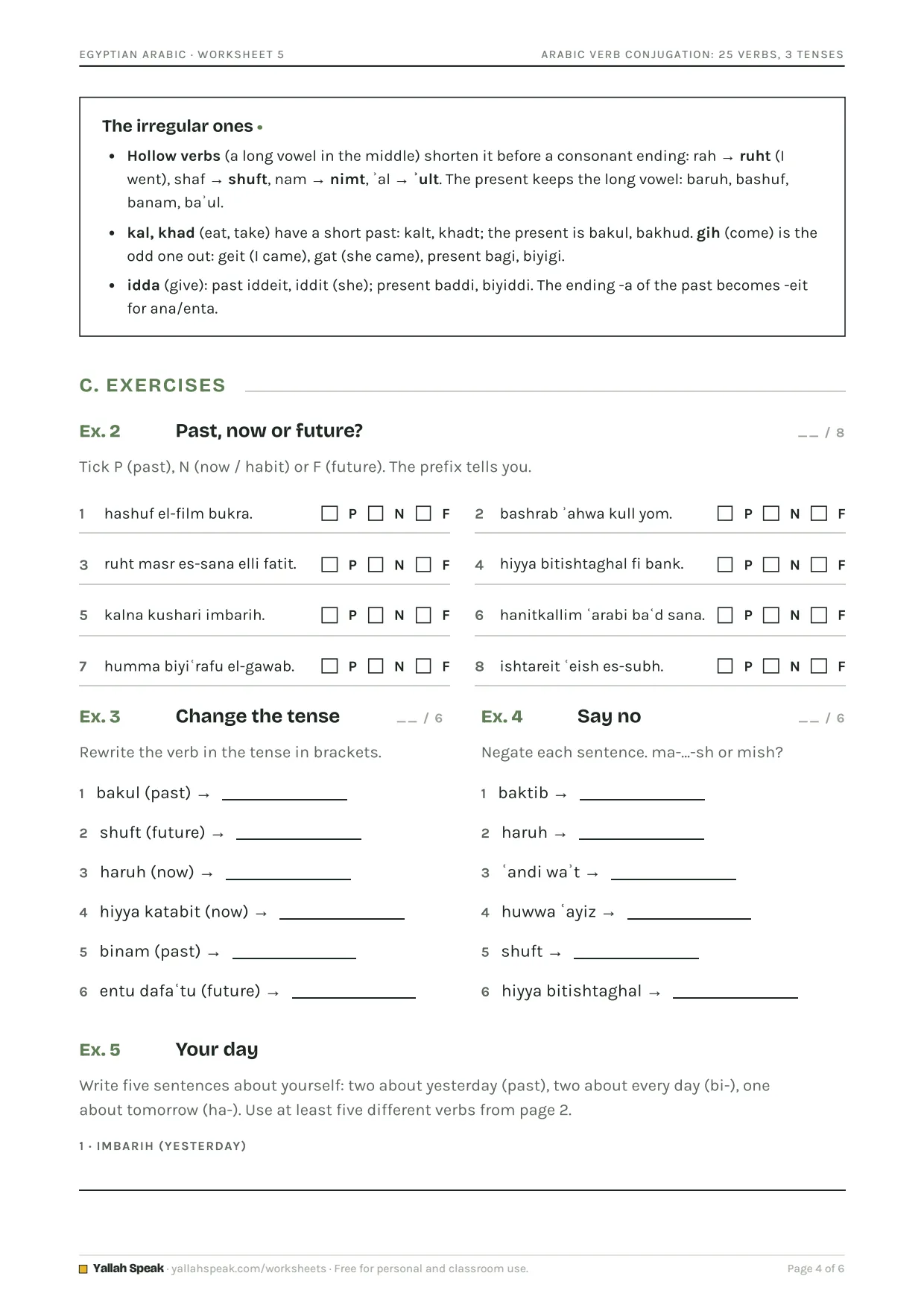
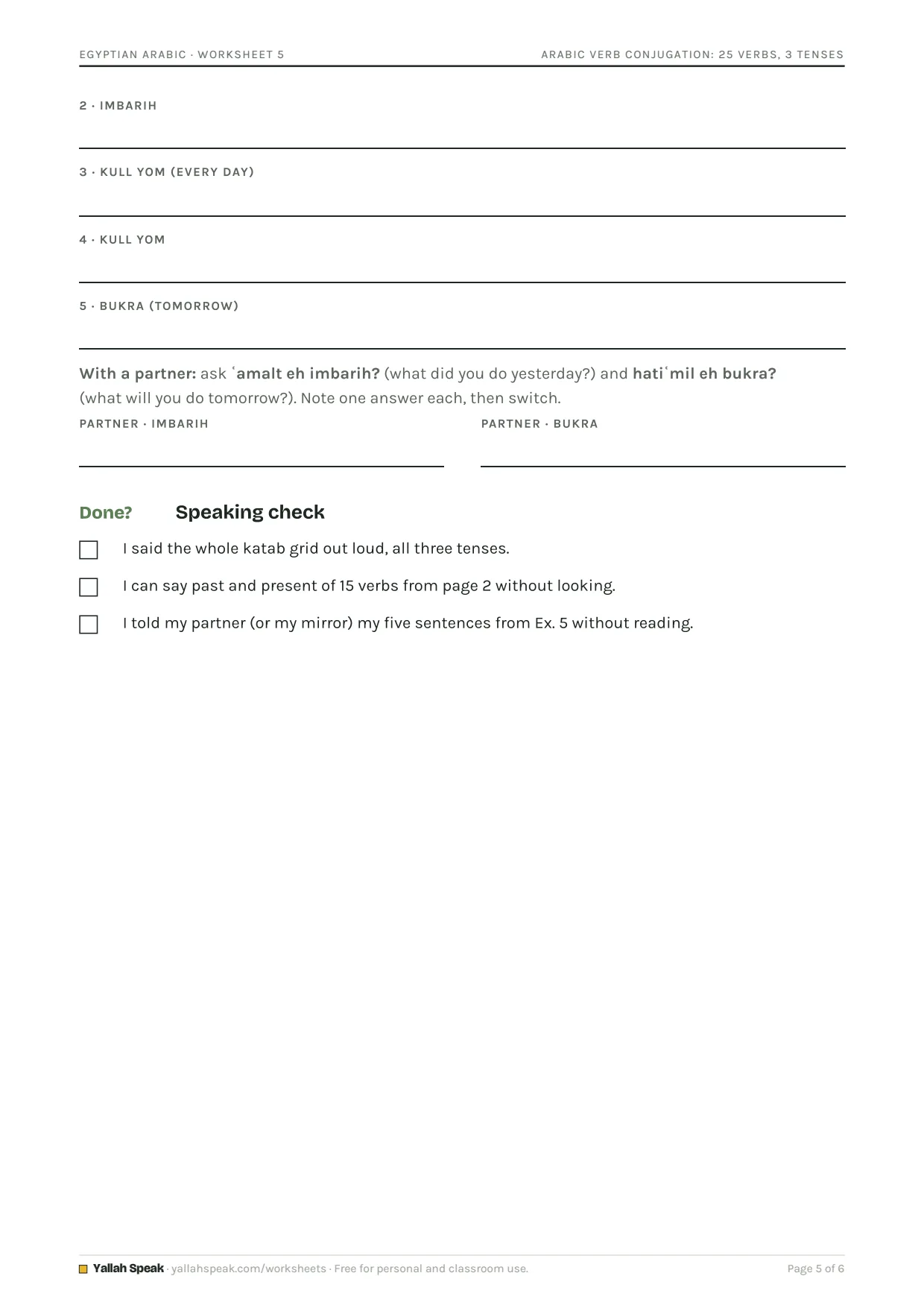
Five exercises: complete a grid, past-now-future, change the tense, say no, write and tell your day
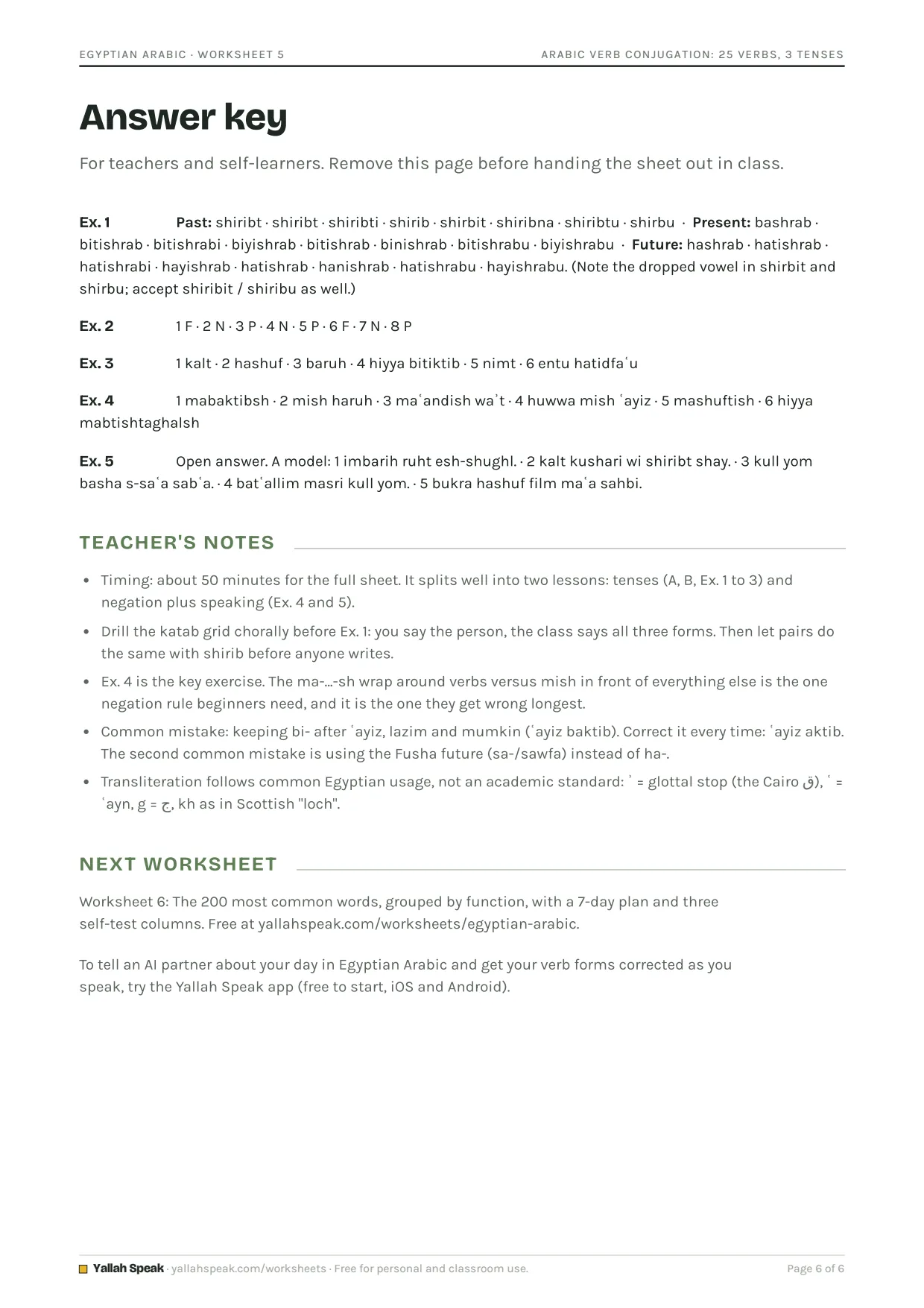
Answer key and teacher notes on a separate page you can remove before handing out
How to use it on your own
Say the katab grid out loud until the prefixes come without thinking, then do Ex. 1 without looking back at page 1. Work through the 25 verbs five at a time and tick a verb only when you can say both forms. Finish with Ex. 5: write your five sentences, then say them to a mirror or record yourself and listen once.
How to use it in class
About 50 minutes, or two shorter lessons: tenses (A, B, Ex. 1 to 3) and negation plus speaking (Ex. 4 and 5). Drill the katab grid chorally before anyone writes, then let pairs conjugate shirib aloud. Ex. 4 is the key exercise, because the ma-…-sh versus mish rule is the one beginners get wrong longest. Ex. 5 ends in a pair interview (what did you do yesterday, what will you do tomorrow) that forces real tense choices. Points fields on every exercise, answer key on the last page.
Worksheets teach you the words. Someone still has to answer back. Practise this exact dialogue with an AI partner who speaks Egyptian Arabic, stays in character and shows you word by word where your pronunciation slips. Try Yallah Speak free
Preview
Page 1 is above. Here are the other pages; click one to open it full size.
Frequently asked questions
How do you conjugate verbs in Egyptian Arabic?
Take the past stem and add the person endings (katabt, katabt, katabti, katab, katabit, katabna, katabtu, katabu). For the present, put bi- in front of the present stem with the person prefix (baktib, bitiktib, bitiktibi, biyiktib, bitiktib, biniktib, bitiktibu, biyiktibu). For the future, replace bi- with ha-. The chart on this page shows all eight persons for katab, to write.
What is the bi- prefix in Egyptian Arabic?
bi- marks the present tense: habitual actions and things happening now. bashrab shay means I drink tea or I am drinking tea. Without bi- the verb is the plain form used after another verb or after ʿayiz (want): ʿayiz ashrab shay, I want to drink tea. Standard Arabic has no bi- at all, which is why MSA learners find the prefix new.
How do you say "I will" in Egyptian Arabic?
With the prefix ha- on the present form: haruh (I will go), hashrab (I will drink), hadfaʿ (I will pay). For the negative use mish in front: mish haruh, I won't go. Standard Arabic uses sa- or sawfa instead.
How many Arabic verbs do you need to start speaking?
Fewer than you think. With the 25 verbs on this sheet (go, come, do, eat, drink, know, want, say, see, speak, understand, learn, work, live, sleep, wake up, buy, pay, take, give, like, read, write, walk, can) you can describe your day, order, ask for directions and make plans. Learn each one in the he-form first, then the I-form, and the rest follows the chart.
Is this worksheet free?
Yes. Download the PDF, print it and copy it as often as you like for personal use and in class. Please keep the Yallah Speak credit in the footer.
Stop studying Arabic. Start speaking it.
AI conversations in 10 real dialects, honest pronunciation feedback and a course from A1.