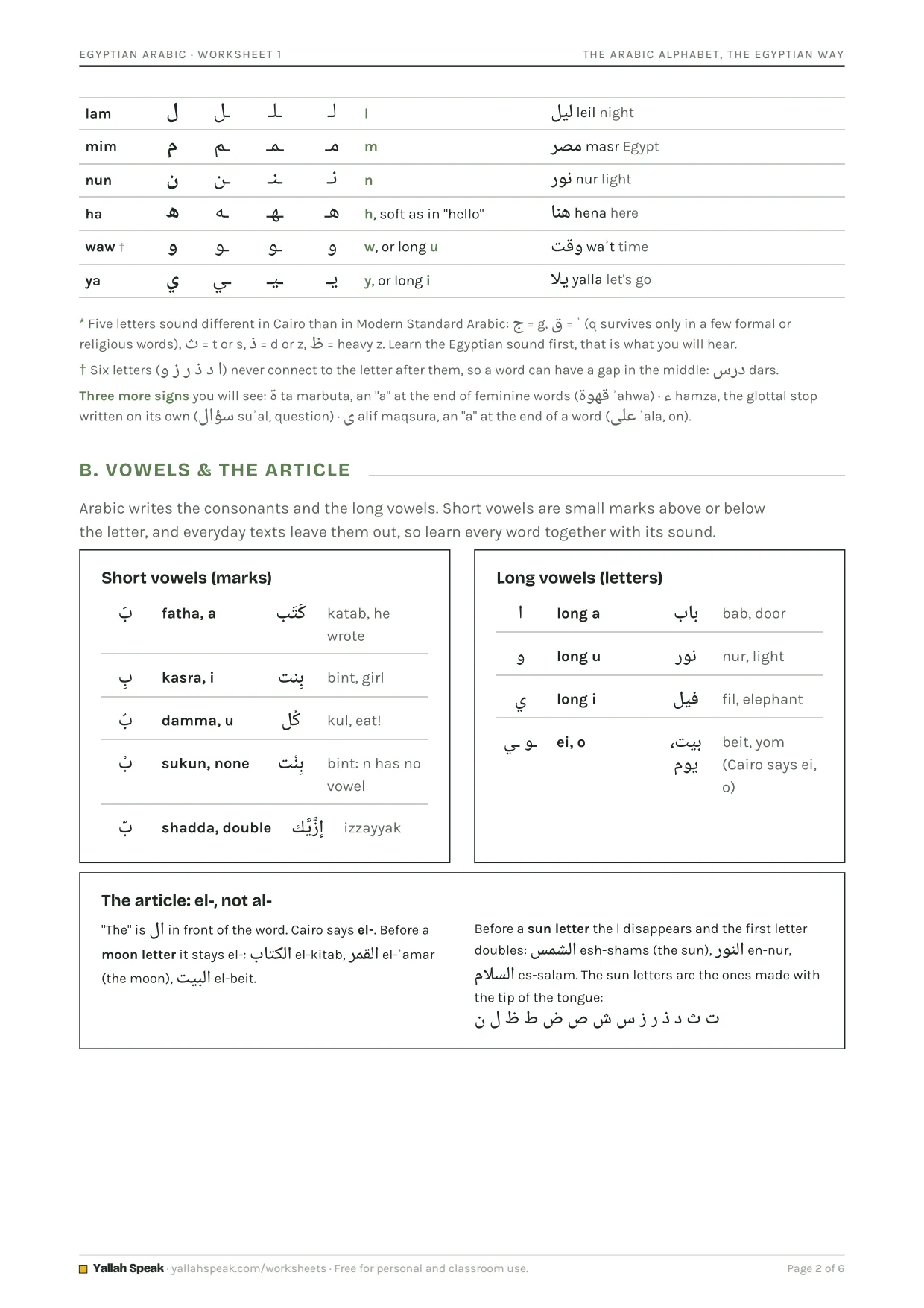
After this sheet you can recognise and write all 28 letters, read short everyday words with the Egyptian sounds (g for ج, a glottal stop for ق) and read prices on a menu.
No sign-up. Print and copy for personal and classroom use. Please keep the credit in the footer.
By Fouad El Ajouaoui, founder of Yallah Speak · · Free worksheet, no sign-up
Quick answer The Arabic alphabet has 28 letters, written right to left, and most letters take a different shape at the start, middle and end of a word. In Egypt five letters sound different from Standard Arabic: ج is a hard g, ق is a glottal stop (ʾ), and ث ذ ظ lose their "th" and become t/s, d/z and z. The full chart with Egyptian pronunciation and example words is below; the PDF adds the four letter shapes, tracing rows and reading exercises.
How many letters are in the Arabic alphabet?
Twenty-eight. Arabic is written from right to left, letters join up like handwriting, and most letters have slightly different shapes at the start, in the middle and at the end of a word. There are no capital letters. Six letters (ا د ذ ر ز و) never connect to the letter after them, which is why words sometimes look like they have gaps. Short vowels are usually not written at all; you read كتب as kitab, katab or kutub from context, which is less frightening than it sounds once you know a few hundred words.
Arabic alphabet chart with Egyptian pronunciation
Most alphabet charts give the Standard Arabic sounds. This one gives the sounds you will actually hear in Cairo, because five letters are pronounced differently in Egypt, and they are among the most common. The example words are the first words on the worksheet.
Letter
Name
Sound in Egyptian Arabic
Example
ا
alif
long a (or carries a short vowel at the start of a word)
باب bab, door
ب
ba
b
بيت beit, house
ت
ta
t
تمام tamam, okay
ث
tha
t or s, never "th"
ثلاثة talata, three
ج
gim
g as in "go", never "j"
جميل gamil, beautiful
ح
ha
h, strong and breathy, from the throat
حلو helw, sweet, nice
خ
kha
kh as in Scottish "loch"
خلاص khalas, done
د
dal
d
درس dars, lesson
ذ
dhal
d or z, never "th" as in "this"
ذهب dahab, gold
ر
ra
r, rolled
راجل ragil, man
ز
zay
z
زيت zeit, oil
س
sin
s
سلام salam, peace, hi
ش
shin
sh
شاي shay, tea
ص
sad
s, heavy (mouth more open)
صباح sabah, morning
ض
dad
d, heavy
ضيف deif, guest
ط
ta
t, heavy
طيب tayyib, fine
ظ
za
z, heavy, never "th"
ظريف zarif, charming
ع
ʿayn
ʿ, a squeezed "a" from deep in the throat
عربي ʿarabi, Arabic
غ
ghayn
gh, like a French "r"
غالي ghali, expensive
ف
fa
f
فلوس filus, money
ق
qaf
ʾ, a glottal stop (the catch in "uh-oh"), not "q"
قهوة ʾahwa, coffee
ك
kaf
k
كتاب kitab, book
ل
lam
l
ليل leil, night
م
mim
m
مصر masr, Egypt
ن
nun
n
نور nur, light
ه
ha
h, soft as in "hello"
هنا hena, here
و
waw
w, or long u
وقت waʾt, time
ي
ya
y, or long i
يلا yalla, let's go
How is Arabic alphabet pronunciation different in Egypt?
Five letters change. ج is a hard g (gamil, not jamil), ق becomes a glottal stop (ʾahwa, not qahwa), and the two "th" letters ث and ذ become t/s and d/z (talata, not thalatha; dahab, not dhahab). ظ is a heavy z. Everything else sounds the same as in Standard Arabic. The worksheet marks these letters with a star so you learn the Egyptian sound first and the standard one as a footnote, not the other way round.
How to use this printable alphabet worksheet
Section A is the chart above with all four shapes of each letter. Section B has the short and long vowels, sukun and shadda, and the sun and moon letters (why "the" is el- before some letters and esh-, es- before others). Section C is practice: tracing rows with grey guide letters for the hardest shapes, a connect-the-letters task, reading ten words the Egyptian way, sun or moon, and a real café menu with Arabic digits. The answer key is on the last page. Most learners need two sittings of about 45 minutes for the sheet, and a week of reading street signs after that. If you want the full seven-day method, read how to learn the Arabic alphabet in 7 days; for the vowel marks in detail, vowels in Arabic. Once you can read the letters, go straight to worksheet 2, greetings.
What's inside the PDF
All 28 letters in a single table: alone, end, middle and start shapes, the sound as Cairenes say it, and an everyday Egyptian example word for each
The five letters that sound different in Egypt than in standard Arabic, marked and explained, plus the six letters that never connect
Short vowels, long vowels, sukun and shadda, and the article el- with sun and moon letters, in two compact boxes
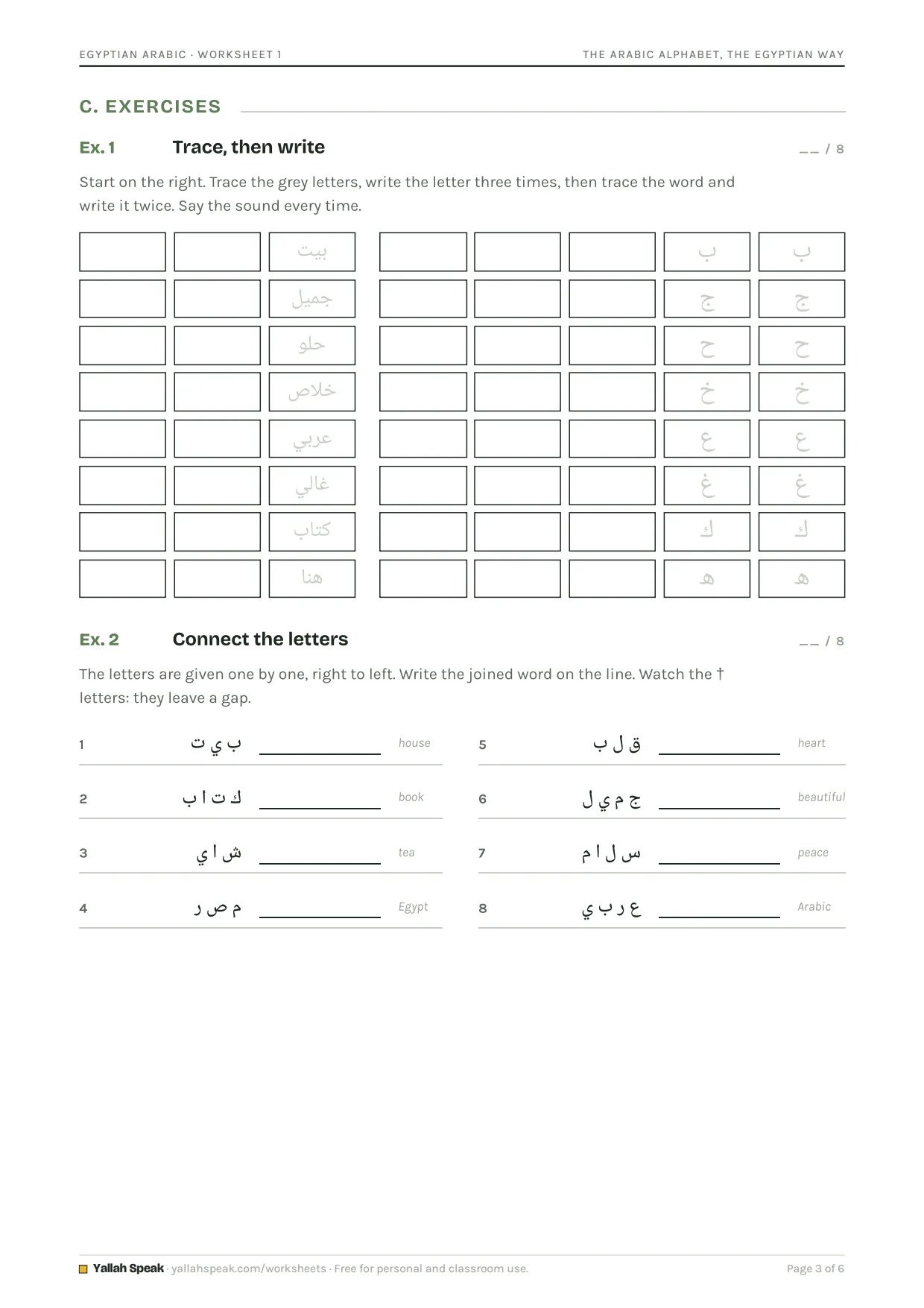
Tracing rows with grey guide letters for the hardest shapes, and a connect-the-letters exercise
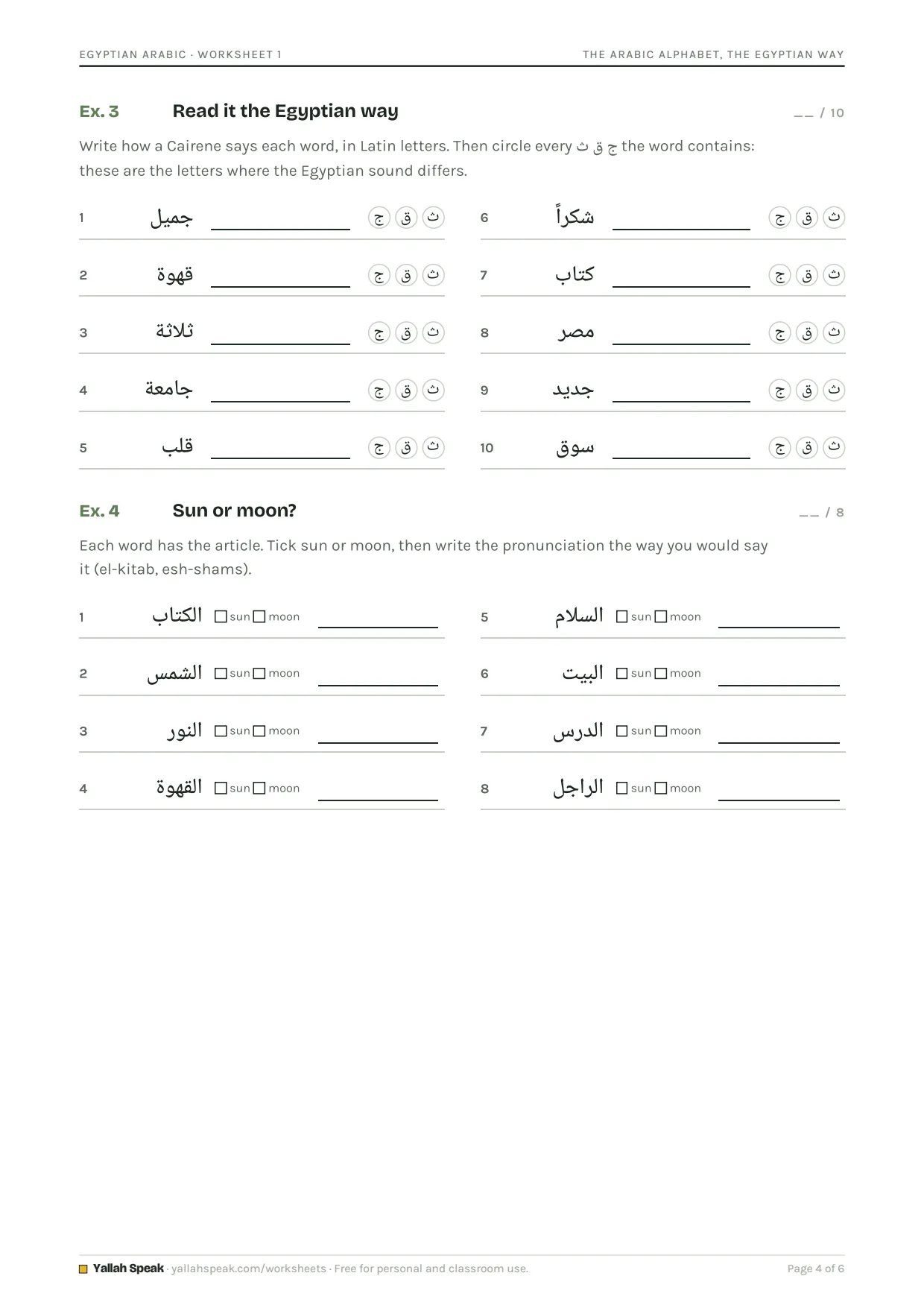
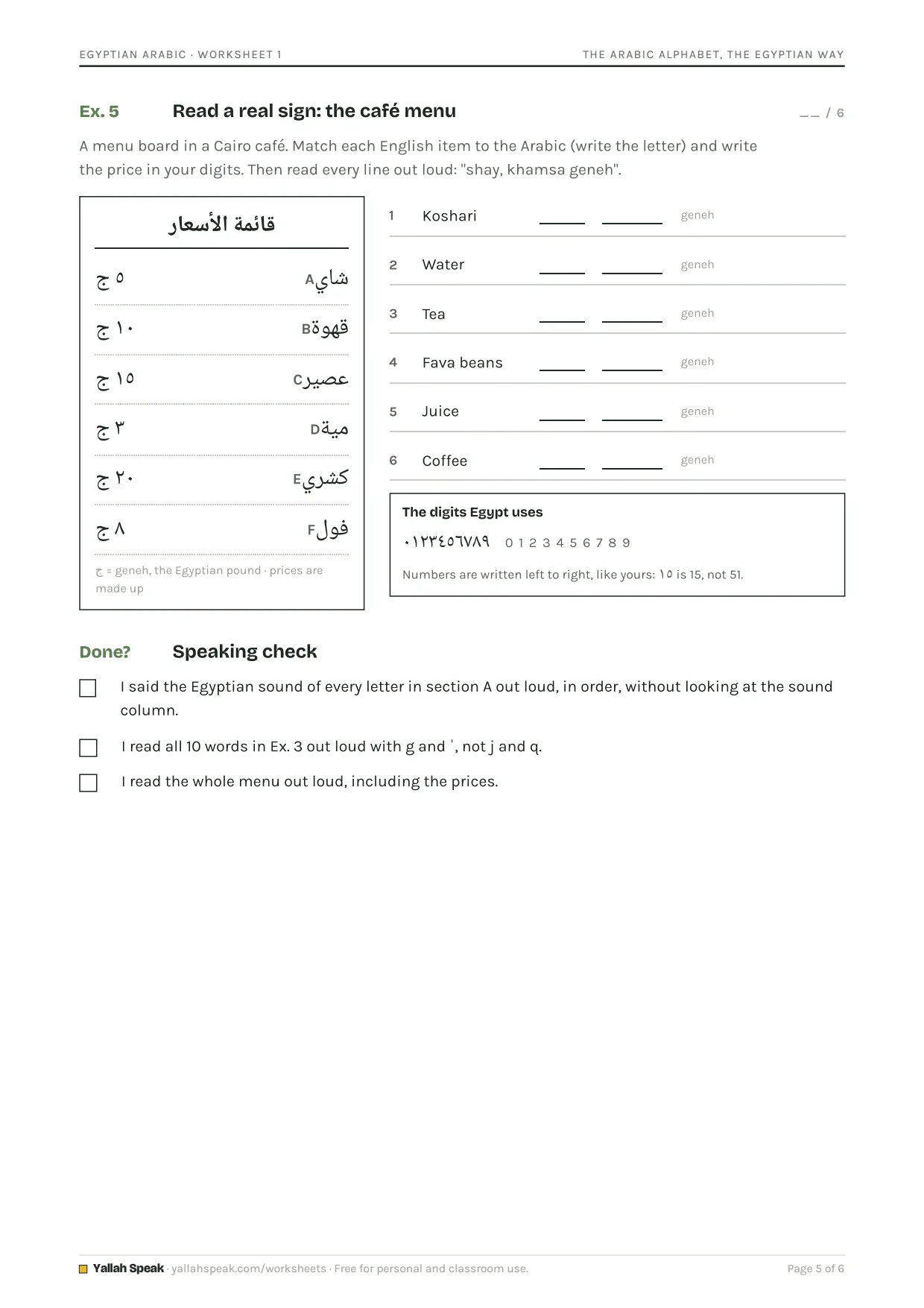
Reading exercises: transliterate 10 words the Egyptian way, sun or moon, and read a real café menu with Arabic digits
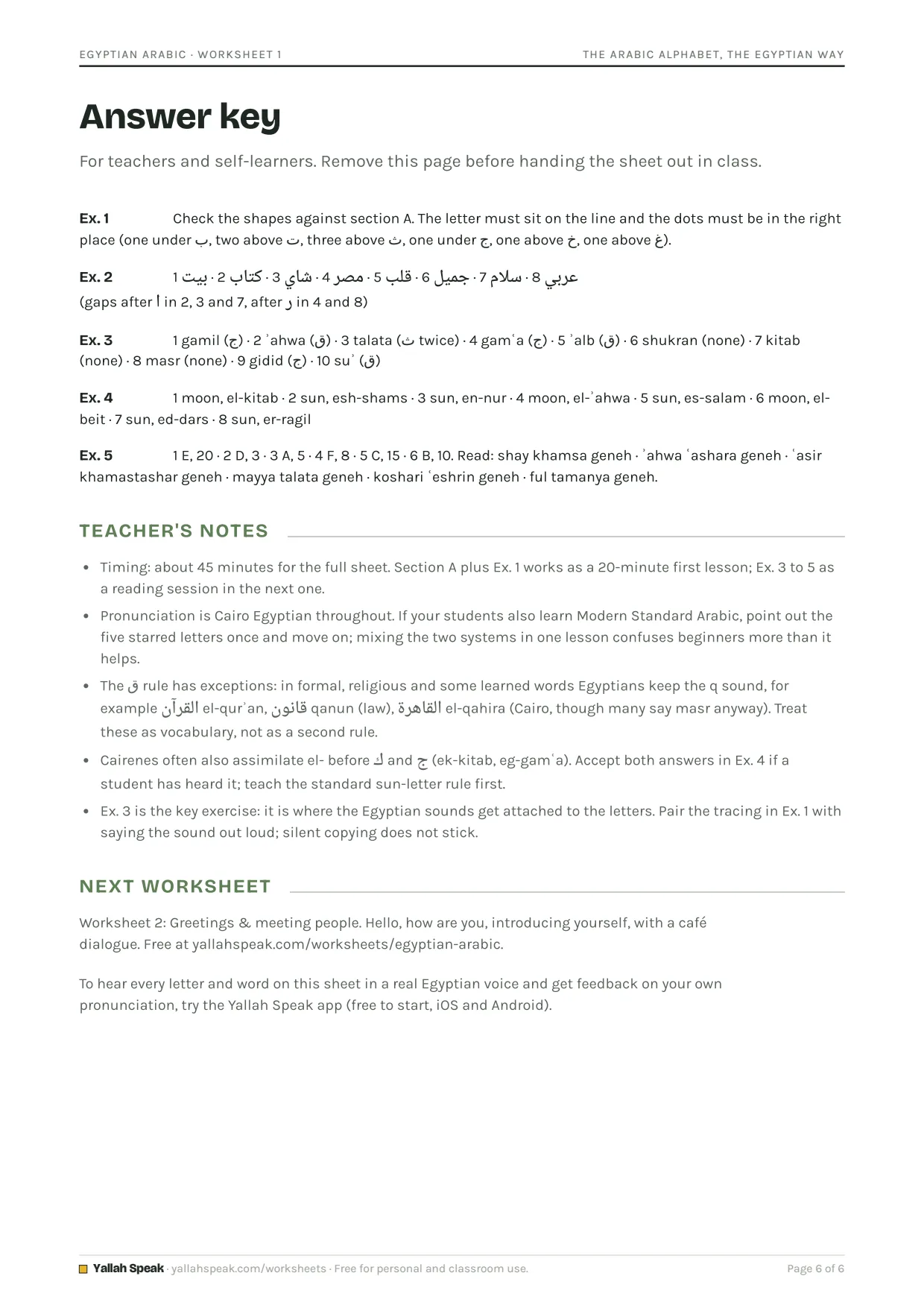
Answer key and teacher notes on a separate page you can remove before handing out
How to use it on your own
Do section A out loud, row by row, saying the Egyptian sound each time. Do not try to memorise all 28 shapes in one sitting; do the tracing in Ex. 1, sleep on it, and come back for the reading exercises the next day. Ex. 3 is the one that matters: if you can read those ten words with g and a glottal stop, you read like a Cairene, not like a textbook.
How to use it in class
Fits a 45-minute lesson, or split it: section A and the tracing (Ex. 1) as a 20-minute first lesson, Ex. 3 to 5 as a reading session in the next one. Ex. 2 and Ex. 5 work well in pairs, with one student reading the menu aloud and the other writing the prices. Ex. 3 is the key exercise, because it attaches the Egyptian sounds to the letters; make students say every word before they write it. The answer key and notes on the last page include the exceptions to the ق rule and the Cairo habit of saying ek-kitab.
Worksheets teach you the words. Someone still has to answer back. Practise this exact dialogue with an AI partner who speaks Egyptian Arabic, stays in character and shows you word by word where your pronunciation slips. Try Yallah Speak free
Preview
Page 1 is above. Here are the other pages; click one to open it full size.
Frequently asked questions
How many letters does the Arabic alphabet have?
28 letters, written from right to left. There are no capital letters, and most letters change shape slightly depending on whether they stand alone, at the start, in the middle or at the end of a word. Six letters never connect to the following letter. The worksheet shows all four shapes of every letter in one table.
Is there a free printable Arabic alphabet worksheet for writing practice?
Yes, this one. Section C has tracing rows with grey guide letters for the shapes beginners find hardest, then empty rows to write each letter on your own and a connect-the-letters exercise. Print it as often as you like; the PDF is free and needs no sign-up.
Is the Arabic alphabet hard to learn?
Harder than it looks for the first two days, easier than it looks after a week. The 28 letters are built from about 18 base shapes plus dots, and the joining rules are regular. Most learners can read simple words after four to six hours of practice. The hard part is not the letters but the missing short vowels, which you learn to fill in from vocabulary.
How is the Egyptian pronunciation different from Standard Arabic?
Five letters: ج is a hard g (gamil, not jamil), ق is a glottal stop (ʾahwa, not qahwa), ث becomes t or s (talata), ذ becomes d or z (dahab) and ظ is a heavy z. Everything else is the same. The worksheet marks these letters with a star so you learn the Egyptian sound first.
Do I need to read the script to speak Egyptian Arabic?
No. Egyptians themselves text in Latin letters, and every Yallah Speak worksheet gives the pronunciation next to the script. But reading unlocks menus, signs, subtitles and song lyrics, and it takes about a week. This sheet is the fastest route.
Is this alphabet worksheet free?
Yes. Download the PDF, print it and copy it as often as you like for personal use and in class. Please keep the Yallah Speak credit in the footer.
Stop studying Arabic. Start speaking it.
AI conversations in 10 real dialects, honest pronunciation feedback and a course from A1.