After this sheet you know the 200 words that carry most everyday Egyptian conversations, can say them from the English without looking, and can read and build short sentences with them.
No sign-up. Print and copy for personal and classroom use. Please keep the credit in the footer.
By Fouad El Ajouaoui, founder of Yallah Speak · · Free worksheet, no sign-up
Quick answer The most common Arabic words in everyday Egyptian speech are small function words: ana (I), enta/enti (you), eh (what), fein (where), fi (there is), mish (not), ʿand (have), kwayyis (good), bass (only), yaʿni (I mean), khalas (done), yalla (let's go), shukran (thank you). The first 50 are in the table below; the PDF has all 200 in seven groups with a 7-day learning plan.
What are the most common Arabic words (in Egyptian Arabic)?
The 200 words on this sheet are grouped by what they do in a sentence, not alphabetically: pronouns and little words, people and family, question words, time and place, food and home, verbs, adjectives, and the politeness words that hold Egyptian conversation together. Here are the first fifty, the ones you will hear within an hour of landing in Cairo.
English
Egyptian Arabic
Arabic
English
Egyptian Arabic
Arabic
I
ana
أنا
yes
aywa
أيوه
you (m)
enta
إنت
no
laʾ
لأ
you (f)
enti
إنتي
not
mish
مش
he
huwwa
هو
and
wi
و
she
hiyya
هي
only, but, enough
bass
بس
we
ehna
إحنا
also, more
kaman
كمان
you (pl.)
entu
إنتو
because
ʿashan
عشان
they
humma
هما
I mean, that is
yaʿni
يعني
this (m)
da
ده
okay then
tab
طب
this (f)
di
دي
done, that's it
khalas
خلاص
here
hina
هنا
let's go, come on
yalla
يلا
there
hinak
هناك
okay, fine
mashi
ماشي
what
eh
إيه
fine, perfect
tamam
تمام
where
fein
فين
today
innaharda
النهارده
when
imta
إمتى
tomorrow
bukra
بكرة
why
leh
ليه
now
dilwaʾti
دلوقتي
who
min
مين
later
baʿdein
بعدين
how
izzay
إزاي
in; there is
fi
في
how much (price)
bikam
بكام
with
maʿa
مع
good, fine
kwayyis
كويس
at (someone's), have
ʿand
عند
big
kibir
كبير
please; excuse me
law samaht
لو سمحت
small
sughayyar
صغير
thank you
shukran
شكراً
nice, sweet
helw
حلو
never mind, sorry
maʿlesh
معلش
a lot, many
kitir
كتير
very (after the word)
awi
أوي
a little
shwayya
شوية
God willing
in shaʾ Allah
إن شاء الله
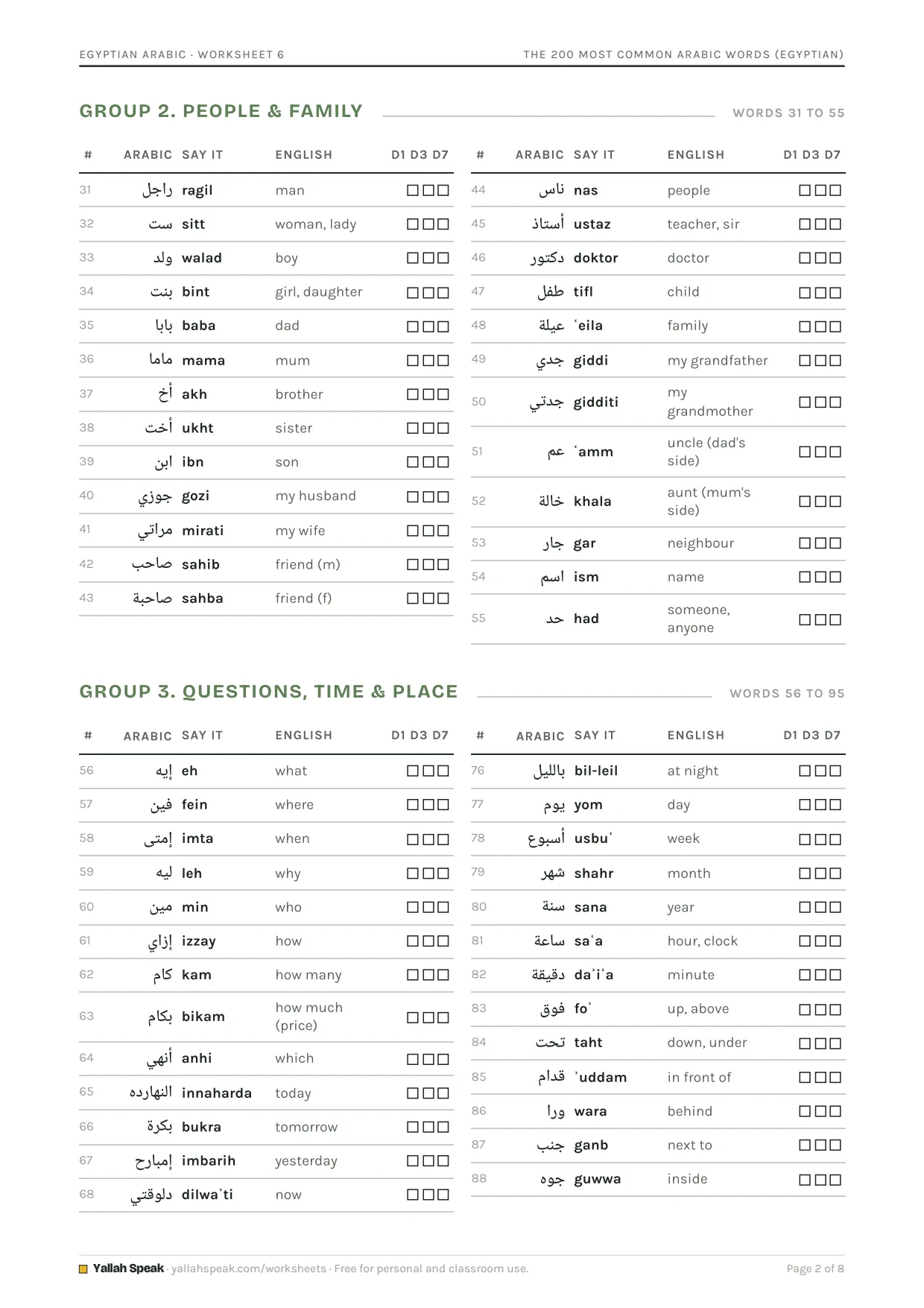
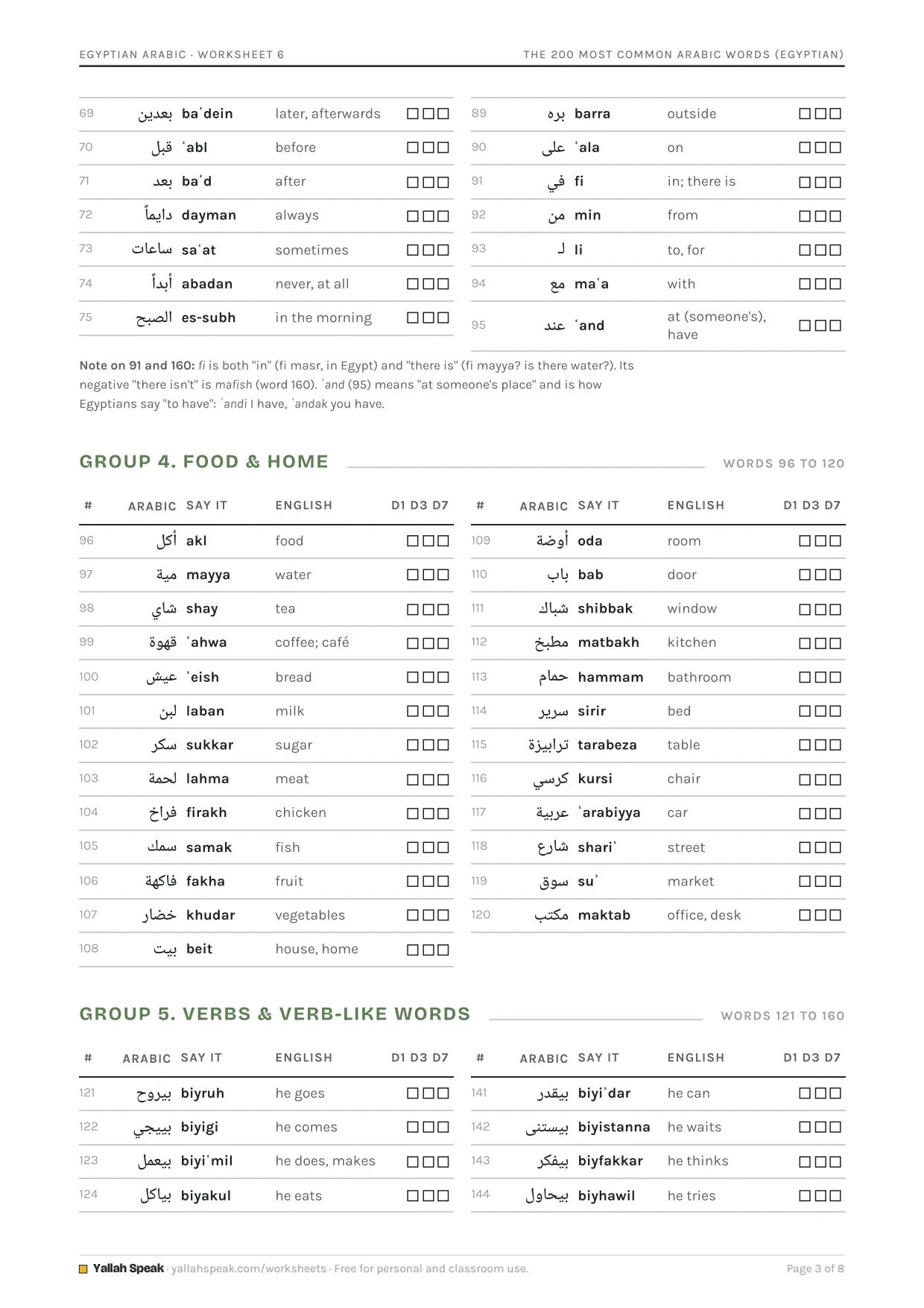
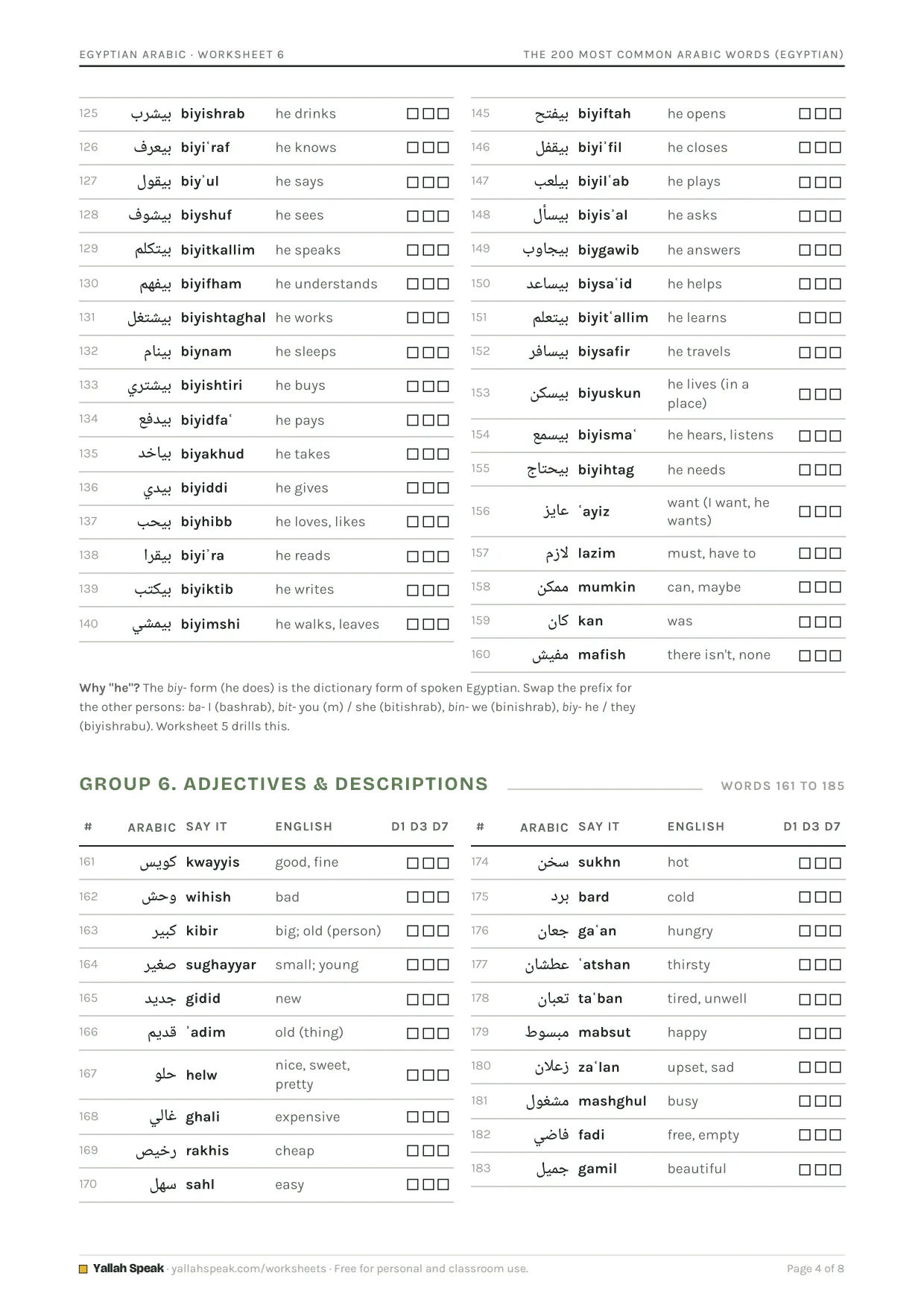
The other 150 words, the people, food, verbs and adjectives, are in the PDF with the same three columns, plus three tick boxes (day 1, day 3, day 7) next to every word for the 7-day plan.
How many Arabic words do you need to speak?
In spoken Egyptian Arabic, the most frequent 200 words cover roughly two thirds of what you hear in everyday conversation, because function words (fi, mish, ʿand, bass, yaʿni) repeat endlessly. With these 200 plus the numbers you can order, ask directions, introduce yourself, say what you did yesterday and what you want tomorrow. Around 1,000 words gets you through most daily conversations; 3,000 lets you follow a film. The point of this sheet is not to memorise a list but to get the first 200 to the stage where they come out without thinking. That is why the plan is seven days of thirty minutes rather than one long evening.
Why Egyptian words and not Modern Standard Arabic words?
A Standard Arabic frequency list and an Egyptian one disagree on about a third of the top 200. "What" is ma in MSA and eh in Egypt; "now" is al-an versus dilwaʾti; "not" is la / laysa versus mish; "I want" is uridu versus ʿayiz. Learn the MSA list and you will read the news; learn this list and you will understand your taxi driver. If you want both eventually, start here: the Egyptian words are the ones you will be tested on in real life every day. For a cross-dialect overview, see common Arabic words and phrases; for how to make these words into sentences, use worksheet 5 on verbs and worksheet 3 on pronouns and question words.
How the 7-day plan on the sheet works
About 30 minutes a day. Days 1 to 6 take the list in blocks of 30 to 50 words (words 1–30, 31–60, 61–90, 91–120, 121–150, 151–200), with built-in reviews on day 3 and day 5. Day 7 is the whole list plus the sentence page: 20 sentences built only from the 200 words, to read aloud and translate. Every word has three tick boxes, D1, D3 and D7: cover the pronunciation and English columns, look at the Arabic or the English, say the word, then tick. A word with three ticks is yours. Teachers run the same cycle as a weekly homework with a short dictation at the end of the week.
What's inside the PDF
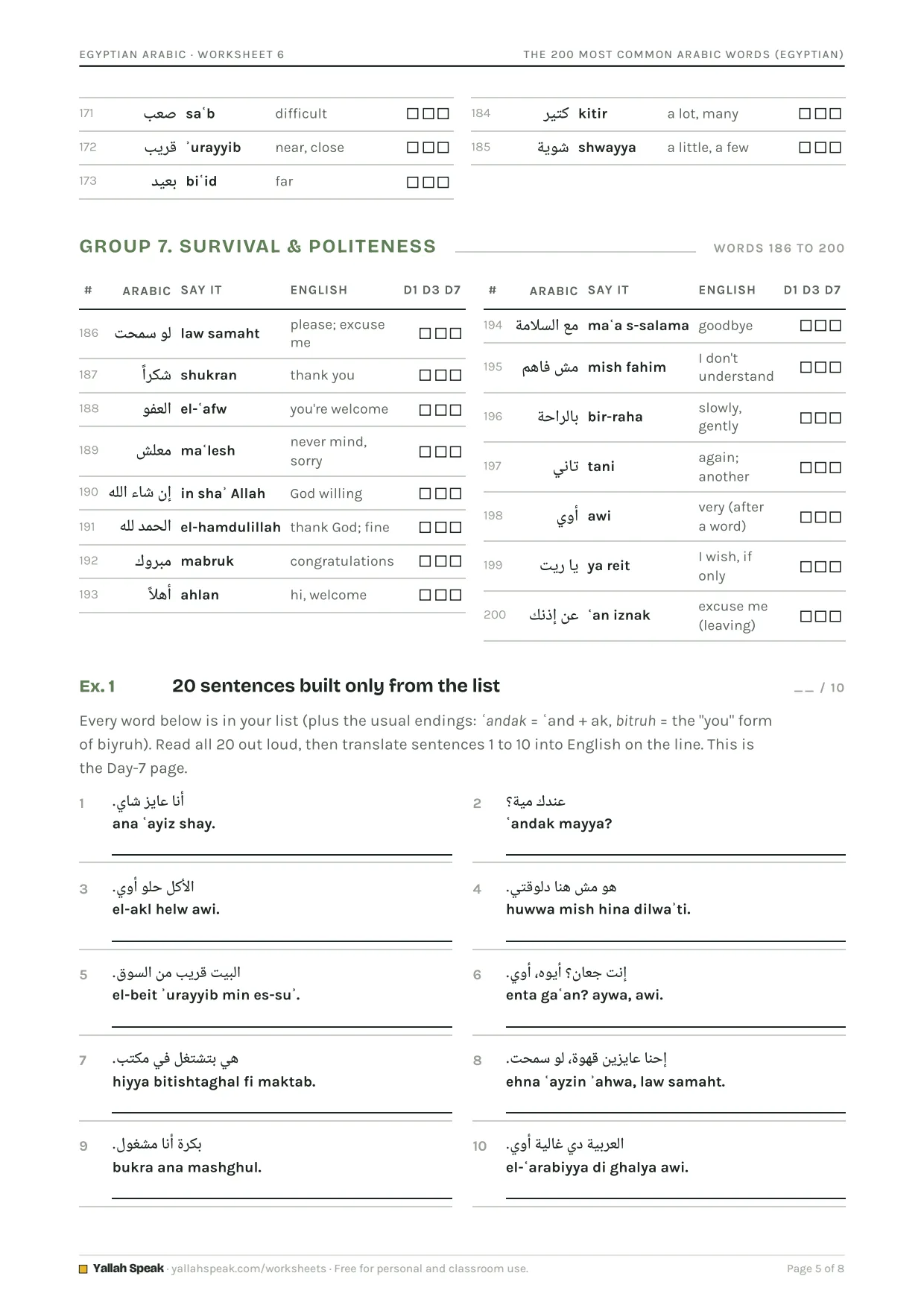
200 numbered words in seven groups: little words and pronouns, questions and time, people and family, verbs, food and home, adjectives, survival phrases. Arabic script, Egyptian pronunciation and English side by side
A 7-day plan (about 30 minutes a day) with two built-in review days
Three tick boxes per word (Day 1, Day 3, Day 7) for spaced repetition
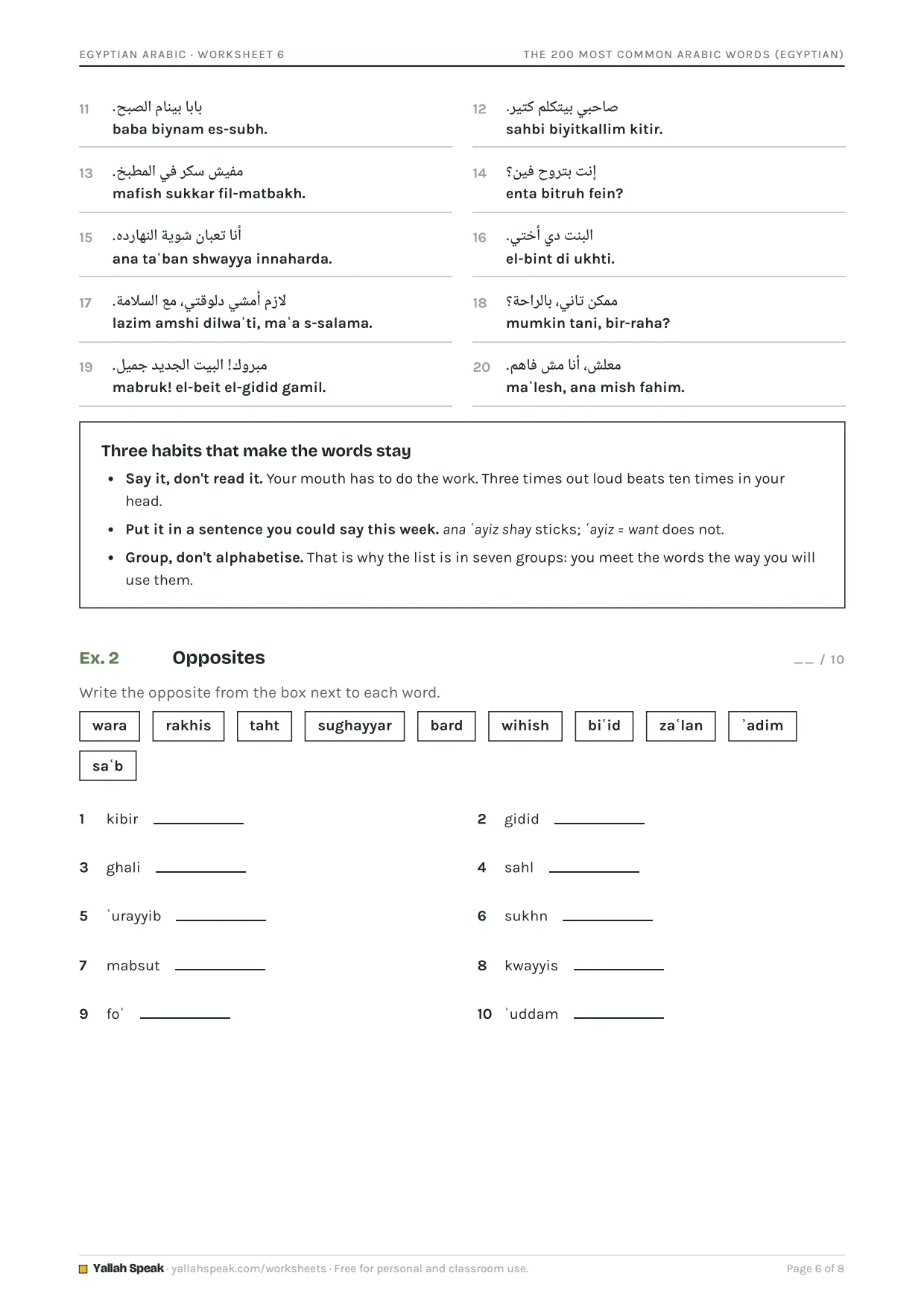
20 sentences built only from words in the list, with Arabic script, to read aloud and translate
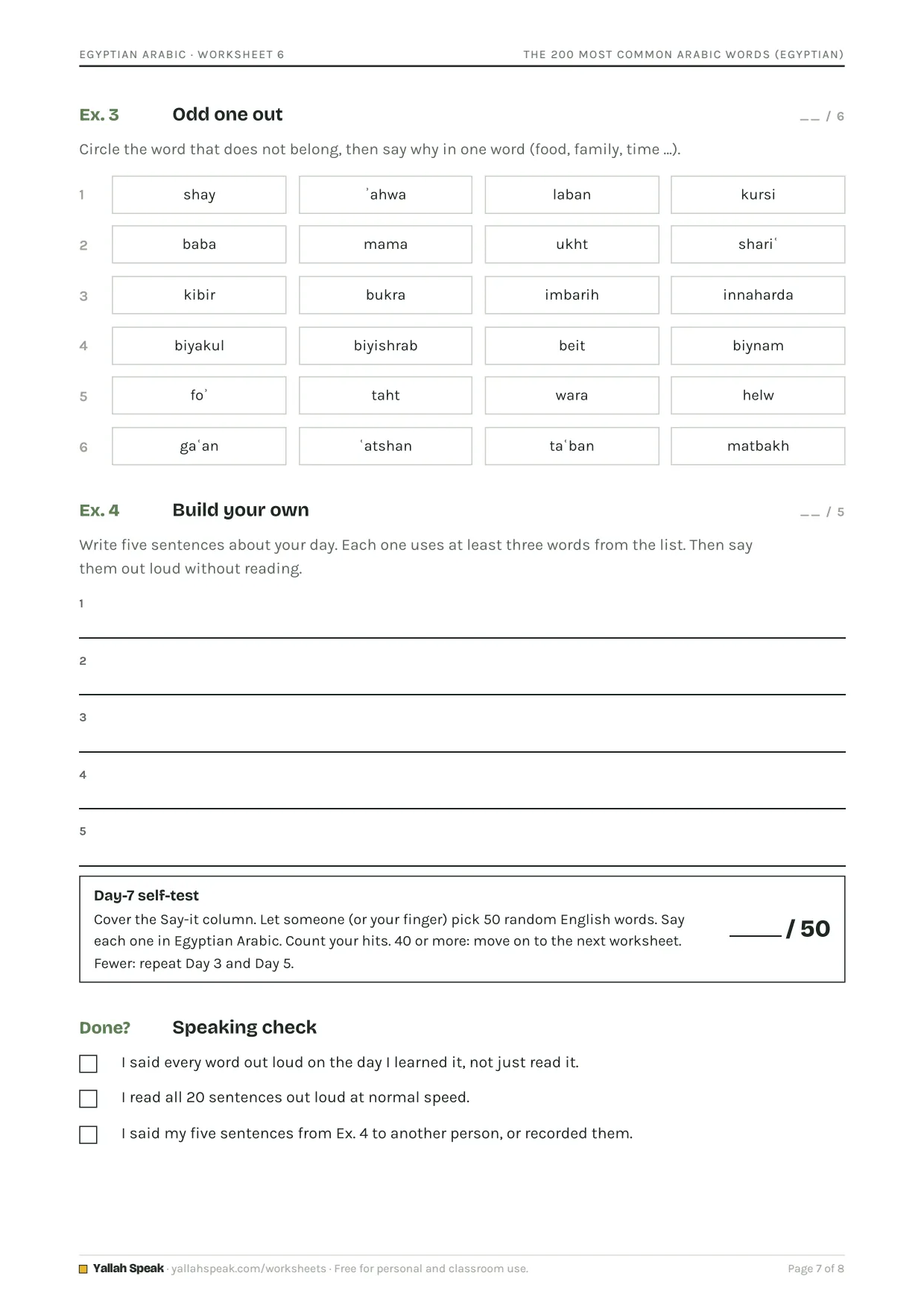
Exercises: opposites, odd one out, build your own sentences, a Day-7 self-test out of 50
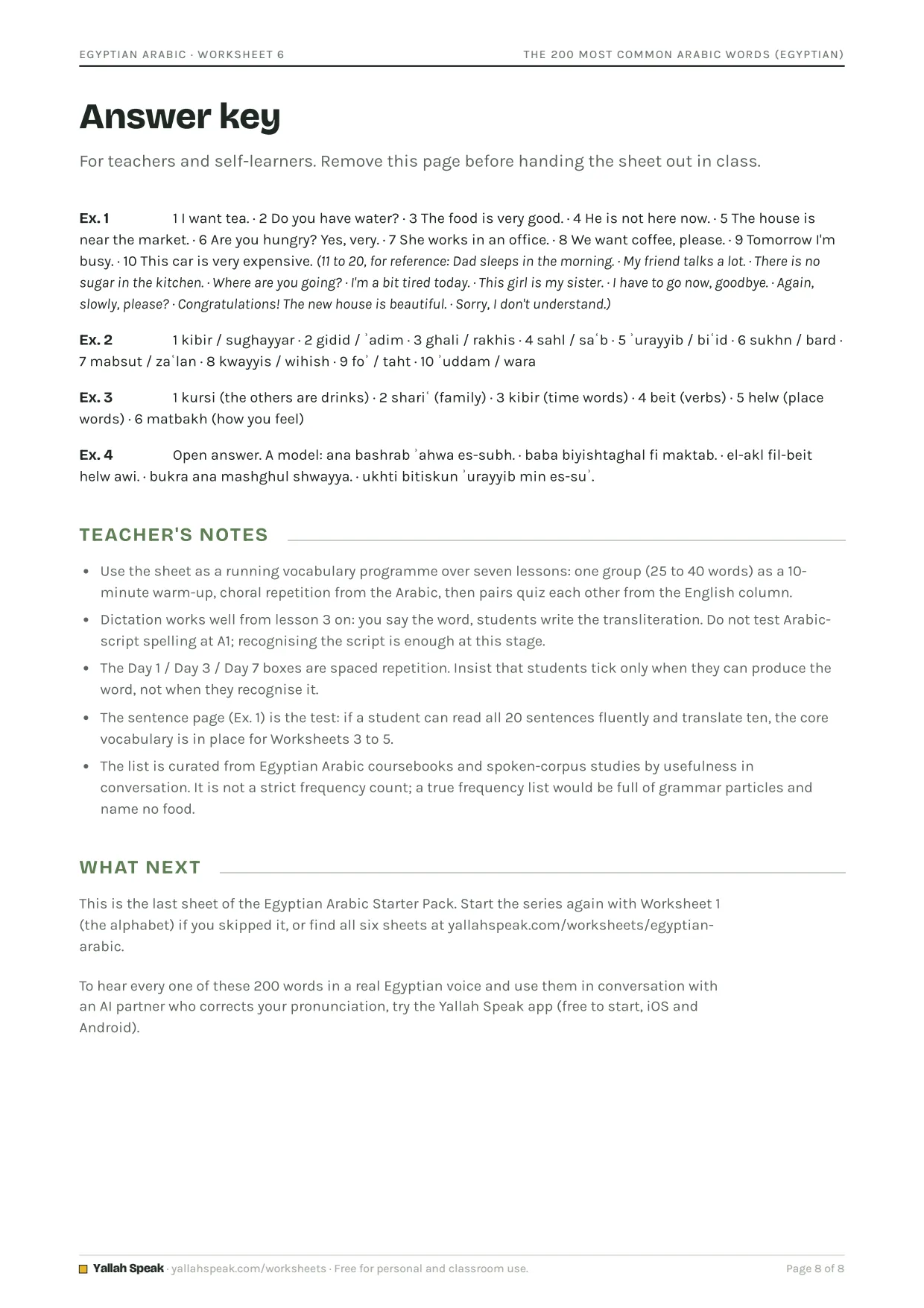
Answer key and teacher notes on a separate page you can remove before handing out
How to use it on your own
Follow the plan on page 1: about 30 words a day, each said out loud three times and put into one sentence you could use this week. On Day 3 and Day 5 you review earlier groups, on Day 7 you do the sentence page and the 50-word self-test; 40 hits or more means you are ready for the next sheet.
How to use it in class
Works as a running vocabulary programme over seven lessons: one group as a 10-minute warm-up with choral repetition, then pairs quiz each other from the English column. From lesson 3 on, dictate words from the Arabic and have students write the transliteration; do not test script spelling at A1. The sentence page (Ex. 1) is the test: reading all 20 sentences fluently and translating ten shows the core vocabulary is in place.
Worksheets teach you the words. Someone still has to answer back. Practise this exact dialogue with an AI partner who speaks Egyptian Arabic, stays in character and shows you word by word where your pronunciation slips. Try Yallah Speak free
Preview
Page 1 is above. Here are the other pages; click one to open it full size.
Frequently asked questions
What are the most common words in Arabic?
In spoken Egyptian Arabic the top of the list is almost all small words: ana (I), enta (you), huwwa (he), da/di (this), eh (what), fein (where), fi (there is), mish (not), wi (and), bass (only, but), kaman (also), ʿand (have), kwayyis (good), aywa (yes), laʾ (no), shukran (thank you), yalla (let's go), khalas (done). The first 50 of the 200 are on this page.
How many words do I need to speak Egyptian Arabic?
The 200 most frequent words cover roughly two thirds of everyday conversation, because function words repeat constantly. With these 200 plus numbers you can order, ask directions, introduce yourself and talk about your day. About 1,000 words gets you through most daily situations; around 3,000 lets you follow a film.
Is this a real frequency list?
It is a frequency-informed list for spoken Egyptian Arabic, adjusted for usefulness to a beginner. Pure frequency lists are full of grammatical particles and leave out words like "water" and "bathroom" that you need on day one. We kept the top function words and filled the rest with the nouns, verbs and adjectives that come up most in real Cairo conversations.
Should I learn Egyptian words or Modern Standard Arabic words?
If you want to talk to people, Egyptian. About a third of the top 200 words differ between MSA and Egyptian: what is ma in MSA and eh in Egypt, now is al-an versus dilwaʾti, not is laysa versus mish, I want is uridu versus ʿayiz. MSA is for reading news and books; this list is for conversation.
Is this word list free?
Yes. Download the PDF, print it and copy it as often as you like for personal use and in class. Please keep the Yallah Speak credit in the footer.
Stop studying Arabic. Start speaking it.
AI conversations in 10 real dialects, honest pronunciation feedback and a course from A1.