Hello in Syrian Arabic: Greetings & Meeting People
After this sheet you can greet someone, say how you are, thank people, introduce yourself and ask where the other person is from, in Syrian Arabic and out loud.
No sign-up. Print and copy for personal and classroom use. Please keep the credit in the footer.
By Fouad El Ajouaoui, founder of Yallah Speak · · Free worksheet, no sign-up
Quick answer Hello in Syrian Arabic is marhaba (مرحبا), answered with marhabtein or ahlein; the formal greeting is es-salamu ʿaleikum. "How are you" is kifak? to a man and kifek? to a woman (كيفك؟), answered with mnih, el-hamdilla. Good morning is sabah el-kheir, reply sabah en-nur, and thank you is shukran or the warmer yeslamu (يسلمو).
How do you say hello in Syrian Arabic?
The everyday hello in Damascus is marhaba (مرحبا). Syrians like to answer a greeting with a slightly bigger one, so the usual reply is marhabtein, "two hellos", or ahlein. When someone welcomes you into a home, shop or café you will hear ahlan w sahlan, answered with ahlan fik to a man and ahlan fiki to a woman. The formal greeting for strangers, elders and officials is es-salamu ʿaleikum, answered with w ʿaleikum es-salam.
English
Syrian Arabic
Arabic
The reply
Hello
marhaba
مرحبا
marhabtein · ahlein
Hi / welcome
ahlan w sahlan
أهلا وسهلا
ahlan fik (m) · fiki (f) · fikon (pl)
Peace be upon you (formal)
es-salamu ʿaleikum
السلام عليكم
w ʿaleikum es-salam
Good morning
sabah el-kheir
صباح الخير
sabah en-nur
Good evening
masa el-kheir
مسا الخير
masa en-nur
How are you?
kifak? (m) · kifek? (f) · kifkon? (pl)
كيفك؟
mnih, el-hamdilla
Good, thank God. And you?
mnih el-hamdilla, w-enta? (f: mniha … w-enti?)
منيح الحمد لله، وإنت؟
Goodbye
maʿ es-salame
مع السلامة
allah maʿak (m) · maʿek (f)
Good night
tesbah ʿala kheir (f: tesbahi)
تصبح على خير
w-enta min ahlo
How are you in Syrian Arabic, to a man, a woman or a group?
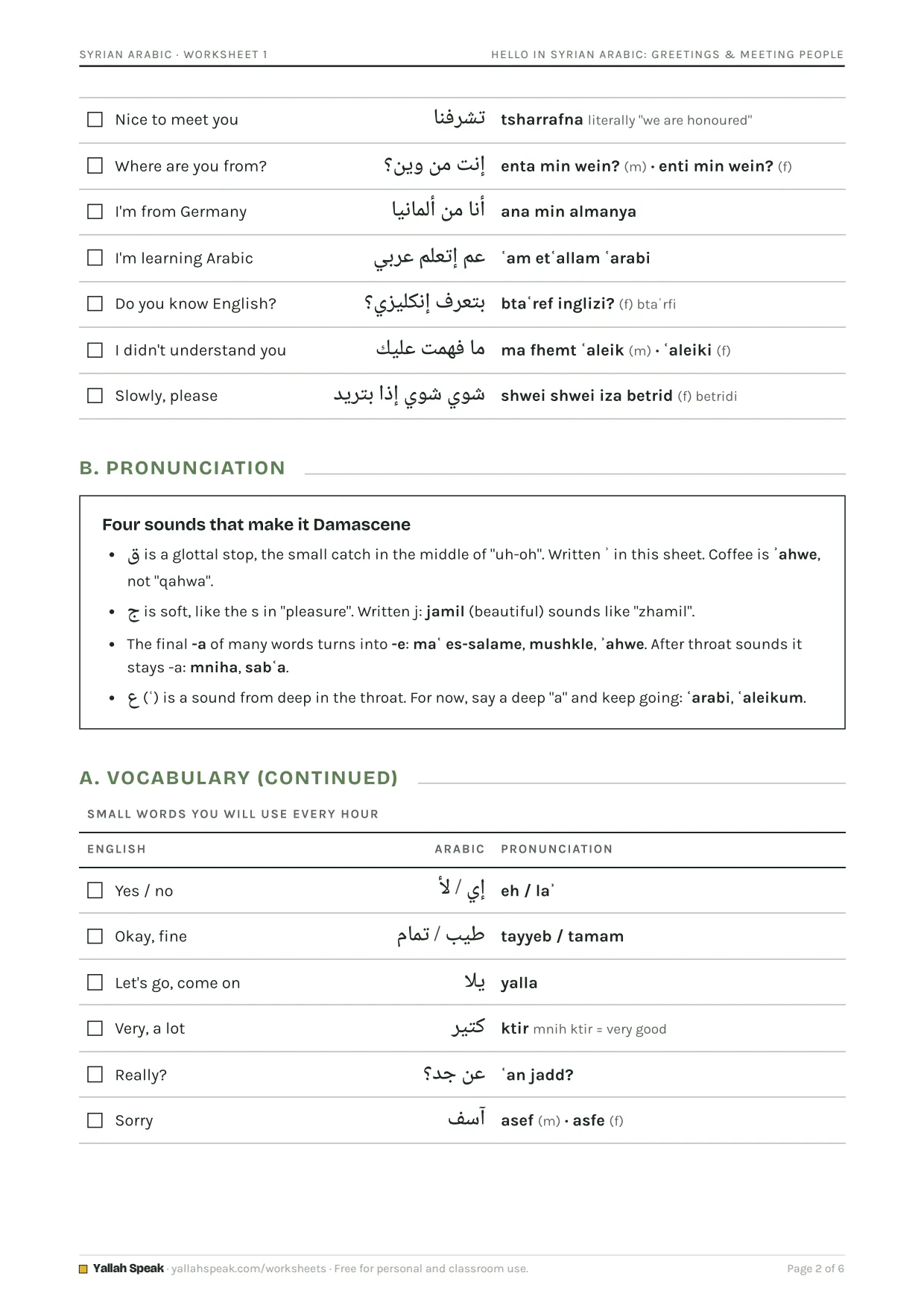
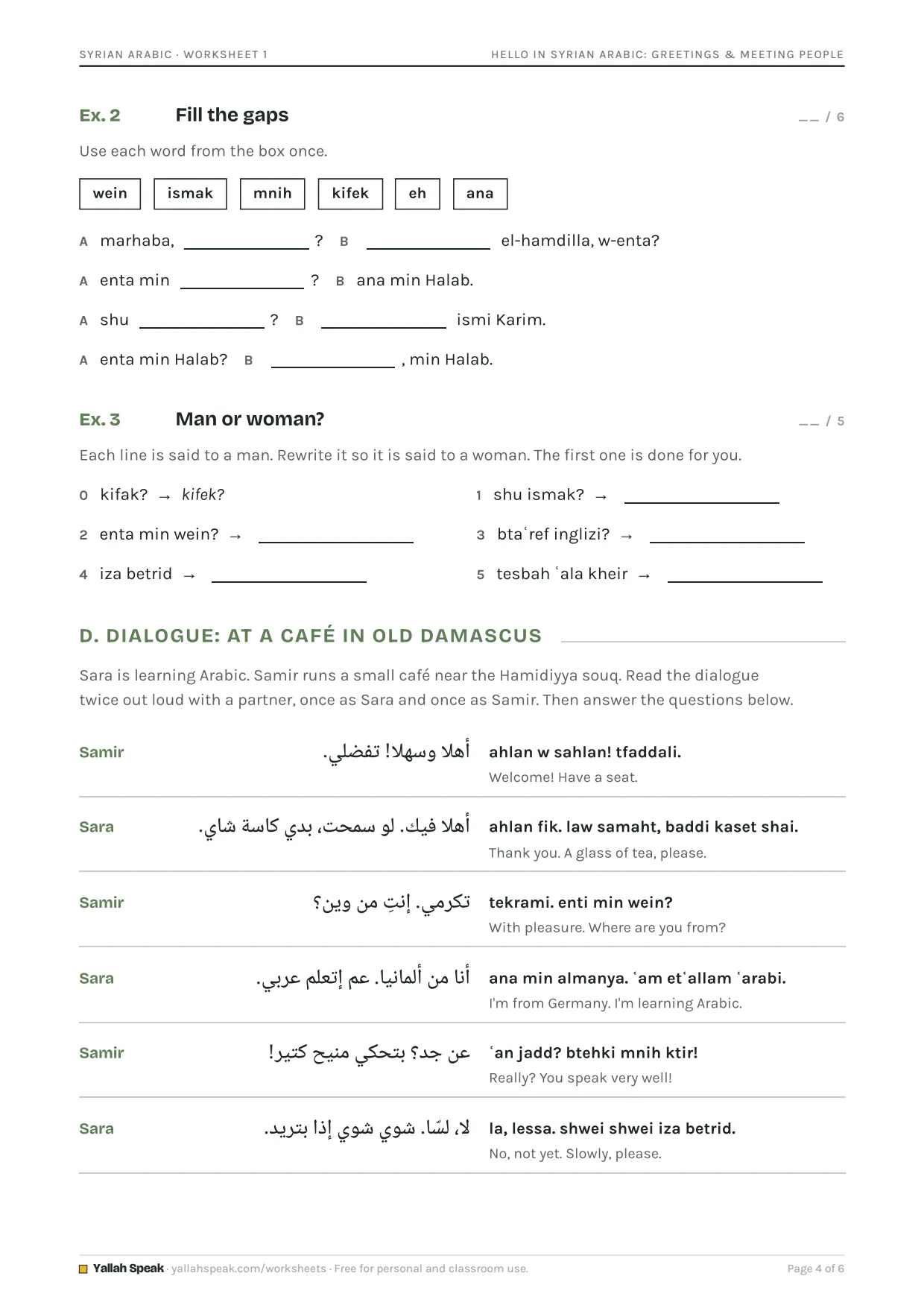
"How are you" is kifak? to a man, kifek? to a woman and kifkon? to a group. The standard answer is mnih, el-hamdilla (good, thank God), or mniha if you are a woman, followed by w-enta? or w-enti?. In Damascus you will also hear shlonak? and shlonek?, and shu akhbarak? (what's new?) between friends. The same -ak / -ek switch runs through the whole worksheet: shu ismak? / shu ismek? (what's your name?), iza betrid / iza betridi (please). Exercise 3 on the sheet is built around exactly this switch.
Good morning and good evening
sabah el-kheir means "morning of goodness" and is answered with sabah en-nur, "morning of light". Damascus, the city of jasmine, likes flowery replies: sabah el-ward (morning of roses) and sabah el-yasmin (morning of jasmine) are warm answers you will hear from friends and shopkeepers. In the evening it is masa el-kheir and masa en-nur.
How do you say thank you in Syrian Arabic?
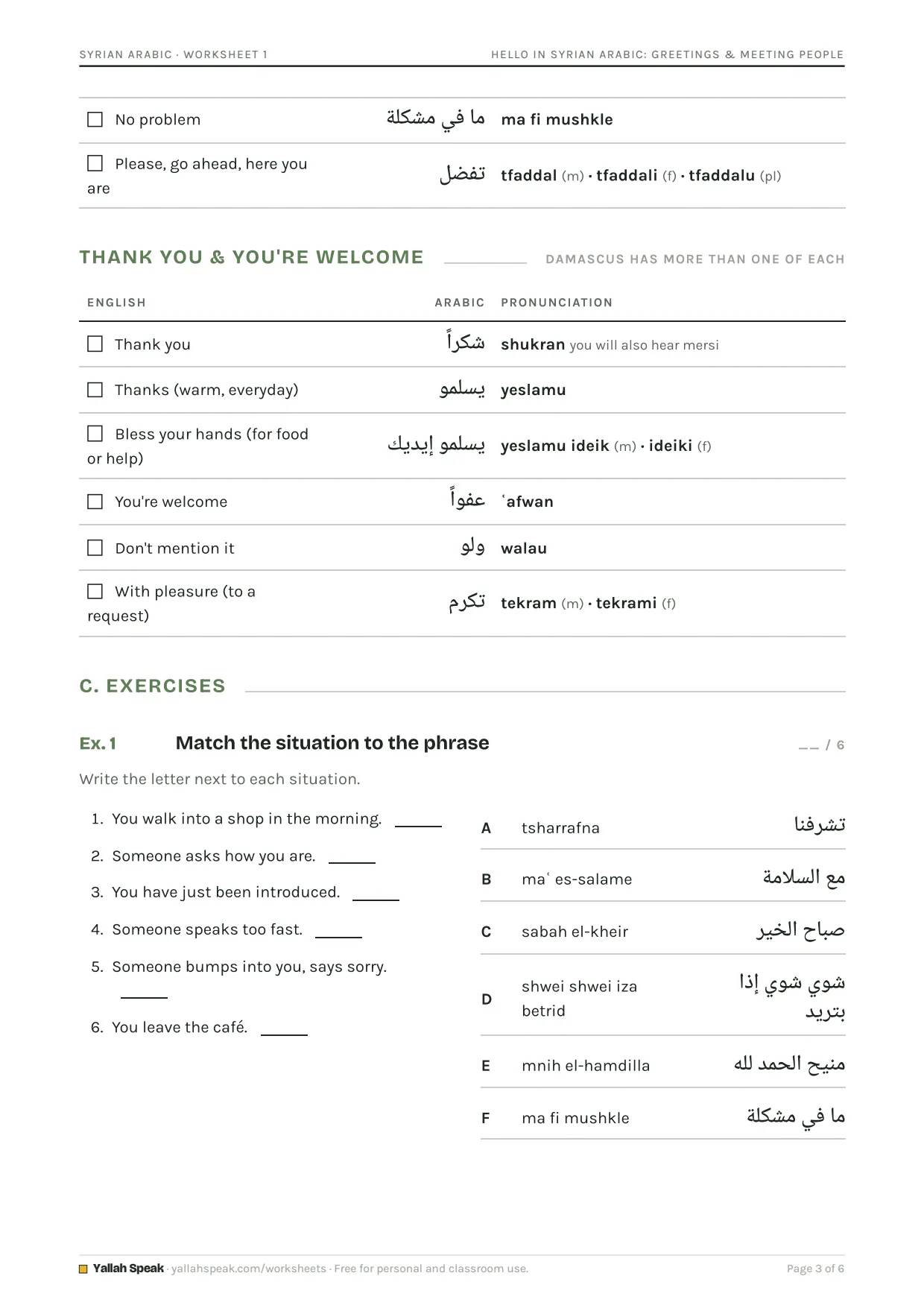
shukran works everywhere, and many Syrians also say mersi. The phrase that sounds most at home in Damascus is yeslamu, a warm everyday thank you, or yeslamu ideik, "bless your hands", when someone has cooked for you or helped you. For "you're welcome" you can say ʿafwan or walau (don't mention it). When you ask for something, the answer is often tekram (to a man) or tekrami (to a woman), "with pleasure".
English
Syrian Arabic
Arabic
Thank you
shukran · mersi
شكراً
Thanks (warm, everyday)
yeslamu
يسلمو
Bless your hands
yeslamu ideik (m) · ideiki (f)
يسلمو إيديك
You're welcome
ʿafwan · walau
عفواً · ولو
With pleasure
tekram (m) · tekrami (f)
تكرم
What's your name?
shu ismak? (m) · shu ismek? (f)
شو اسمك؟
Nice to meet you
tsharrafna
تشرفنا
Where are you from?
enta min wein? (m) · enti min wein? (f)
إنت من وين؟
Slowly, please
shwei shwei iza betrid (f: betridi)
شوي شوي إذا بتريد
How is Syrian Arabic different from Standard Arabic and other dialects?
Modern Standard Arabic would say kayfa haluka and ma ismuka; in Damascus that sounds like a news anchor. Syrians say kifak and shu ismak, pronounce ق as a glottal stop (ʾahwe, coffee), soften ج to the s in "pleasure", and turn many final -a sounds into -e (maʿ es-salame, mushkle). Lebanese and Palestinian Arabic share almost all of these greetings, so they work across the Levant; Syrian touches are iza betrid for please and baddi for "I want". Egyptian Arabic is further away: izzayyak instead of kifak, and a hard g for ج.
32 phrases in four groups: greetings and goodbyes, meeting someone, small words you use every hour, thank you and you're welcome. Arabic script, pronunciation and the (m)/(f) forms side by side
Every greeting with the reply Syrians expect: marhaba / marhabtein, sabah el-kheir / sabah en-nur, maʿ es-salame / allah maʿak
Pronunciation box: the four sounds that make Damascus Arabic sound Damascene (ق as a glottal stop, soft ج, final -a as -e, ع)
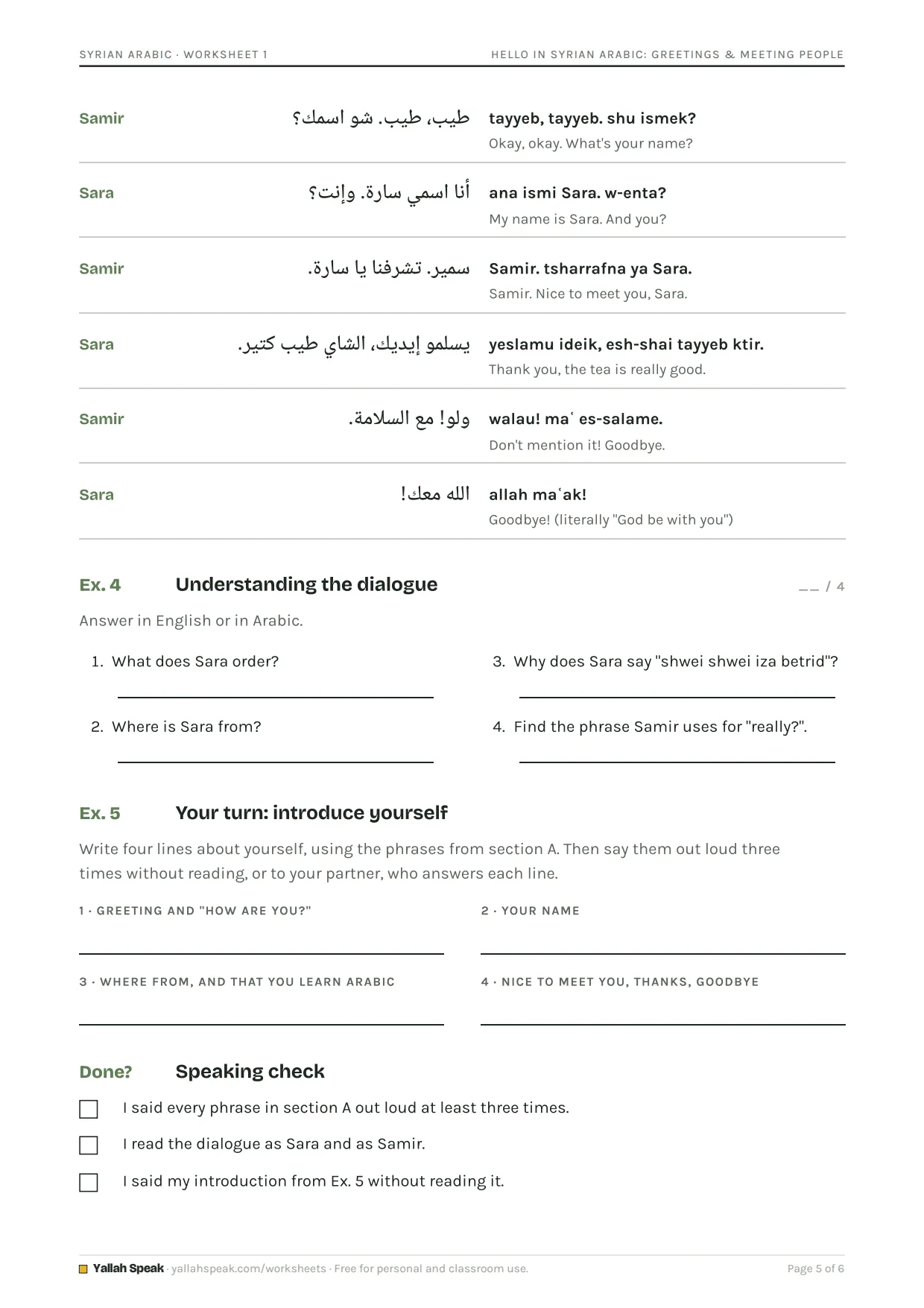
A café dialogue in old Damascus to read in pairs, with script, transliteration and translation
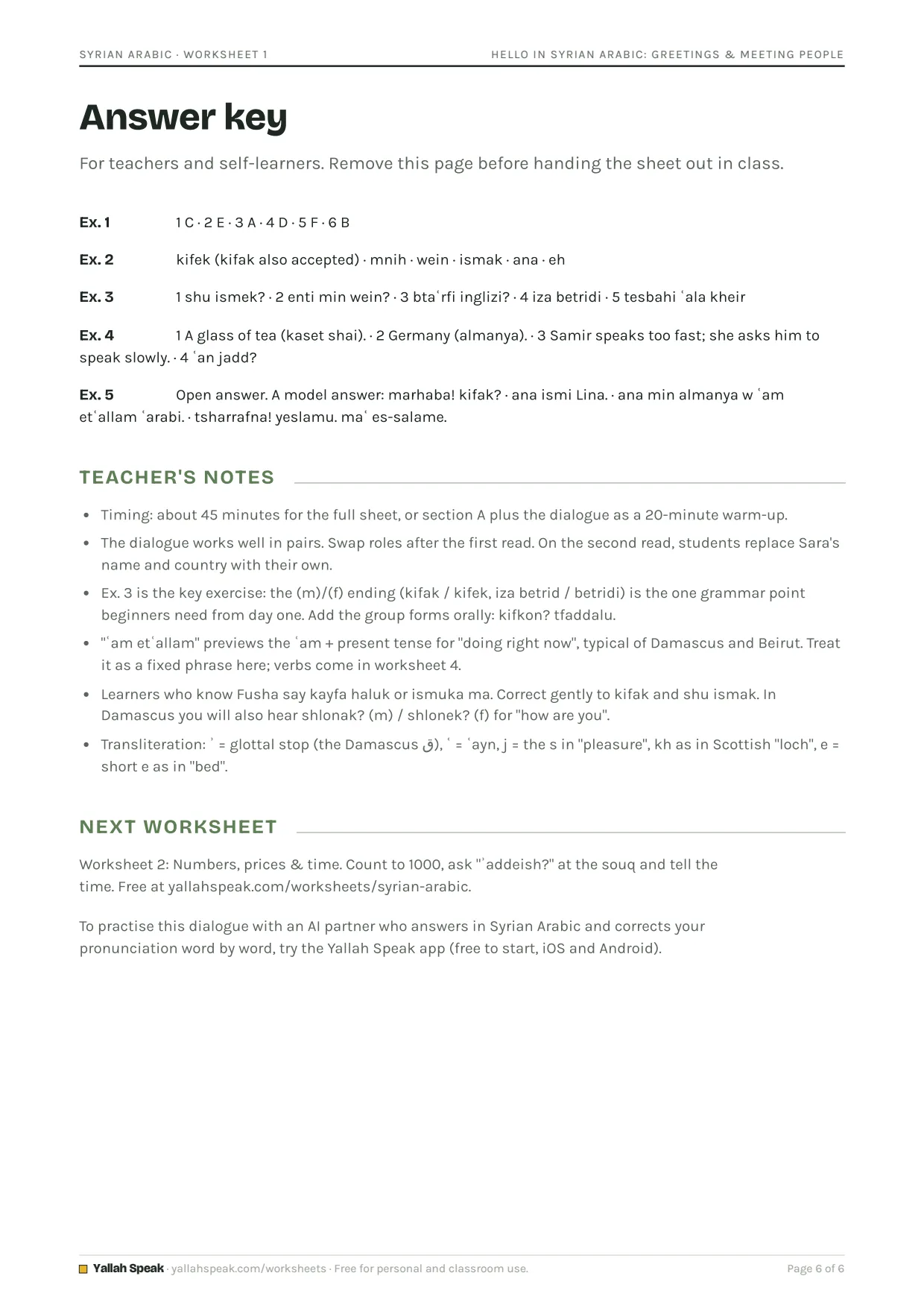
Five exercises: matching, gap fill, rewriting (m) to (f), comprehension questions, write your own introduction
A speaking check, plus answer key and teacher notes on a separate page you can remove before handing out
How to use it on your own
Work through section A out loud, not silently. Tick a phrase only when you can say it from the English alone. Learn each greeting together with its reply, because Syrians always answer with a matching phrase. Read the dialogue twice, once as each speaker, then record your own introduction (Ex. 5) and listen back once.
How to use it in class
Fits a 45-minute lesson or a 20-minute warm-up (section A plus the dialogue). The café dialogue works in pairs; swap roles on the second read and let students replace Sara's name and country with their own. Ex. 3 (man or woman) is the key exercise, because the (m)/(f) ending is the one grammar point beginners need from day one. Points fields on every exercise, answer key on the last page.
Worksheets teach you the words. Someone still has to answer back. Practise this exact dialogue with an AI partner who speaks Syrian Arabic, stays in character and shows you word by word where your pronunciation slips. Try Yallah Speak free
Preview
Page 1 is above. Here are the other pages; click one to open it full size.
Frequently asked questions
How do you say hello in Syrian Arabic?
marhaba (مرحبا) is the everyday hello in Damascus, and the usual reply is marhabtein ("two hellos") or ahlein. ahlan w sahlan is a warm welcome, answered with ahlan fik to a man or ahlan fiki to a woman. es-salamu ʿaleikum is the formal greeting for strangers, elders and shops.
How do you say how are you in Syrian Arabic?
kifak? to a man, kifek? to a woman and kifkon? to a group. The usual answer is mnih, el-hamdilla (good, thank God), mniha if you are a woman, followed by w-enta? or w-enti? (and you?). In Damascus you will also hear shlonak? and shlonek?, which mean the same.
How do you say good morning in Syrian Arabic?
sabah el-kheir (صباح الخير), literally "morning of goodness". The standard reply is sabah en-nur, "morning of light", and friends often answer with sabah el-ward (morning of roses) or sabah el-yasmin (morning of jasmine). Good evening is masa el-kheir, answered with masa en-nur.
How do you say thank you in Syrian Arabic?
shukran is understood everywhere, and many Syrians also say mersi. The warmest everyday thank you is yeslamu, and for food or a favour yeslamu ideik (bless your hands). You're welcome is ʿafwan or walau (don't mention it); when you ask for something, the answer is often tekram, "with pleasure".
Is Syrian Arabic the same as Lebanese or Palestinian Arabic?
They are all Levantine Arabic and understand each other easily. Damascus has its own flavour: marhaba and kifak are shared, but Syrians say iza betrid for "please", baddi for "I want" and turn many final -a sounds into -e (maʿ es-salame). Greetings you learn here work in Beirut, Amman and Jerusalem too.
Do I need to read Arabic script to use this worksheet?
No. Every phrase comes with a pronunciation in Latin letters, written the way Syrians text each other. The Arabic script is there for learners who already read, and to get your eyes used to it. The worksheet is free to print and share for personal use and in class.
Stop studying Arabic. Start speaking it.
AI conversations in 10 real dialects, honest pronunciation feedback and a course from A1.